



Over the years, big businesses have been following inescapable geography in Indonesia.
The standard rules for a founder of a national company were that one would have to sample life in the lights of Jakarta sometime and put aside regional development. The definition of corporate legitimacy appeared to be the domain of the capital city that houses Sudirman’s towers, the national regulatory bodies, and the big financial institutions.
That being said, behind Java’s economic weight is an intriguing story which is etched all over Eastern Indonesia. Much earlier than the modern supply chains found their footing on the shores of Java, South Sulawesi merchants used to sail on the sea lanes that extended from the Gulf of Siam down to the northern coast of Australia. Today, that centuries-old heritage survives not only as historical myth but also as a successful and very robust decentralised model of capitalism.
The story of Bugis/Makassar enterprise is an inspiring and living rebuttal to Jakarta-centrism. These businessmen have created multi-trillion rupiah conglomerates, but they have never left their respective regions.
The Cultural Engine: Honour, Grit, and Maritime Roots
It is imperative to first look at the cultural architecture behind Bugis and Makassar business models to see why the Buginese and the Makassarese do not follow the Javanese approach to business. The former’s regional identity is based on the dual notions of siri’ na pacce: strict personal honour (siri’) and compassion, as well as solidarity, for the community (pacce). It is a level of personal resilience, fairness, and self-reliance that is unyielding.
Siri’ na Pessea is a practical worldview that has been developed on the open sea. Bugis and Makassar traders developed far-reaching commercial networks throughout Asia, long before the advent of modern borders, with their iconic pinisi wooden schooners as their means of transport. The sea offered these early merchants two important lessons: the first was how to control unacceptably high levels of risk in an uncertain world; the second was how to identify lucrative economic opportunities outside of their geographic sphere of vision.
Anchored Empires: The Towers of Makassar
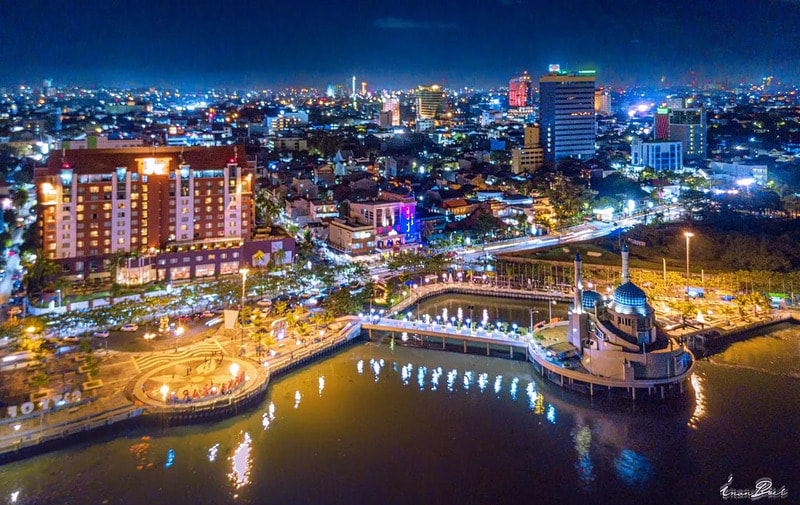
The economic strength of this region is evident nowhere more so than in the sprawling urban capital of South Sulawesi, Makassar, which is the main commercial port to the eastern part of the country.
The Kalla Tower rises sharply above the city’s coastline and is an impressive physical expression of corporate ambition in the region. The Kalla Group started as a small regional trading company in 1952 under the leadership of Hadji Kalla and Hajjah Athirah. Then, it developed into an infrastructure, green energy, logistics, real estate, and automotive powerhouse. The family business grew, under the leadership of former Vice President Jusuf Kalla and the next generations, across Sulawesi and the national markets. Most importantly, the centre of gravity of the Kalla Group did not change to Java when the group grew into a huge national enterprise. It continued to hold strong in Makassar.
Just around the corner is the fascinating story of the Bosowa Group, set up by Aksa Mahmud in 1973. While originally a small car dealer, Bosowa Group quickly diversified to cement, toll roads, mining, agriculture, and financial services. Digging a groove in the local competition, Bosowa Group created a strong stronghold in cement manufacturing, cement supply lines, and logistics throughout the East Indonesian region, which effectively transformed a regional strategic edge into an irresistible economic moat.
As these business groups have shown, gaining control of the main distribution channels and overpowering infrastructure, as well as the primary distribution lines, in Eastern Indonesia provide a kind of strategic ‘market leverage’ that is difficult for many traditional, Jakarta-centric corporations to replicate.
The Power of Merantau: Expanding Across the Frontier
While some business titans maintain their main bases in Makassar, others export this powerful merchant spirit in the so-called merantau: the deep-rooted cultural tradition of leaving one’s homeland to seek fortune, independence, and legacy in far-distant lands.
Notice the incredible journey of Andi Syamsuddin Arsyad, who is now known nationwide as Haji Isam. His journey, which began in Bone, South Sulawesi, took an impactful turn not in Makassar or Jakarta but in the backlands of Batulicin, South Kalimantan, which is a land endowed with abundant natural resources. Haji Isam, who started his career as a heavy equipment operator in local mines, took advantage of the Bugis work ethic, high-risk attitude, and business sense to establish the Jhonlin Group, which now encompasses coal mining, maritime shipping, aviation, palm oil refining, and bio-energy production.
The ability of Haji Isam to put foot in the frontiers, far from the developed centre with plenty of resources, and set up a complex and vertically integrated industrial supply chain from scratch has become an example of what Bugis business diasporas are capable of. Furthermore, with its swift transformation into a major business centre within the region, South Kalimantan’s Batulicin made amply clear that a remote district, far from the traditional business hub of Central Jakarta, can still exert the same market influence as a traditional boardroom in the same location.
A Model for Indonesia’s Decentralised Future
The success of these Bugis and Makassar titans is a lesson in strategy for the future of Indonesian capitalism, especially as the country accelerates its administration’s decentralisation from Java toward Nusantara (IKN) in East Kalimantan.
Key takeaways from these regional conglomerates:
- Close to raw materials: Operational strongholds are established in the immediate vicinity of raw materials and strategic access routes to and from agricultural and trade centres, with the goal of producing long-term cost benefits;
- Dominance in secondary markets: By taking market share in fast-growing regional centres, longer-term profit margins can be achieved with less direct competition;
- Reinvesting corporate profits back into the region: Local infrastructure helps to create real local loyalty and provides robust, self-reliant talent streams.
For generations, it was accepted wisdom in mainstream business commentary that all paths to corporate success had to lead through Java. However, the lasting impact of the Bugis and Makassar traders is palpable and most emphatically demonstrated. These are the powerful corporate empires that are proud of their seafaring heritage, understand complex supply chains, and see the entire archipelago not as the limits of the economy but as the expanse of possibilities. It is their strength of foundational roots that is never defined by an address in Jakarta.
The writer of this article, Donny Syofyan, is a lecturer at the Faculty of Humanities, Andalas University.