



Our editor examines his relationship with his ‘comfort food’ — and how the food mercilessly reflects his suppressed views about life.
Who would have thought that my relationship with my so-called ‘comfort food’ is way more complicated than my relationships with my fellow human beings?
As I have been thinking about the void that ‘comfort food’ fills in my life, I have also realised that my choice of ‘comfort food’ — including when, where, and how many times I would consume it — unsparingly reflects my deepest, rawest insecurity as a person. Even though it might be true that we are what we eat, how come a meal that is supposed to be trivial and insignificant ends up being so unflinchingly revelatory about one’s psyche?
Yum, yum, yum!
Apparently, the term ‘comfort food’ first entered the human vocabulary going back as far as the 15th century — to be more precise, in the second part of the Spanish literary classic Don Quixote by Miguel de Cervantes.
Among the contemporary foodies, however, many of whom believe that the term ‘comfort food’ was initially coined, popularised and, eventually, entered the forever zeitgeist thanks to American singer and actress Liza Minnelli. Urban legend has it that, during an interview back in the 1970s, Minnelli cheekily remarked that ‘comfort food’ is “anything you just yum, yum, yum” — which, in hindsight, is a pretty accurate definition.
The funny thing about Minnelli’s quote: there is perhaps a shockingly philosophical reason why, when read on paper, the word “yum” looks a lot like the word “you”. After all, each person’s ‘comfort food’ can be very unique, as it is shaped by their respective cultural and socioeconomic backgrounds and life experiences.
Someone’s ‘comfort food’ might not be as easily predicted as one might imagine, either. For instance, someone hailing from a highly affluent economic household might prefer cheaper street foods as their ‘comfort food’. On the other hand, a person born and raised in a lower economic tier might choose a classier, more expensive solace from time to time. Meanwhile, someone used to home-cooked meals might end up finding convenience store lunchboxes more palatably comforting instead.
‘Comfort food’ versus ‘mood food’
In recent years, however, more contemporary food scientists and food technologists have examined another type of food, termed ‘mood food’.
For instance, Liang et al., in their 2025 research paper titled “Bridging food and mood: What foods are defined as ‘mood foods’, and how do they modulate our emotions?” published in Volume 161 of Trends in Food Science & Technology, analyse how certain foods are capable of regulating emotional states. According to Liang et al., ‘mood food’ has the capacity to go so far as to support both cognitive and psychological health, as well as manage neuropsychiatric disorders.
Several food and health-oriented media have also recognised the benefits of ‘mood food’. For instance, Canadian dietitian Katey Davidson, in a piece for Healthline in 2024, breaks down how certain foods contain elements that may impact the neurotransmitters dopamine, serotonin, and GABA, resulting in the consumer’s mood improvements. Davidson also divulges that some of the examples of what constitute healthy, yet mood-boosting foods are bananas, oats, berries, and nuts.
Writing for BBC in 2026, Sue Quinn, in a piece titled “Can food really boost serotonin? Here’s what the science says”, elaborates how certain foods that contain an essential amino acid called tryptophan —such as chicken, eggs, and chia seeds — may help with depression and stress.
Food companies and manufacturers have also set their eyes on ‘mood food’. Case in point: in 2024, Unilever introduced mood-inspired flavours for its ice-cream brand Magnum. Named ‘Magnum Pleasure Express’, this was also the first Unilever ice cream range that was designed to match three different moods: euphoria, wonder, and chill.
Solace or sanctuary?
As I educated myself more regarding the difference between ‘comfort food’ and ‘mood food’, I came to realise that I should have indulged in the latter instead of the former. After all, unlike ‘mood food’, the emotional impact post-consuming ‘comfort food’ — in my experience, at least — tends to be much more short-lived as well as artificial.
Holt et al., in a paper titled “Comfort Foods in the Twenty-First Century: Friend or Foe?” published in Volume 16, 2025, of Annual Review of Food Science and Technology, wrote how comfort food (CF) can be described as “familiar foods that elicit feelings of well-being and play a role in social interactions and psychological health. These foods are often calorically dense and nutrient-poor, and overconsumption of some CF may contribute to negative metabolic health outcomes.“
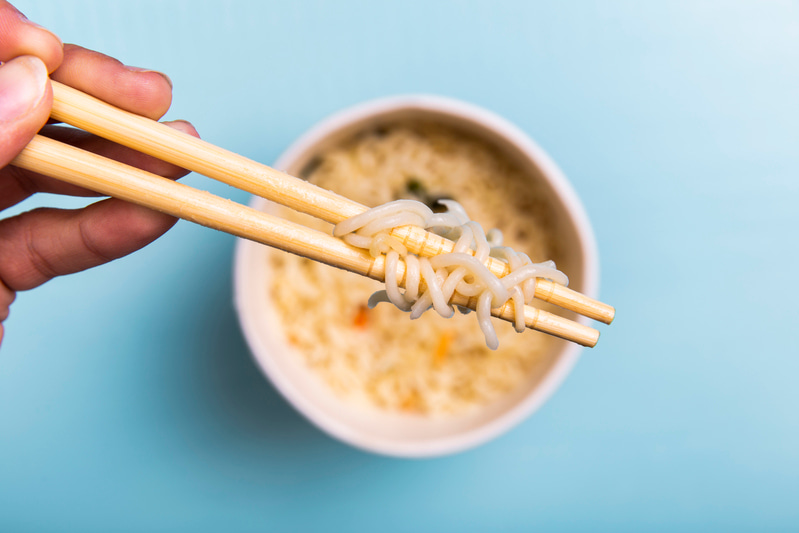
My number-one choice of ‘comfort food’ is instant noodles — and I have a feeling that instant noodles are also irresistibly comforting for many of my fellow Indonesians as well as expatriates in the country. There are many reasons for this. Instant noodles are very affordable, accessible, and easy to prepare. And then, there is the element of simplicity. Instant noodles are — again, based on my experience, at least — one of the very few meals out there that are best enjoyed in a simple and unpretentious presentation.
How do I personally view instant noodles? Well, to be more brutally honest, the simplicity of instant noodles never fails to remind me of the much simpler times in my life. Times when I did not have to deal with work deadlines, credit card bills, utility expenses, and leaking roofs at the peak of the rainy season. There is never a single week in my adult life so far in which I have not consumed instant noodles at least once. On top of that, in a very twisted spot inside my heart, consuming instant noodles feels as though I were keeping the child in me alive.
I then landed on what should have been a very obvious conclusion: that what I look for in my ‘comfort food’ is not exactly the artificial ease of instant noodles; instead, what I subconsciously look for is an escape to the simpler times that no longer exist.
Finding comfort is not the same as finding an escape — and, this whole time, I have been grossly mistaking sanctuary for solace. Once you enter your sanctuary, the more comfortable it feels inside, the less likely you are to ever leave and rejoin reality outside.
To be fair, however, feeling sentimental is, undeniably, a part of growing up. The further we go in life, the stronger the urge to look back. Meanwhile, many studies have shown how the sensory experience of eating is wired to the brain’s emotional and memory centres — even when such memories might not necessarily be reliable. For instance, even though I frequently enjoyed instant noodles as a child, it was simply because my household could not afford healthier, more diverse meals at the time. Those simpler times, after a second glance, turn out to be not as comforting as they appear in my memory centre. So, now that I am much wiser and more financially comfortable, why do I still look at those times, including instant noodles, through rose-tinted glasses?
My advice for readers out there: next time you are looking for comfort in your meal, you’d better think again. What is it exactly that you are looking for? Your memory could play tricks on you — and so could your palate.
DISCLAIMER: Any opinions expressed in this article are those of the author and do not necessarily reflect the views of Indonesia Expat.