



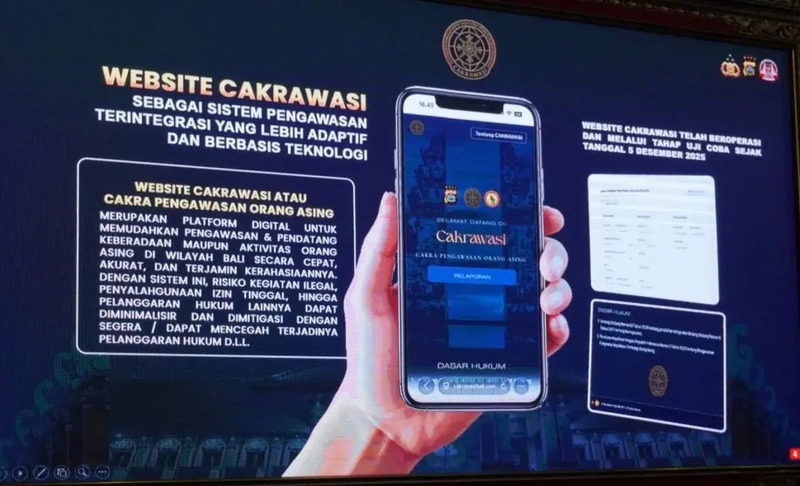
The Bali Regional Police has introduced Cakra Pengawasan Orang Asing (Cakrawasi), a digital platform designed to enhance the monitoring and data collection of foreign nationals’ activities in Bali to mitigate illegal acts and visa violations.
Cakrawasi was launched on the legal basis consisting of Law Number 63 of 2024 concerning the third amendment to Law Number 6 of 2011 concerning Immigration, and Regulation of the National Police of the Republic of Indonesia Number 3 of 2025 concerning Police Functional Supervision of Foreigners.
Bali Regional Police Chief Inspector General Daniel Adityajaya, in his statement in Denpasar on Saturday, the 14th of March, explained that Cakrawasi is expected to help facilitate the monitoring and data collection of the presence and activities of foreigners in the Bali region quickly, accurately, and with guaranteed confidentiality.
“With this system, the risks of illegal activities, misuse of stay permits and other legal violations can be minimised and mitigated immediately,” said Adityajaya.
According to data from the Bali Province Statistics Centre, the number of foreign tourist visits to Bali reached 7.05 million in 2025, representing an increase of 750,000 people, or 11.9%, compared to 2024. Furthermore, Bali’s status as a popular tourist destination has attracted the attention of both foreign and domestic investors. However, the increasing mobility and presence of foreign nationals can also create vulnerabilities, such as security risks and legal violations involving foreigners in the Bali region, either as victims or as perpetrators.
According to Adityajaya, monitoring by Immigration alone is insufficient; therefore, other alternatives — such as Cakrawasi — are needed to complement this cross-sectoral task. It was also revealed that Cakrawasi has been undergoing a trial phase since December 2025.
“With Cakrawasi, we can track [the foreigners’] movements through hotel, lodging and other similar reports. So, if something unusual occurs, we can detect it,” he continued.
In addition, Adityajaya also requested that all parties involved in lodging, hotels, villas, and other accommodations in Bali provide foreign national data in accordance with their original passport information.
“Because of the experience of some criminals, they use more than one passport; they enter using a genuine passport, and here [in Bali], transactions are made using fake or counterfeit passports [instead],” he added.