



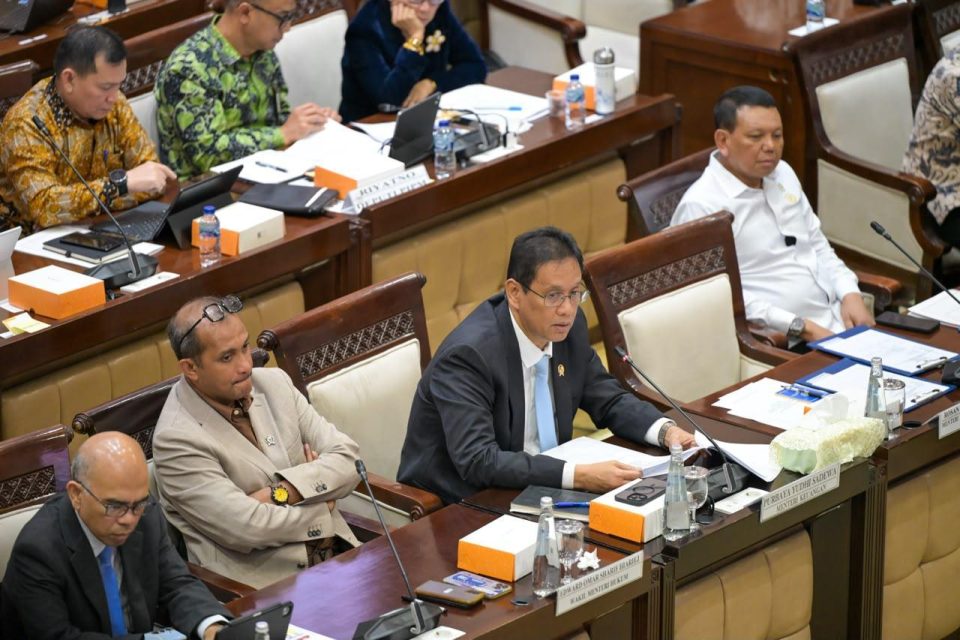
The Indonesian House of Representatives (Dewan Perwakilan Rakyat or DPR) approved the draft law on the Indonesian International Financial Centre (Pusat Finansial Internasional Indonesia or PFII) during a plenary session, officially passing it into law.
The meeting was held at the DPR building in the Senayan parliamentary complex, Central Jakarta, on Tuesday, 21st of July. It was chaired by House Speaker Puan Maharani and attended by Sufmi Dasco Ahmad, Sari Yuliati, and Saan Mustopa.
Deputy Chairman of Commission XI of the DPR and Chair of the Working Committee, Mohamad Hekal, stated that the establishment of the PFII is mandated by Law Number 4 of 2026 concerning Amendments to Law Number 4 of 2023 concerning Strengthening and Development of the Financial Sector (Penguatan dan Pengembangan Sektor Keuangan or PPSK).
“The creation of the PFII bill is mandated by Article 248A of Law Number 4 of 2026 concerning Amendments to Law Number 4 of 2023 concerning Strengthening and Development of the Financial Sector, enacted on the 17th of June, 2026. This law stipulates that provisions regarding the operation of the Indonesian International Financial Centre shall be specifically regulated by law, to be established no later than three months after the law’s enactment,” he said.
Hekal stated that the PFII Bill regulates several key issues, including general provisions, the formation, and the objectives of the PFII.
“The PFII’s institutional structure includes the establishment of the PFII Advisory Council, the PFII Board, the PFII Management Institute, and the PFII Financial Services Supervisory Agency. The PFII Arbitration Institute serves as an alternative dispute resolution mechanism within the PFII,” he added.
Indonesian Finance Minister Purbaya Yudhi Sadewa stated that the PFII Law would serve as a new architecture for the Indonesian economy amid global economic dynamics. According to him, the PFII will complement the national financial system with an internationally recognised financial services ecosystem without replacing the existing system.
“The PFII Bill is not merely a formal regulation, but rather a new architecture for Indonesia’s financial future. This represents a joint commitment between DPR RI and the government to affirm Indonesia’s position as a key pillar of the global economy,” he said.
The PFII is designed as a special economic and financial services zone that meets global standards. The primary objective of this mega-project is to attract capital flows from international investors, facilitate the needs of family wealth management offices, and serve as a funding epicentre for various national strategic projects. The PFII is projected to be headquartered in Bali.