



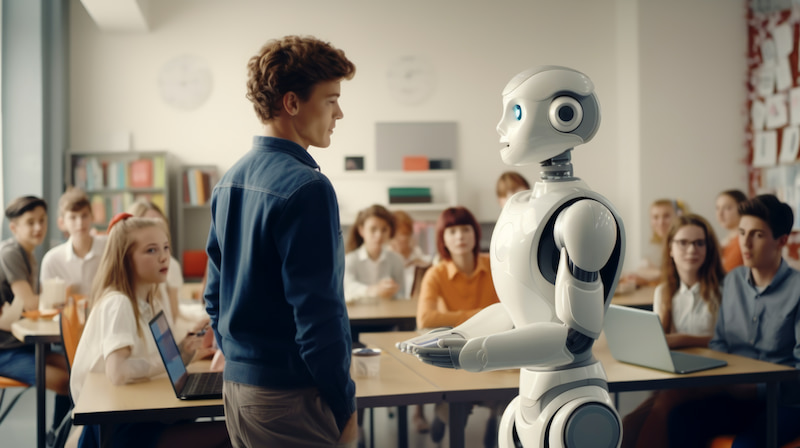
A common conversation to be found in almost every international school staffroom in Indonesia today is one based around Artificial Intelligence (AI).
Once an abstract concept reserved for hi-tech companies and the realms of science fiction, AI has landed with a firm bang in the classroom and beyond, with writing assistants, image generators, adaptive learning platforms and automated feedback tools all now readily available to teachers and students alike.
International schools are in a unique position since they are often positioned as forward-looking and globally connected, thus the urge to fully embrace AI can be strong. Parents’ expectations are high in terms of innovation in lessons, teachers glimpse at a world of reduced administrative issues running alongside more personalised learning, and schools are looking to boast of preparing students for future global careers. And yet, an unease remains. Are we using AI to enhance and improve learning, or are we still moving too fast with a lack of consideration regarding what might be lost along the way?
Why International Schools are Leading the AI Push
International schools in Indonesia are generally well-resourced and financially stable, and so are expected to be well placed to adopt AI technologies. In addition, by their very nature, international schools are at least expected to be integrating global trends into curricula while following international programmes that are based around inquiry, research skills and independent learning—areas where AI tools appear, at first glance, to fit neatly.
However, while schools are often swift to adopt such AI procedures, reflection and understanding sometimes lag. Technology is developing at such a pace that shared understanding about how—and when—it should be used is not keeping pace.
The Real Opportunities: Where AI Can Genuinely Help
AI is here to stay, and when used thoughtfully, it can bring real benefits to classrooms. A great example of AI in positive use is in the area of personalised learning, where thoughtful planning and development can assist in tailoring reading levels, vocabulary practice or revision tasks to individual students, thereby allowing teachers to better support mixed-ability classes.
Another area in which AI benefits is that of formative assessment. Students can be assisted in the form of drafted comments, language suggestions and guided prompts, which will help them refine their work while allowing teachers to concentrate on more in-depth learning procedures and concepts on ideas and structures. In addition, AI can assist considerably with student cohorts learning in a second or third language, as is often the case in international schools, through offering valuable scaffolding—helping students clarify meaning without lowering expectations.
Then there is the area of creative and inquiry-based learning. Here, AI can assist in the process of brainstorming, developing research pathways and generating ideas. In this way, AI acts as a thinking partner rather than an answering machine, and thus can help students explore topics more easily and ask better questions.
The Risks: When Support Becomes Substitution
What happens, though, when AI becomes—or is allowed to become—a replacement rather than a support for creative thinking? As students get more used to using it, the temptation is for them to submit work that, while appearing polished and sophisticated, is in fact lacking in genuine understanding. When this happens, students are invariably unable to explain their work orally or describe their way of thinking.
When this occurs, there will be a risk of surface learning—well-written answers lacking depth and coherence without comprehension. This, in turn, leads to an erosion of skills such as planning, drafting, evaluating evidence and the structuring of arguments.
Assessment integrity is perhaps the one area of most worry, with understandable concern surrounding teachers’ ability to accurately and fairly grade and assess students’ work. Teachers are forced to rethink strategies along the lines of redesigning tasks to include in-class writing, oral explanations or reflective components.
Teachers in the Middle
Teachers need help. All too often, they find themselves floundering with insufficient guidelines or training, resulting in inconsistencies in usage and expectations across departments or age groups. Some teachers feel the ‘pressure to use AI’ without clear pedagogical direction, while others worry about appearing resistant to innovation.
The role of the teacher is changing. No longer are teachers mere transmitters of information; rather, they are now guides for ethics, thinking and judgment. This requires a change in mindshift, but also professional development and collaboration. There will be a period of experimentation, and even trial and error, until they arrive at the right balance—not merely a list of do’s and don’ts.
Teachers need support to ask the right questions: When does AI add value? When does it undermine learning? How do we teach students not just to use AI, but to question it?
What Responsible AI Use Looks Like
So, how to move forward? Should we ban AI entirely, or go the opposite way and embrace it totally? Well, the first thing we need is clarity. Teachers and students alike need to know what is allowed, what is not, and—most importantly—why.
AI should be used as part of the process, and not as the final product. The goals should be set, then AI should be used to assist with reaching those goals. Examples of this in action include: brainstorming ideas, checking language accuracy or exploring alternative perspectives. All of these can be legitimate uses when acknowledged transparently.
When setting assessments, design matters. If teachers wish to assign tasks that value thinking, justification and personal voice or opinion, then AI is not the best outlet—and this should be made clear. Above all, students must be taught AI literacy: how to question outputs, recognise limitations and make informed decisions.
Opportunity—with Intentional Limits
So, is AI in the classroom an opportunity or an overshoot? The answer, perhaps unsurprisingly, is both.
AI offers international schools in Indonesia powerful tools to personalise learning, support language development and prepare students for a rapidly changing world. But without clear values, strong pedagogy and thoughtful boundaries, it risks weakening the very skills schools aim to cultivate.
The challenge is not whether to use AI, but how.
[DISCLAIMER: Any opinions expressed in this article are those of the author and do not necessarily reflect the views of Indonesia Expat.]