



High in the hills of Kintamani, Bali is at the centre of something extraordinary.
The ceremonies of Madewasraya are not an annual festival, nor something staged for visitors every full moon during Peak Season. Held only once every five years, the month-long sequence of ceremonies centred on the temple of Pura Tuluk Biyu and Mount Abang (Gunung Abang) in Kintamani brings together priests, communities, and thousands of worshippers in a process concerned, at its deepest level, with balance. More specifically, restoring balance by remembering what balance means.
It’s a balance between human beings and nature. Between the sekala, the world we can see, and niskala, the world we cannot. Between what is taken and what must be returned. On the 21st of September, as part of this year’s Madewasraya, Taur Labuh Gentuh, a ceremony to restore harmony between humanity and the natural world, and Mapekelem, in which sacred offerings are returned to the lake and mountain, were conducted. Indonesia’s Directorate General of Hindu Community Guidance described the rituals in unusually contemporary language: as an expression of ecotheology and a commitment to the conservation of Lake and Mount Batur.
That connection is worth reading again. Because down the mountain, beyond the fields of marigolds and orange groves, beyond the incense and offerings, Bali has a problem. Not simply a tourist problem. Not just a rubbish problem, water problem, traffic problem, or development problem. And certainly not something that can conveniently be blamed on whichever badly behaved foreigner happens to be going viral on social media this week.
The uncomfortable possibility is that these are symptoms of something larger. Bali may have outgrown the model that created its exceptional success.
Too Much of a Good Thing?
According to Statistics Indonesia (Badan Pusat Statistik or BPS), almost seven million foreign tourists arrived directly in Bali in 2025—a record by all accounts. But when you add the 9.6 million domestic visitors, the total is more than 16.5 million tourist visits in a single year. Remember, that’s on an island with a resident population of roughly 4.5 million.
There is no question that tourism has brought enormous benefits to Bali. It provides employment, supports families and businesses, attracts investment, and connects a relatively small Indonesian island with virtually every corner of the world.
The argument is not that tourism is bad. It’s whether more tourism is automatically better tourism.
For decades, success has largely been measured numerically: arrivals, hotel rooms, occupancy, investment, return on investment, tax revenue, construction, and expenditure. If seven million foreign visitors are good, presumably eight million are better. Right?
But there is another balance sheet. It contains water, land, waste, traffic, infrastructure, culture, community, and quality of life. And on that balance sheet, the numbers tell a different story, and they’re not so easy to ignore. The severe floods of September 2025 provided one warning. Sixteen people died after torrential rain inundated Denpasar and other parts of the island. I Nyoman Gede Maha Putra, an urban planning expert at Warmadewa University, told Reuters that rapid development had prioritised tourism and investment without sufficient attention to infrastructure and disaster preparedness. Bali Governor Wayan Koster disputed the suggestion that conversion of agricultural land was responsible.
The disagreement illustrates the larger question Bali now faces. How much development can an island absorb before development begins to destroy the very thing being developed?
The Water Beneath Our Feet
Water may ultimately provide the clearest answer.
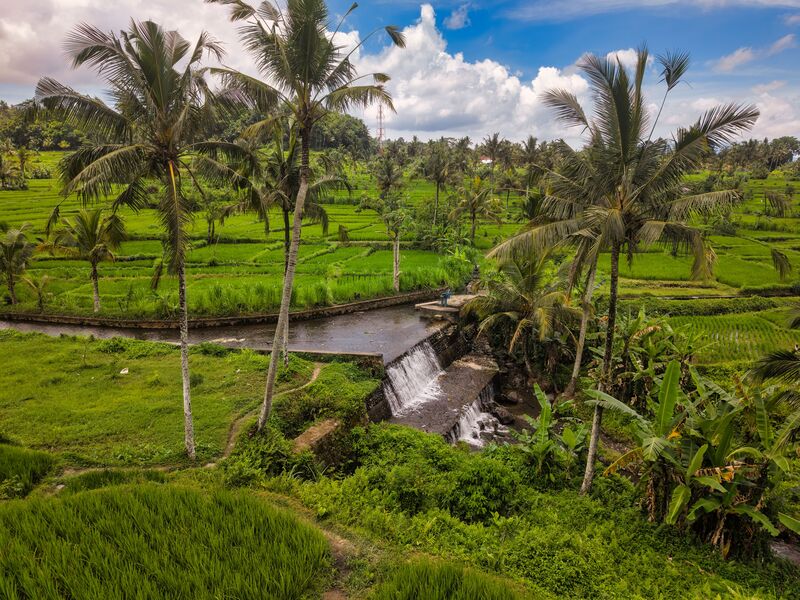
Water in Bali is not merely a commodity. It sits at the heart of one of the island’s most celebrated cultural institutions: the subak irrigation system, through which farming, community, religion, and landscape have been interconnected for centuries. Water is also a critical element of the Madewasraya ceremony.
Every hotel room, villa, swimming pool, landscaped garden, restaurant, and laundry adds to demand. So does Bali’s rapidly growing resident and expatriate population.
And this isn’t simply perception. Research by Udayana University has already classified Denpasar as being in water deficit, while another study of 60 wells in North Kuta found evidence of seawater intrusion around Petitenget and Batubelig. Peer-reviewed research has warned that competition for water is contributing to environmental problems and putting agriculture under pressure.
The subak is not simply an ingenious irrigation system. UNESCO describes it as a network connecting rice fields, farmers, temples, canals, and entire watersheds, based upon Tri Hita Karana: the relationship between the spiritual world, humanity, and nature. There are around 1,200 such water collectives across Bali.
And this is where philosophy and physical reality meet.
The same idea of balance expressed through Madewasraya is written into the landscape through subak. The relationship between people, nature, and the spiritual world is not simply an abstract Balinese philosophy. It determines where water flows, which fields survive, and, ultimately, whether communities built around them survive too. And when that relationship is disturbed, the consequences can be measured in wells, aquifers, rice fields, and water shortages.
Yet UNESCO is now warning about pressure from land conversion and tourism development on the subak landscape, particularly around Jatiluwih. In 2024, it went so far as to request information from Indonesia about the loss of rice fields and its impact on the system. A luxury villa can be Instagrammably ‘Balinese’ with stone walls, tropical gardens, and a strategically positioned Ganesha, while consuming resources in ways that are anything but traditional.
This is where the conversation about sustainability can become uncomfortable, because it’s easy to ask hotel guests to reuse their towels and use paper straws, but much harder to question whether another villa development or shopping mall should have been built in the first place. Water exposes the fundamental weakness in an economic model based upon endless expansion: Bali is finite. Its aquifers are finite. Its agricultural land is finite. Its roads are finite. Its coastline is finite.
Truth is, there is no infinite version of Bali.
The Mountain at Suwung
Then there’s the rubbish.
For years, the vast landfill at Suwung, just south of Sanur, became perhaps the most literal monument to Bali’s consumption economy: a mountain created from everything the island no longer wanted. In April this year, new restrictions stopped Suwung from accepting organic waste, limiting disposal there to residual waste as part of a shift away from the old collect-transport-dump system. Now, the Indonesian Ministry of Environment says the objective is reduction and sorting at source, combined with more sustainable processing. In July, construction also began on a waste-to-energy facility in South Denpasar as part of an attempt to reduce Bali’s dependence on landfill.
These are important changes, yes, but they only address one end of the equation. The other side is consumption. Seven million international visitors consume things. So do 9.6 million domestic visitors. So do the places they stay and eat in. So do the people who live here.
Bali’s rubbish problem was not created exclusively by foreigners, any more than its traffic problem was. That’s important because blaming tourists can become another way of avoiding the more difficult discussion.
The Bad Tourist
There are, unquestionably, bad tourists. Foreigners have been photographed behaving disrespectfully at sacred sites and driving recklessly, while others have been working illegally and overstaying visas. As crazy as it sounds, foreigners have also been accused of kidnapping and premeditated murder.
Bali has responded.
Governor Koster’s 2025 code of conduct for foreign tourists requires visitors to respect temples, religious symbols, ceremonies, customs, and local traditions; dress and behave appropriately; obey traffic laws; stay in licensed accommodation; and refrain from working or conducting business without the appropriate permits.
Immigration enforcement has also intensified. During the first six months of 2026, Bali immigration authorities deported 342 foreign nationals for visa violations, while the Dharma Dewata task force stepped up enforcement. There is nothing unreasonable about that.
A guest is expected to respect the house. But there is a danger in allowing the ‘bad tourist‘ to become the entire story. It clearly isn’t. A foreigner riding a motorcycle without a helmet is easily and highly visible. It gains traction on social media. But an illegally constructed villa, poorly regulated development, an inadequate sewage system, or a slowly depleted aquifer is considerably less photogenic. Which ultimately causes greater damage to Bali?
Respect must work on several levels. Visitors must respect Bali. Businesses must respect Bali. Developers must respect Bali. Government must respect the limits of the island it administers. And Bali must respect itself enough to decide that not every rupiah of investment is necessarily worth having.
From Quantity to Quality
This may be where the idea behind Madewasraya becomes surprisingly relevant, because balance does not mean stopping change. Bali has never been static. Its culture has survived precisely because it has repeatedly absorbed outside influences and made something distinctly Balinese from them.
Turning against tourism doesn’t make much sense. The paradigm shift we’re exploring here is subtler. It means moving from quantity towards quality. From extraction towards stewardship. From measuring investment simply by its monetary value to considering its cost in land, water, and infrastructure. And perhaps from seeing environmental protection as the price of economic development to recognising that, in Bali, the environment and culture are themselves the economic assets.
There is already movement in this direction.
Bali’s foreign tourist levy is explicitly intended to fund the protection of culture and the natural environment. The provincial government talks increasingly about “quality and dignified tourism.” Waste policy is shifting towards processing at source. Immigration authorities are making it clear that laws cannot be ignored.
The same rethink is beginning to reach foreign investment.
In July, Bali blocked foreign-owned companies from obtaining licences in 18 business classifications considered important to protecting local small and medium-sized businesses. The numbers behind that decision are revealing. According to the Indonesia Investment Coordinating Board (Badan Koordinasi Penanaman Modal or BKPM), the Ministry of Investment and Downstream Industry, Bali accounted for 72% of all projects registered nationally under the business classification covering owned or leased real estate. Authorities are also targeting nominee arrangements, fictitious companies, and foreign businesses operating outside the activities for which they were licensed.
But policies don’t qualify yet as a paradigm. A paradigm shift changes the way we understand the problem itself. And when that happens, questions change too. Instead of asking, “How do we accommodate another million tourists?“ it asks, “Should we?”
Instead of asking how another development can be supplied with water, it asks whether the development belongs there. Instead of cleaning rubbish after it has been produced, it asks why so much waste is being generated. Instead of advertising Balinese culture while simultaneously eroding the communities and landscapes that sustain it, it recognises culture as a living system rather than a tourism attraction.
That would be a much more profound change.
What Must Be Returned?
There is a principle embedded in ritual that modern economies sometimes struggle to understand. You cannot endlessly take without returning something. Madewasraya expresses that idea spiritually. Modern Bali faces essentially the same thing in material form.
Tourism takes something from the island: water, land, road space, energy, and resources. In return, it brings employment, opportunity, investment, cultural exchange, and prosperity. For many years the exchange worked remarkably well. But there are increasingly persuasive signs that the balance has shifted. Perhaps that’s why a ceremony to help us remember how important balance is feels particularly relevant right now.
To be clear, this isn’t an argument against foreigners. It’s not against tourism. Not against development. Not against the government. But against the assumption that more must always mean better. Bali has tested that assumption for long enough. It has spent decades asking how much the world wants from the island.
Perhaps the next chapter begins by remembering and asking how much the island is willing to give.
For more insights, feel free to reach out to Seven Stones Indonesia via hello@sevenstonesindonesia.com
Photo by Tom Fisk on Pexels.
Sources:
Indonesian Ministry of Religious Affairs’ Hindu Affairs Directorate, BPS Bali, Reuters, Bali Government Tourism Office, Rudenim Bali, Environment Ministry, UNESCO, Stroma Cole / Annals of Tourism Research, BKPM