



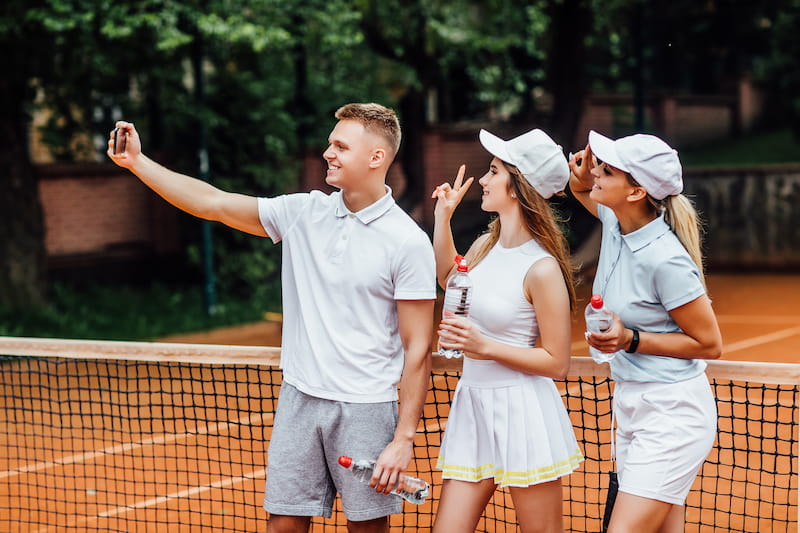
In a time when loneliness and burnout sometimes go hand in hand with modern young adults’ busy, connected lives, racquet sports have observably helped turn exercise into a more meaningful and emotionally rewarding experience.
Not too long ago, sports communities were mostly associated with discipline, competition, or fitness goals. Today, at least among young adults in urban cities, that dynamic feels noticeably different. Sports like padel and tennis have evolved into social ecosystems of their own.
Spend enough time around Bali, Jakarta, Singapore, or other increasingly wellness-oriented cities, and the pattern becomes far too apparent to ignore. Racquet sports courts are constantly booked, group chats are filled with invitations to casual matches, and post-game coffees have become just as important as the games themselves. I’ve noticed that the culture surrounding these sports now extends beyond exercise. For many young adults, especially those navigating post-pandemic social life, padel and tennis in particular have quietly become modern social lifelines.
That shift is not entirely anecdotal. Recent sociology and psychology research increasingly points towards sports participation as a powerful source of social connectedness, particularly among young adults. A 2024 review published by researchers at the University of Lincoln, which analysed nearly 200 studies involving over 88,000 participants, found that sports environments can significantly reduce feelings of loneliness because they provide recurring social interaction, support systems, and a sense of belonging. Other studies have described sports communities as forms of ‘social capital’, where repeated interaction gradually creates familiarity, trust, and long-term social bonds.
What makes the current rise of padel and tennis particularly interesting is that not everyone entering these spaces comes from the same relationship with sports. For some, the courts became a gateway into social life first, with fitness arriving almost incidentally. For others, the racquet-sport wave simply became another chapter in a longer lifestyle already centred around sports communities.
Alena (mid-20s) falls into the latter category. Long before tennis became heavily associated with social media aesthetics and post-work social circles, she was already active in sports environments through golf and cycling. Yet even with that background, she noticed something different about the current racquet-sport culture.
“What initially drew me into tennis, in order, was firstly the social aspect,” she says. “Then the branding and aesthetic side, and only after that, the sport itself.”
Alena’s answer reflects how even experienced sports enthusiasts recognise that today’s tennis and padel culture operates differently from more traditional athletic spaces: atmosphere, presentation, and community now play equally important roles.
“There’s something aesthetic about every component,” she explains. “The court, the outfit, the ball, the racket. During COVID, even dressing up for groceries felt exciting, so dressing up and feeling like the main character on a tennis court felt even better.”
That self-awareness says a lot about how younger generations approach sports today. Lifestyle and identity have become deeply intertwined with physical activity, particularly through social media. Research from the German Sport University Cologne found that young adults increasingly use sports spaces not only for exercise, but also for self-presentation, lifestyle expression, and social interaction online. In many ways, racquet sports became visually aligned with the broader wellness culture that dominates platforms like Instagram and TikTok: clean aesthetics, coordinated outfits, cafés after games, and social rituals built around class signalling.
Meanwhile, Cindy (early 30s) offers a contrasting perspective. While she was once quite involved in padel communities, she has since stepped away from those circles, allowing her to reflect on them more retrospectively rather than from inside the trend itself.
Looking back, she admits the sport ultimately fulfilled more of a social need than a fitness one.
“The exercise was a bonus,” Cindy says. “The sport gave me a fun way to stay active while meeting new people and expanding my social circle, which is something my current gym routine doesn’t really revolve around.”
Cindy’s experience highlights an important distinction between racquet sports and many other wellness spaces. Sports like padel are able to create repeated, low-pressure social contact through shared activity, partly because they feel more approachable and less physically intimidating than traditional tennis for many beginners. The learning curve is often perceived as gentler, the matches more casual, and the doubles-based format naturally encourages interaction, making it easier for newcomers to participate socially even before becoming technically skilled.
“The interactions feel more natural because there’s already a shared interest,” she explains. “At gyms, people are usually focused on themselves, and nightlife scenes can sometimes feel too loud for any substantial conversation.”
Psychologists have long noted that shared activities tend to create social bonds more naturally than environments centred purely around conversation. Sports, particularly doubles-based or community-oriented ones like padel, allow people to interact without the pressure of constant social performance. Conversations happen gradually between rounds, after matches, or through recurring encounters over time.
That dynamic may explain why these sports have become especially attractive to young adults navigating increasingly fragmented social lives. In many urban environments, opportunities to consistently meet new people outside work or existing friendships have become surprisingly limited. Remote work, digital communication, and increasingly individualised routines have all contributed to what many researchers are dubbing a growing “loneliness epidemic” among younger adults.
For some players, those circles eventually become central to their identity and routine. Alena estimates that sports-related friendships now make up roughly 40% of her social circle, particularly among working adults whose opportunities for meeting new people naturally decrease over time.
“It feels like fresh new connections,” she says. “And from what I know of my friends who do work full-time, sometimes that percentage becomes even higher.”
That observation mirrors findings from a Norwegian study published in the International Journal of Environmental Research and Public Health, which described sports as one of young people’s “most important social arenas”. The study found that friendships formed through sports often extend beyond the activity itself into wider social networks, leisure activities, and everyday life.
Still, Cindy’s experience also shows that not every connection survives beyond the sport itself. Some friendships faded once people stopped playing regularly together, while others developed into more meaningful relationships outside the court.
“The stronger friendships lasted because there was genuine compatibility beyond the sport,” she says.
Perhaps that is what makes racquet sports culturally significant right now. They are not simply spaces for athletes or fitness enthusiasts. At a time when socialising is often associated with indulgent leisure, excessive screen time, or environments that can feel emotionally draining, sports like padel and tennis stand out as something noticeably different. They encourage productive movement and routine in a structure that allows human connection to happen simultaneously, without forcing either one to become the primary purpose. One could see it as a ‘two birds with one stone’ situation, where young adults no longer feel the need to choose between prioritising their health or maintaining a social life.
For many young adults, that balance may be the real appeal. The sport provides structure, the community provides belonging, and the exercise becomes an added benefit rather than an obligation. In an era where loneliness and burnout often coexist with hyperconnectivity, racquet sports have, over time, rebranded exercise into something more emotionally fulfilling.