



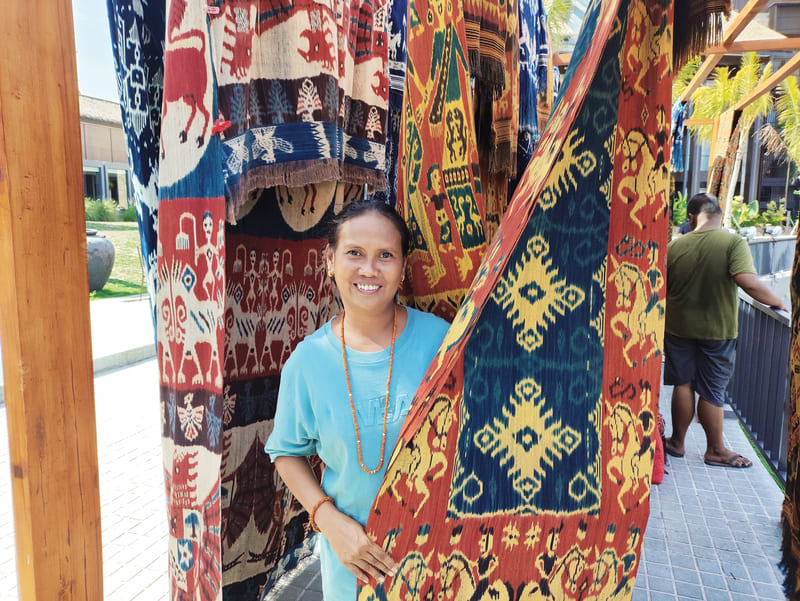
Rambu Ana dedicates her life to honouring Sumba’s living heritage through the artistry of weaving.
Sumba, with its unique landscape and charming ambience, has its own culture that has gained popularity recently, namely Tenun Ikat Sumba: artistically hand-woven fabric that manifests the Sumbanese identity. This fabric is commonly used for traditional clothes, keychains, slingbags, and other wearable fashion.
While I was roaming around my hotel in Waingapu, I met a middle-aged woman showcasing her collection of Tenun Ikat Sumba at the hotel’s plaza. Although she was quite busy preparing her booth, she didn’t mind having a quick talk with me. Her name is Rambu Ana, a native Sumbanese who has devoted her life to creating these masterpieces.
Rambu Ana is currently running her own business, as she is selling Tenun Ikat Sumba under the brand Rambu Chiko. You can find the art shop in Prailiu, East Sumba regency. Rambu Chiko is also Rambu Ana’s way to inherit and continue her family’s legacy. As the fourth-generation weaver in her family, she reminisced about how she had started learning how to weave when she was as young as six years old. I didn’t ask her age, but she looked like she was already in her 40s, which means that she has been doing this work for more than four decades. What a dedication!
Through every step of weaving, for every strand connected, Rambu Ana expresses her soul and ideas. She has an indefinite passion towards her artworks. Never in her life has she felt regret for this dedication. By making Tenun Ikat Sumba, she can make money to provide for her family — while also preserving the authentic Sumbanese culture.
“Making this weaving is filled with passion, filled with heart. I just love it, basically, and it helps us financially. It can help us send our children to school and for other needs,” she said.
Then, I was curious about the buyers. According to her, in the last five years, Tenun Ikat Sumba has become more popular globally, attracting potential buyers from Europe and many other countries. However, she also said that this traditional hand-woven fabric is even more popular among the local tourists, specifically the ones from Jakarta. They usually fly directly to Sumba, not only to explore the landscape but also to purchase the fabric as souvenirs.
Turns out, creating an ikat weave is complex and time-consuming. Producing a single large piece of fabric requires at least six months to a year, involving 42 craftsmen who assist Rambu Ana. The most challenging part, she told me, is the scarcity of raw materials, as she is committed to using only natural resources for the colouring. Moreover, the subsequent motif-designing and dyeing processes also take considerable time.
Tenun Ikat Sumba plays a significant role in Sumbanese customs, as each design conveys both cultural and historical narratives of the Sumbanese people. It is commonly used in daily exchanges, traditional weddings, and funeral ceremonies. These garments are a source of pride and are considered among the most precious family heirlooms to preserve — no matter the cost.
“We convey our Sumbanese culture through Tenun Ikat. This will be a story for future generations, a story that will never end,” said Rambu Ana.
As I wrapped up my conversation with Rambu Ana, I realised that Tenun Ikat Sumba is far more than a piece of fabric; it is a living archive of identity, craftsmanship, and ancestral memory. Through artisans like her, this heritage continues to thrive, connecting the past with the present while inspiring future generations to appreciate the cultural soul woven into every thread. Anyone visiting Sumba should not miss the chance to witness this remarkable tradition firsthand and support the people who keep it alive.