




In the lush, emerald highlands of Tanah Datar, West Sumatra, the air is often thick with the scent of rain and damp earth.
But as you wander through the winding roads of Tabek Patah or the outskirts of Batusangkar, another aroma begins to take hold—a peculiar, smoky fragrance that bridges the gap between a roasted coffee house and a tranquil tea garden. This is the scent of kopi daun kawa, a beverage that defies the standard definition of coffee and serves as a liquid monument to the resilience of the Minangkabau people.
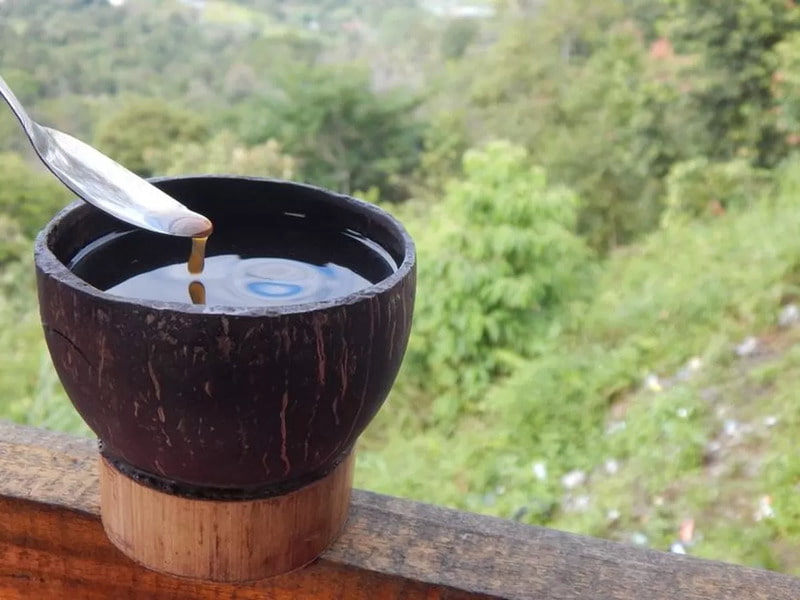
To the uninitiated, the name is a paradox. In the local dialect, the word “kawa” is derived from the Arabic word “qahwah” (coffee). Yet, if you look into the cup—or more accurately, the coconut shell—you won’t find the dark, opaque brew of ground beans. Instead, you will find a clear, amber-hued liquid brewed from the toasted leaves of the coffee plant.
It is a drink born of necessity, seasoned by struggle, and preserved by pride.
The Bitter Roots of a Sweet Tradition
The story of kopi daun kawa is inseparable from the dark chapters of Indonesian colonial history.
During the 19th century, the Dutch colonial government implemented the Cultuurstelsel: the forced cultivation system imposed by Van den Bosch. West Sumatra, with its fertile, volcanic soil and cool climate, was designated as a prime hub for coffee production. The hillsides were blanketed with coffee trees, and the local population was forced to tend to them under gruelling conditions. However, a cruel irony sat at the heart of this industry: while the Minangkabau people laboured to produce the finest beans for the global market, they were strictly forbidden from consuming them. Every single bean was a commodity for export, destined for the aristocratic salons of Europe.
The locals were left with the ‘waste’—the leaves of the trees they painstakingly cultivated. Refusing to be stripped of the ritual of a warm beverage, the ancestors of Tanah Datar began to experiment. They took the discarded leaves, dried them, and roasted them over an open fire. This act of defiance transformed a byproduct of colonial greed into a staple of cultural identity.
What started as a ‘poor man’s coffee’ eventually became a beloved local heritage that outlived the empire that created its necessity.

From Branch to Shell: The Art of the Brew
The process of making kopi daun kawa is an exercise in patience and primitive chemistry. Unlike tea leaves, which are often steamed or oxidised, coffee leaves require a more rugged treatment to release their flavour profile.
- Selection: Only the mature leaves of the coffee tree are used.
- The Smoking (Salai): The leaves are skewered on bamboo sticks and placed over a traditional wood-fired hearth. They are smoked for hours—sometimes days—until they become brittle and turn a deep, chocolate brown. This smoking process is crucial; it removes the ‘green’, grassy taste of the raw leaf and replaces it with a signature, woodsy depth.
- The Crumble: Once dried, the leaves are crushed by hand into coarse flakes.
- The Steep: These flakes are boiled in large clay pots or kettles. The resulting infusion is light-bodied, resembling a dark oolong tea but with a distinct, roasted undertone.
The presentation is just as vital as the preparation. In Tanah Datar, kopi daun kawa is traditionally served in a tempurung (a polished half-coconut shell) resting on a bamboo stand. Drinking from a coconut shell isn’t just a rustic aesthetic choice; the porous nature of the shell is said to soften the infusion’s edges, and the lack of a handle forces the drinker to cradle the warmth with both hands, which, subsequently, fosters a sense of intimacy with the drink.
A Flavour Profile Like No Other
If you approach kopi daun kawa expecting the punch of an espresso or the creamy body of a latte, you will be surprised. Its flavour profile is a sophisticated middle ground.
Upon the first sip, you are greeted by a smoky, earthy aroma—the ghost of the wood fire. The taste itself is remarkably refreshing, possessing the herbal clarity of tea but with a nutty, slightly savoury backbone that hints at its coffee origins. It lacks the intense acidity and bitterness of bean-based coffee, making it an incredibly smooth drink that can be consumed in large quantities without the ‘jittery’ edge.
In the lapau (small cafes) of Tanah Datar, kopi daun kawa is rarely enjoyed alone. It is the perfect companion for Minangkabau soul food. It cuts beautifully through the richness of gorengan (fried snacks) like fried bananas, bakwan (vegetable fritters), or the iconic bika, a sweet, smoky rice cake grilled over cinnamon wood.
The Symbol of Cultural Resilience
Today, kopi daun kawa has transitioned from a symbol of hardship to a badge of honour. It represents the Minangkabau Way, meaning the ability to take a restrictive situation and turn it into something creative as well as enduring.
In recent years, there has been a resurgence of interest in kopi daun kawa. While the younger generation in Padang and Bukittinggi frequents modern speciality coffee shops, kopi daun kawa remains the ‘slow food’ alternative. It draws tourists to the highlands of Tanah Datar, where they sit in open-air wooden shacks overlooking the Marapi volcano, sipping from coconut shells just as the locals have done for nearly two centuries.
Beyond its historical weight, kopi daun kawa is gaining attention for its health benefits as well. Modern studies have shown that coffee leaves are exceptionally high in mangiferin and antioxidants—often higher than both traditional coffee beans and green tea. It provides a gentle caffeine boost without the stomach irritation often associated with beans, making it a ‘superfood’ that the Minangkabau people discovered long before the term existed.
Preserving the Highland Spirit
As the sun sets over the terraced rice fields of Tanah Datar, the smoke from the kawa hearths continues to rise. To drink kopi daun kawa is to participate in a living history. It is a reminder that culture cannot be suppressed; it simply finds new ways to bloom—even if it has to grow from the leaves instead of the fruit.
For any traveller visiting West Sumatra, a stop in Tanah Datar is incomplete without this ritual. Holding that warm coconut shell, feeling the steam rise against your face, and tasting the smoky resilience of the people who refused to go without— kopi daun kawa is more than just a drink. It is the liquid soul of the highlands.
The writer, Donny Syofyan, is a lecturer at the Faculty of Humanities, Andalas University.