



Contributing writer and expatriate Dewi Aroha reflects on how she navigates her immersion into the local cuisine and her cravings for a comforting taste of home.
If you asked me what I eat in Indonesia, I would probably hesitate to answer at first. Not because I do not know how to answer that question; it is because the answer always changes. It depends on the day, how I am feeling, how much money I want to spend, and sometimes, how much I miss home.
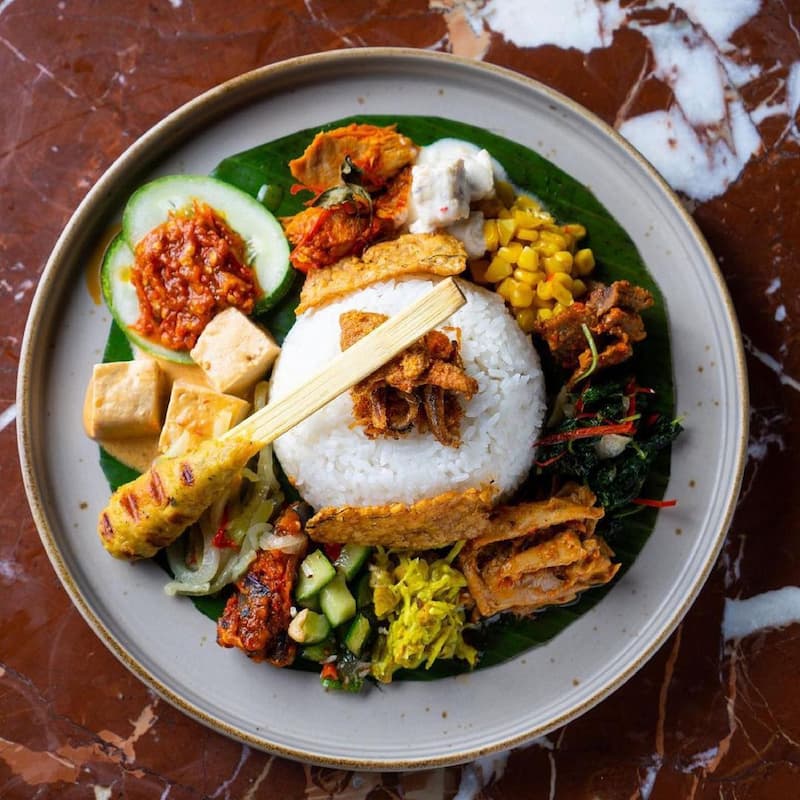
When I first arrived in Indonesia, I was certain of one thing: I would eat like a local. It felt like the right way to live here, fully immersed, fully present. In Bali, that was easy. Warungs were everywhere. I remember the first time I pointed through the glass cabinet, choosing a little of this, a little of that. Nasi campur, still warm, fragrant with lime, curry leaf, and lemongrass. Grilled fish wrapped in a banana leaf. A spoonful of sambal that I underestimated completely.
It was simple, delicious, and somehow grounding. I felt like I was doing it properly. For a while, I was. But then, slowly, something shifted.
It was not dramatic. No sudden rejection of local food. Just small, quiet cravings that began to appear. A proper piece of sourdough with a crust that cracked under your fingers. A salad that tasted as it did back home. Coffee that hit with the same depth I had grown used to before all of this.
I started noticing what was missing. And that is when my fridge began to tell a different story.
Open it now, and you will find sambal next to a jar of imported pasta sauce. Tempeh sits beside a block of Australian cheddar. There is olive oil, Dijon mustard, and something from home that I cannot quite give up. It is not one cuisine. It is a compromise, or maybe something softer than that. A blend that makes sense only to me.
Shopping changed, too. What used to be a quick stop became something more deliberate. I would walk through the supermarket and pause at familiar labels, feeling a small, unexpected comfort. Into the basket they would go. The total would climb quickly, always a little higher than planned, but I rarely put anything back.
Some things feel worth it.
In Jakarta, I noticed this happened faster. The city makes it easy to hold on to old habits. Everything is available, or close enough. You can move through your week barely adjusting your diet if you choose. Indonesian food becomes one option among many, not the centre of it.
Even then, I found myself drifting back.
Lunch might be nasi goreng at my desk, eaten quickly between tasks. Dinner might lean elsewhere, something predictable, something I do not have to think too hard about. In a city that moves quickly, there is comfort in knowing exactly what you are going to get.
Back in Bali, the rhythm feels different, but the pattern is still there. A morning might start with tropical fruit and strong local coffee, barefoot on a terrace. By afternoon, I am driving across town for a specific brand of hummus or chocolate that reminds me of somewhere else. By evening, I am back at a warung, ordering the same dish I have eaten countless times.
It is not an inconsistency, though. It is a balance.
Cost plays its part, of course. Eating local is affordable in a way that makes daily life here possible. Warung meals are not just good—they are also sustainable. Imported food is something else entirely. It is chosen carefully, stretched out, and made to last.
But it is not only about money.
Food carries memory in a way nothing else quite does. The taste of something familiar can pull you back instantly, cutting through distance and time. In those moments, the price feels less important.
At the same time, my palate has changed more than I expected. Things that once felt unfamiliar are now part of my routine. Tempeh is no longer something I try occasionally; it is something I rely on. Sambal has moved from the side of the plate to the centre. I eat spicier food without thinking about the spiciness.
And ‘home food’ has shifted too.
It is no longer about recreating something exactly. It is about getting close enough. A pasta made with what is available. A version of a meal I used to know, adjusted, improvised. It still feels like mine, even if it is not quite the same.
Eating, moreover, is rarely a solo act. In Bali, long lunches stretch into late afternoons, tables filled with everything from local dishes to café staples. In Jakarta, meals are shaped by time, by work, and by convenience. But in both places, food becomes a way of connecting, of sharing something across cultures without needing to explain it. I have also become more aware of the choices behind it all. Where I eat. Who I support. Whether I am contributing to the local food culture or just passing through it. These are not always easy questions, but they sit there in the background now.
So, returning to the earlier question: what do I actually eat in Indonesia?
I eat nasi campur on plastic stools and sourdough in polished cafés. I eat instant noodles late at night, and when I am home, I often eat meals that remind me of home. I eat what is comforting, and on numerous occasions, what I eat is guided by where my emotion goes and what I simply feel like having in that moment. More than anything, though, I eat according to where I am in my own process of living here in Indonesia. Still adjusting in some ways. Settled in others.
Food, in the end, has become a kind of map. Not just the map of Indonesia, but also the map of my place within this country. Something that shifts and adapts, never quite set in stone.
The expat table is never fixed. It shifts, expands, and contracts. It holds both the unfamiliar and the deeply known. It is, ultimately, a place where identity is not left behind, but quietly reshaped—one meal at a time.