



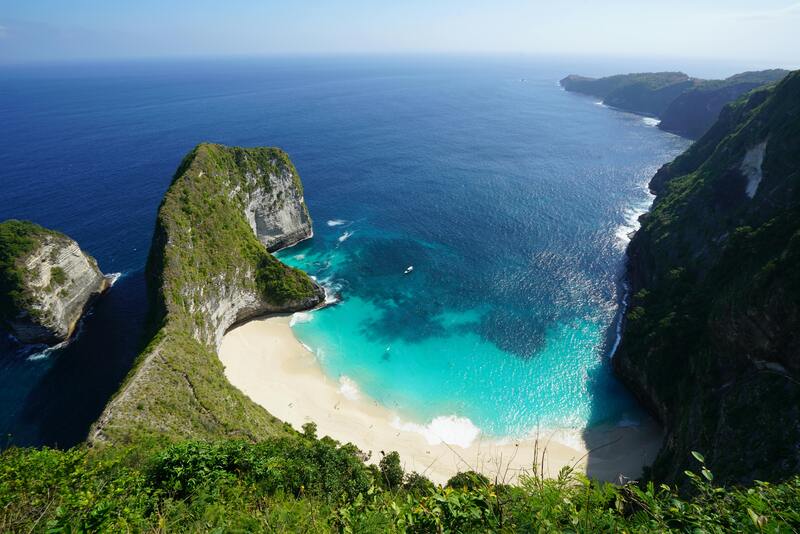
Controversy grows over the construction of a 182-metre glass lift at Kelingking Beach, Nusa Penida, Bali, as questions arise about its environmental impact, funding, and local government involvement.
As a context, the glass lift is planned to stand approximately 182 metres high and include a 64-metre bridge, with designated photo spots every 20 metres. Aside from serving as a tourism facility, the lift is also intended to assist in the evacuation of visitors who frequently experience marine accidents while exploring the cliffs below Kelingking Beach.
Made Sudiarka Jaya, the Head of the Klungkung Investment and One-Stop Integrated Licensing Service (Dinas Penanaman Modal dan Pelayanan Perizinan Terpadu Satu Pintu or DPMPTSP), stated that the project is funded by Chinese investors and already holds a Business Identification Number (Nomor Induk Berusaha or NIB), as well as a Building Permit (Persetujuan Bangunan Gedung or PBG), with total fees amounting to Rp1.05 billion.
“Yes, it’s PMA [Foreign Investment]. We already have the NIB and PBG,” Jaya said on Thursday, the 30th of October.
Jaya, furthermore, explained that, under PMA regulations, the minimum investment value is Rp10 billion. Meanwhile, the investment for the glass lift construction is estimated to reach around Rp200 billion. However, the investment realisation report has not yet been received, as the investor has not submitted an Investment Activity Report (Laporan Kegiatan Penanaman Modal or LKPM).
Nevertheless, the Head of Nusa Penida District, I Kadek Yoga, said that the local government was not involved in either the planning or the execution of the construction. The development was carried out through a land lease agreement between the private investors and the Karang Dawa Traditional Village, the local customary territory in Nusa Penida. This means the construction permit was not issued through formal government channels, but rather through an agreement between the investor and the traditional village.
The Chairman of Commission VII of the Indonesian House of Representatives, Saleh Partaonan Daulay, also commented on the controversy surrounding the lift’s construction. He cautioned that the project’s purpose should not be misconstrued as an act of environmental destruction.
“We must not allow the drive for convenience in development to be misunderstood or even seen as harmful to nature and the environment,” Daulay told the press on Thursday as well.
On the other hand, Daulay also expressed his concern that the project could alter the natural character of the cliffs, which are the main attraction of Kelingking Beach. He stressed that the project must nevertheless be handled transparently, and that the developer should involve multiple parties, including the community and environmentalists, in order to assess the lift’s potential impacts.
“Please listen to [the local community’s] concerns. Find the best solution so that everything can proceed as planned. If there is positive input, please take it on board and follow up accordingly,” he suggested.