


The upcoming revitalisation of Muaro Port and Padang Old Town may reaffirm their significance as West Sumatra’s pivotal cultural symbols.
In Muaro Port, Padang City, West Sumatra, dusk has just descended, casting its beauty along the Batang Arau River. The late afternoon sunlight paints orange reflections on the tranquil river surface, where several boats gently sway at the bank.
The silhouettes of Dutch colonial buildings lining the Batang Arau River complete this picturesque scene. They seem to transport observers back to the late 17th century, when the Dutch trading company, Vereenigde Oostindische Compagnie (VOC), established the Muaro Port area as a bustling trade hub.
Indeed, centuries have passed. The golden age of Muaro Port as a major trading centre has long become history. Nevertheless, the VOC’s remnants along the Batang Arau River still endure. Rows of buildings that once served as offices and warehouses for diverse commodities such as gold, coal, tea, coffee, camphor, salt, and frankincense still stand, having weathered centuries.
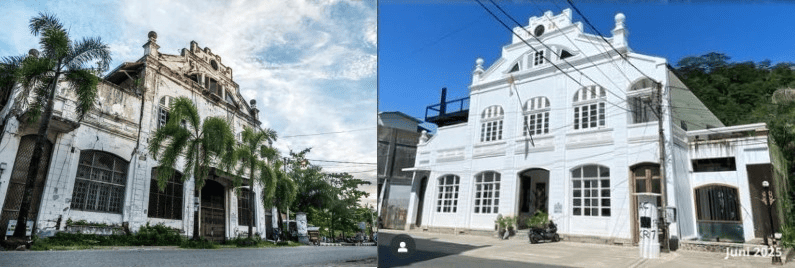
Currently, some of these European-architectured Dutch colonial buildings have been repurposed into vibrant cafes adorned with colourful lights, offering contemporary fare and live music entertainment. This captivating beauty can be appreciated from atop the Siti Nurbaya Bridge, which spans the Batang Arau River.
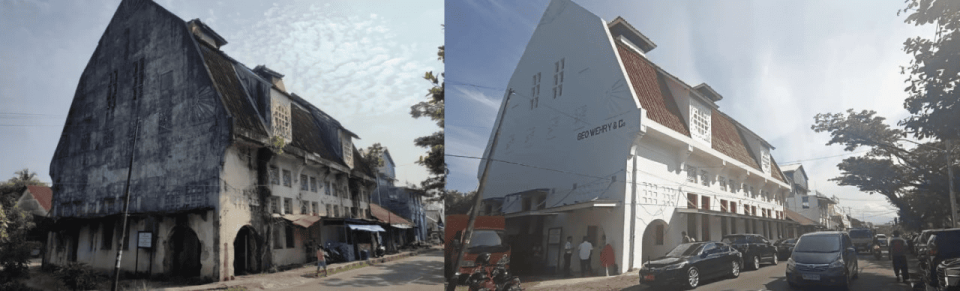
Not far from the Siti Nurbaya Bridge, the majestic Geo. Wehry & Co. office building stands tall. This office and warehouse, belonging to the largest export-import firm or company in the Dutch East Indies (Indonesia) during the colonial era, was established in 1911 and inaugurated in 1920.
The building, currently an asset of PT Perusahaan Perdagangan Indonesia (PPI), is the largest along the Batang Arau River, its 24-metre height making it particularly prominent.
This structure, like many other Dutch colonial buildings along the Batang Arau River, had previously been neglected, unkempt, dull, and slowly decaying with age. Its beauty could only be appreciated when it transformed into a silhouette at dusk.
However, a large-scale restoration is now underway for this building, which has been designated as a cultural heritage site. PT PPI, in collaboration with a partner from Jakarta, is repurposing the building into a restaurant and cafe. The revitalisation budget is fully borne by the tenant, with the strict condition that the building’s architecture must not be altered, in accordance with cultural heritage design regulations.
This collaborative concept represents a breakthrough. The local government lacks sufficient budget for the revitalisation of dozens of Dutch colonial buildings along the Batang Arau River, including the equally substantial maintenance costs. Yet, these historically significant buildings are assets that could be developed into a world-class destination.
A pivotal symbol
Meanwhile, Padang Old Town stands as a pivotal symbol in the history of Padang City, located in West Sumatra. This area is not merely a locus of historical events that profoundly influenced the nation, but also a preserved cultural heritage zone, integral to the city’s legacy. Padang City is renowned for its historical richness, and its Old Town serves as a tangible testament to these preservation efforts.
The Dutch colonial heritage buildings along the Batang Arau River are part of the extensive Padang Old Town area, spanning 32,690 square metres and encompassing two districts: Padang Selatan and Padang Barat.
Historically, the genesis of Padang Old Town can be traced to the flourishing development of Muaro Port as a thriving trade hub, which spurred the growth of settlements in the region. In the mid-17th century, the Dutch subsequently implemented a policy of demarcation, creating a boundary between their settlements and those of the indigenous population.
The Dutch occupied the strategically vital banks of the Batang Arau River at that time, neighbouring Chinese communities, Tamil Indian ethnic groups, and, finally, the indigenous populace. This residential area is what is presently referred to as the Old Town. To this day, Chinese, Tamil Indian, and Minangkabau ethnic groups continue to intermingle in the Old Town area, serving as a symbol of cultural acculturation and inter-ethnic harmony in Padang City.
The revitalisation of Dutch colonial buildings along the Batang Arau River constitutes only a portion of the efforts to develop the Padang Old Town area into a world-class destination. Based on the prepared master plan, the Old Town area would be subdivided into nine sub-zones, each possessing its unique characteristics, such as Kampung Tionghoa (Chinese Village) with several temples still standing robustly and well-preserved cultural activities. Furthermore, there is the Tamil Indian ethnic quarter with its enduring traditions. Pasar Tanah Kongsi (Tanah Kongsi Market) showcases cultural acculturation, alongside Pasar Gadang (Gadang Market), which historically served as a primary settlement for Minang merchants.
As a preliminary step, Padang City will host the National Coordination Meeting of the Indonesia Creative Cities Network (ICCN). This event will involve approximately 250 ICCN member cities sending their delegations to the city. Padang City’s opportunity to host the ICCN Rakornas is expected to be a timely momentum for gathering input from delegates to realise its gastronomy creative city aspiration.
Padang City is also preparing to join the global creative cities network through UCCN. With the mentorship of ICCN, the local authority is optimistic that this step will further propel Padang City toward becoming a gastronomy creative city.
The writer, Donny Syofyan, is a lecturer at the Faculty of Humanities, Andalas University.