



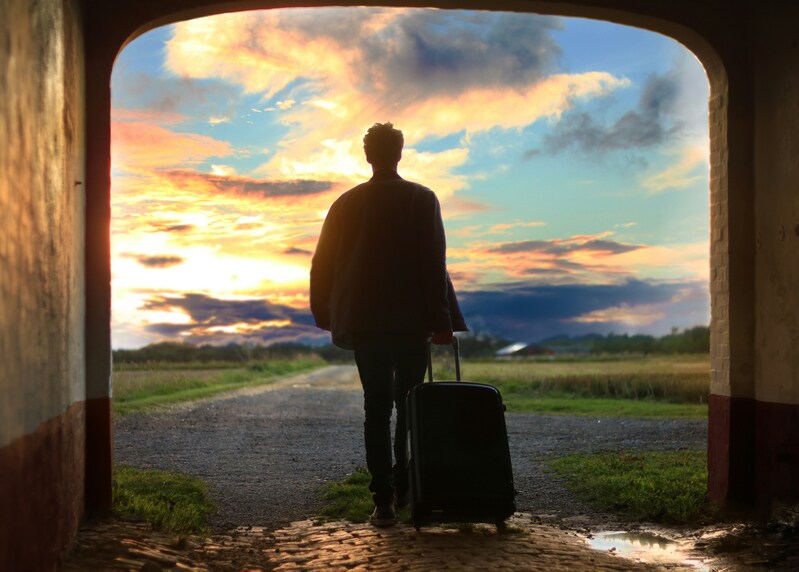
People are now travelling more than ever, whereas for many others, the idea of going anywhere feels further away than it did a few years ago.
Somewhere between the post-pandemic travel surge and the cost-of-living crisis, a quiet contradiction has settled in. UN Tourism recorded 1.52 billion international arrivals back in 2025—a new post-pandemic record— but the numbers alone don’t tell you much. The surge is being driven by something more layered: revenge travel, yes, but also a world that’s becoming increasingly unstable.
In an era of economic precarity, political polarisation, and conflicts that have displaced millions, travel has taken on a secondary function for those who can access it. Meanwhile, inflation has driven up the cost of flights and accommodation across most major destinations, pricing out one segment of would-be travellers just as another segment books their third trip of the year. The gap cuts through the middle, separating those with the flexibility to move from those whose stability depends on staying put.
The easy explanation, one might assume, stops at money. However, the more I sat with that, the less satisfactory it became, which is what led me to start asking around—friends, acquaintances, the kinds of people whose lives I could actually see up close. I sought to understand how they were each relating to travel right now. What I found was a more nuanced reality of the different shapes that an escape or a getaway takes when the conditions of your life change.
The ‘Revenge Travel’ Wave
The years immediately following the pandemic produced what analysts quickly labelled ‘revenge travel’: a surge in movement driven by two years of enforced stillness. People booked trips with an urgency that felt almost biological. The industry responded accordingly. Prices climbed, popular destinations hit capacity, and the viral spread of locations on social media compressed the typical tourist lifecycle of a place from years into months.
Cindy, who has been working remotely for four years and travels regularly, observed that the ‘revenge travel’ wave changed not just costs but the texture of destinations themselves.
“Prices are higher, places get crowded faster, and everything moves quicker once it goes viral,” she told me. “The moment a place blows up online, it shifts the whole experience.”
Similarly, Alex, who also works online and travels often, agreed with this sentiment, though in a more direct manner.
“I definitely think more before booking now,” he divulged.
For Iqbal, a 9-to-5 office worker in his early thirties, the calculus was already more deliberate before costs rose further. Financial stability comes first, then the purpose of the trip.
“I’m not the type to travel just to take some pictures,” he said.
What Actually Urges Someone to Travel?
Stripped of logistics, the motivations behind travel turn out to be remarkably consistent across very different lives.
Alex books a trip, for instance, “Usually when I get bored with where I am or when I feel like I need a change of scenery. Sometimes it’s just a random decision, nothing too deep.”
Cindy describes a similar but more considered sentiment.
“If everything aligns, like the timing works, the price makes sense, and the place feels right,” she said of her ideal condition to travel.
What travel delivers, once you get there, also tends to land in similar territory.
“It kind of resets your head,” Alex added. “New place, new people, different vibes. It makes you look at things differently.”
For Iqbal, however, his current version of escape on a regular week is something as simple as “not touching my laptop, but one thing that is integral for me is a lingering coffee ritual.”
Iqbal also divulged his wish to travel to Japan someday, solo, and at his own pace. He yearns to experience, in his words, “how Japanese people go about their daily life, how they appreciate the little details.”
The Trade-Off Nobody Talks About
This is, interestingly, where the financial explanation starts to crack.
In Iqbal’s case, constraints may initially look like a money problem. Things for him to consider include limited leave, corporate deadlines, and a budget that requires careful management.
“Although the desire to escape is always there, the reality is I’d still have to compromise with the existing conditions,” he explained.
But here’s what complicates that reading: Iqbal used to travel far more frequently back in his twenties, when he earned significantly less than he does now. The current job that pays better turns out to be the job that keeps him in place. After all, stability comes with its own set of walls.
This is the trade-off that rarely makes it into conversations about who travels and who doesn’t. Financial freedom and freedom of movement aren’t the same thing—and gaining one doesn’t guarantee the other. A better salary can theoretically fund a trip to Japan while simultaneously making it structurally impossible to go. Time, energy, leave entitlements, the particular exhaustion of a life organised around deliverables—these are valid constraints that money doesn’t automatically dissolve.
Alex’s lifestyle, on the other hand, looks from the outside like the version everyone is working towards— but even he is already questioning it. When I asked whether travel had started to feel more like a habit than an intention, Alex didn’t hesitate in his answer.
“Yeah, sometimes it does feel like that. Like you’re just moving because you’re used to it,” he remarked.
Cindy, despite being a frequent traveller, candidly revealed that she didn’t frame her lifestyle as a final destination.
“I don’t see myself constantly moving forever,” she said. “At some point, I do want to be somewhere I can actually settle; somewhere that feels stable, with a culture I can grow into long-term.”
Alex echoed the same pull, if a little more loosely.
“For now, yeah, it works. But long-term, I might want some kind of base; just not a fully fixed life,” he added.
The Ultimate Threshold
Ultimately, the conditions that make an escape or a getaway possible are more temporary than we tend to admit—and that applies to almost everyone. Cindy doesn’t see herself moving constantly forever. Alex is already catching himself in the habit. Iqbal once had the mobility and traded it, knowingly or not, for something else he needed more at the time.
No travel habits are fixed. That, more than anything, is what the people I spoke to have in common. At the end of the day, everyone engages in an ongoing negotiation between what they want, what their life currently allows, and what they’ve subconsciously agreed to give up in exchange for everything else they have.