



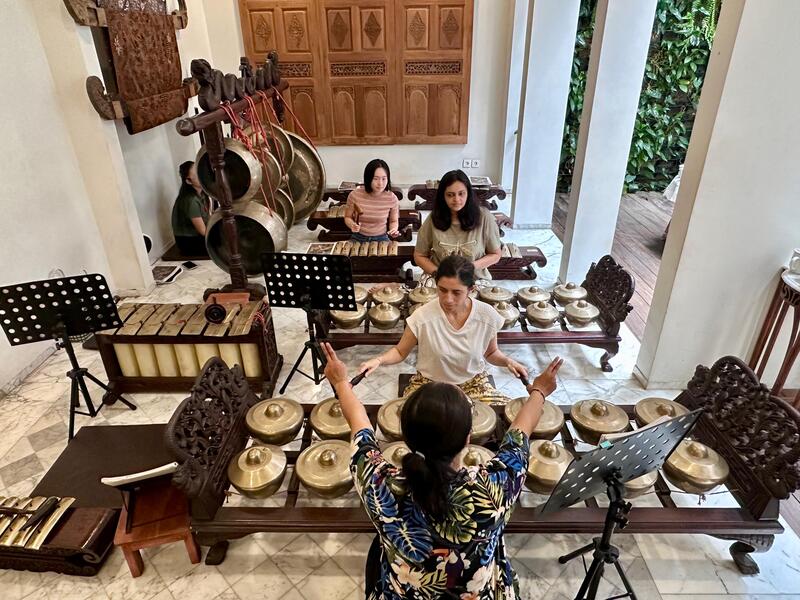
Pramoedya Ananta Toer, an icon of Indonesian literacy, in his book The Earth of Mankind, described gamelan’s melody as “the longing of a nation for the coming of a Messiah— linking it with deep hope and expectation that reflects the Javanese life.”
Every instrument comes to life the moment it’s played. It is a combination of shimmering waves of instruments from the resounding gong to the delicate gambang xylophone, each with its own name, tune, and playing technique. When played alone, it sounds incomplete. However, when played together, it creates a beautiful orchestra of harmony, mirroring the Javanese philosophy that a proper balance comes when individuals unite for a shared purpose. It becomes a reminder that true harmony, in both music and life, arises from respect and togetherness.
The history and evolution of gamelan is rooted in several legends; one of the most common stories is of Sang Hyang Guru, also known as Batara Guru: the highest God in Javanese and Balinese mythology. Legend has it, he ruled Java from his palace at the summit of the current Mount Lawu in Central Java. As Sang Hyang Guru needed a signal to summon the Gods, he made a gong tuned to a specific pitch to communicate various messages. In the end, it was said that three drums were tuned. Depictions of the legend can be seen on the 8th-century Borobudur Temple along with flutes, bells, drums, and lutes — the roots of gamelan.
In the era of Indonesia’s ancient kingdoms, instruments like idiophones played an essential role in both daily life and spiritual traditions. Over time, they evolved into the gamelan we know today. When Islam arrived, gamelan often accompanied wayang (shadow puppet) shows, sharing stories and faith. More than just music, gamelan became one of the most beautiful expressions and a living symbol of Javanese culture — blending bronze, wood, rhythm, and spirit into harmony and balance with sounds that feel both grounding and ethereal.
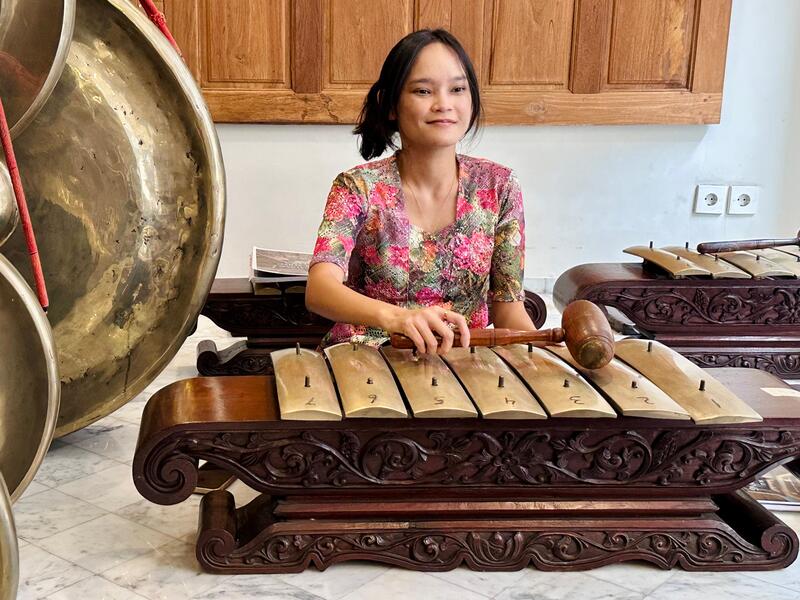
Harmony of sound, spirit, and life
Gamelan has long been part of Javanese court culture, with the royal palaces of Yogyakarta and Solo housing the oldest existing sets.
Traditionally, only men played the instruments while women sang, though over time, women began playing the gender: an instrument admired for being played with subtle, graceful wrist movements. The word “gamelan“ itself comes from an Old Javanese word “gamel“, meaning “to strike,” referring to the use of a mallet. Each instrument carries meaning beyond sound, symbolising the universe, society, and life itself.
Learning gamelan is not just about rhythm but also patience, humility, and awareness. Forged with precision and intuition, a whole ensemble can include five to 40 types of instruments — such as kendang, kenong, gong, bonang, saron, and demung — performed together by up to 80 musicians in harmonious unity.
Today, there are various types of gamelan ensembles used for different occasions, such as accompanying ceremonial events like royal weddings or a king’s coronation, or wayang performances. At its heart lies the gong ageng: the largest and most powerful instrument. As a famous Javanese proverb states, “It is not official until the gong is hung”. Its deep, resonant tone represents the universe — the unseen forces linking the earthly and the divine. Traditionally believed to summon the gods, the gong anchors the entire ensemble.
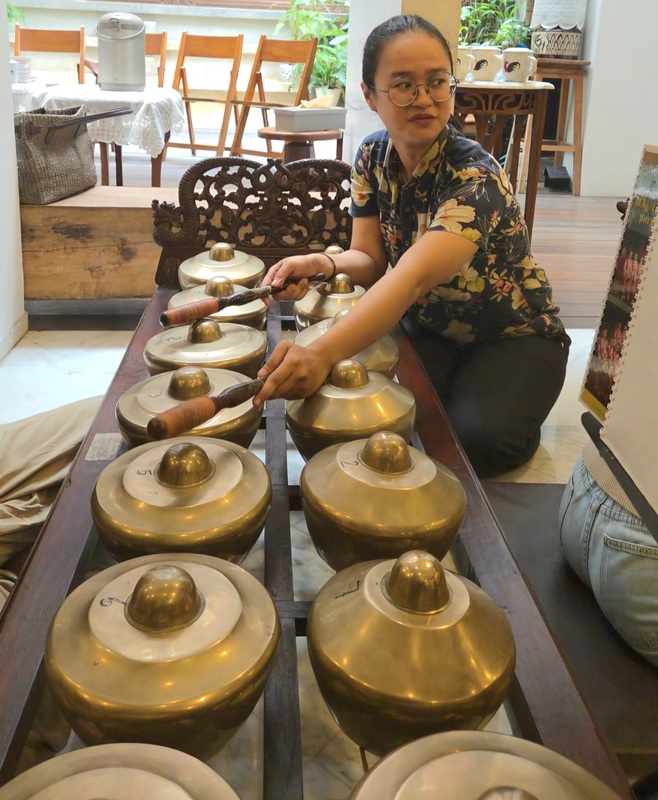
Supporting the gong are the saron metallophones as well as kenong, which form the foundation or the ‘skeleton’ of the music, symbolising order, stability, and the flow of existence. The kendang, or double-headed drum, is the heartbeat of gamelan. The drummer sets the tempo and leads the flow — much like rhythm and awareness guide our lives. The rebab, a bowed string instrument, adds a human voice to the ensemble, its gentle melodies infusing emotion and soul into the collective sound. Together, they create a sound that feels complete. A simple, yet complete harmony.
Gamelan is more than just instruments, though. It is believed to have a spiritual identity, with offerings made or performances given only on certain occasions. Footwear must be removed when coming near the gamelan instruments. Moreover, foot contact with the instruments must be avoided at all times, and even stepping over an instrument is forbidden. With mindful and respectful care, both the physical quality and spiritual harmony of the instruments are preserved. This belief adds to its mystical presence — you don’t just hear gamelan music, you feel it.
The making of gamelan is an art that demands both technical mastery and spiritual understanding. Each instrument must be carefully tuned, as even a small mistake can ruin its sound or damage the metal. This art, passed down through generations, is an Indonesian intangible cultural heritage, admired around the world, and recognised by the United Nations Educational, Scientific and Cultural Organization (UNESCO) in 2021.

Songs with purpose
For beginners learning gamelan, the teacher usually chooses the famous Javanese song “Suwe Ora Jamu” (“long time no see”) because it has a simple notation and a theme of reunion after a long absence.
In the royal courts of Yogyakarta and Surakarta, the opening and closing songs also carry a deep meaning. The Gangsaran’s melody welcomes the Sultan’s arrival, while the song “Udan Mas” (“golden rain”) is played to mark the end of a performance or event — as a blessing of joy and good fortune to departing guests. “Gugur Gunung“, another famous song, embodies the Javanese philosophy of gotong royong (collective harmony) to achieve a common goal benefiting the community. No instrument stands alone, and when all instruments are played together, they create a beautiful harmony.
The tradition kept alive
The tradition of gamelan continues to thrive as more people learn this beautiful ensemble. In Jakarta, Gamelan by Bodro Sewu Gallery — founded by Mutiara Gayatri and Bambang Suryoputro — offers classes for locals and English speakers. What began as a family space in 2018 has grown into a vibrant cultural community with performances across Jakarta, keeping the spirit of tradition alive through music and shared joy.
The ethereal, soothing rhythms of gamelan bring peace and calm to both listeners and players, even inspiring legendary composers like Claude Debussy and John Cage. Despite the changing times, it remains an integral part of Indonesian life — evolving from its early role in rituals and royal ceremonies to its place in education, festivals, weddings, and cultural performances. Throughout its journey, gamelan has also remained a symbol of balance — between sound and silence, community and individuality, the human and the divine — reminding us that true harmony is born when every sound, person, and moment moves together in rhythm with life.
Representing harmony at its core, life, just like music itself, is most beautiful when everything moves in balance.