


Written by Tim Maitland, the Head of School at New Zealand School Jakarta.
What does meaningful learning look like in the early years?
For a young child, learning rarely happens by sitting still and memorising information. It happens while asking questions, playing with friends, building something, telling a story, discovering something new—or simply trying again after something doesn’t work.
This is one of the ideas at the heart of Te Whāriki, New Zealand’s early childhood curriculum.
Te Whāriki is a Māori phrase meaning “woven mat.” The name reflects an important idea: children’s learning and development are made up of many different strands, woven together to create a strong foundation.
Rather than separating learning into individual subjects, Te Whāriki takes a holistic view of the child. Wellbeing, relationships, communication, exploration, and a sense of belonging are all connected.
Learning begins with the child
One of the four principles of Te Whāriki is empowerment.
Young children are naturally full of ideas. They want to choose, experiment, question, and make sense of the world around them. Giving children opportunities to make choices and express their thoughts helps them develop a growing sense of agency.
This does not mean children learn without guidance. Instead, adults create an environment where children can explore their interests while having the support and encouragement they need.
A simple choice—what to build, which story to tell, how to solve a problem—can become an opportunity for a child to develop confidence in their own thinking.
Seeing the whole child
Early education is sometimes associated primarily with preparing children academically for the next stage of school.
Te Whāriki offers a broader perspective.
Its principle of holistic development recognises that children grow in many different ways. Intellectual development matters, but so do physical, social, emotional, and spiritual wellbeing.
A child learning to share a toy, for example, is developing more than a social skill. They are learning about relationships, emotions, communication, and consideration for others.
These experiences may seem small, but together they become part of a child’s development.
Home, school, and community
Children do not leave their identity at the classroom door.
Their family, culture, language, experiences, and interests all influence how they see the world. For this reason, family and community are an important part of Te Whāriki.
When children’s backgrounds are recognised and valued, they can develop a stronger sense of who they are and where they belong.
It also highlights the importance of relationships between families and teachers. Parents know their children in ways that teachers may not, while teachers observe children in different social and learning environments.
Sharing these perspectives can help create a more complete understanding of the child.
Relationships are part of learning
The fourth principle is relationships.
Children learn through their interactions with people, places, and things. Positive relationships can provide the security children need to explore their environment and try unfamiliar experiences.
It also extends beyond relationships with other people. Children gradually develop an understanding of their relationship with the natural world and the impact their actions can have on others and the environment.
In this sense, learning is not something that happens separately from everyday life. It is woven into the way children experience the world.
Five strands of early childhood learning
The principles of Te Whāriki are expressed through five interconnected strands: Wellbeing, Belonging, Contribution, Communication, and Exploration.
Each strand represents an important part of a child’s development, but none exists in isolation.
Wellbeing
Children need to feel safe before they can confidently explore.
The Wellbeing strand focuses on children’s physical and emotional health, helping them recognise their needs and feelings while developing healthy habits and a sense of security.
Belonging
A familiar environment can make a significant difference to a young child.
Through Belonging, children develop connections with their classroom, school, family, and wider community. They become familiar with routines and expectations while developing the confidence to ask questions and explore.
Contribution
Every child brings different interests, experiences, and abilities.
The Contribution strand encourages children to participate and learn alongside others. It recognises individual strengths while helping children understand the value of cooperation, inclusion, and shared experiences.
Communication
Children communicate in many ways—not only through words.
The Communication strand supports children’s verbal and non-verbal communication, giving them opportunities to express ideas, feelings, and experiences.
Stories, conversations, music, movement, art, and play can all become ways for children to communicate and make meaning.
Exploration
Perhaps one of the most recognisable features of early childhood learning is play.
But play is more than entertainment.
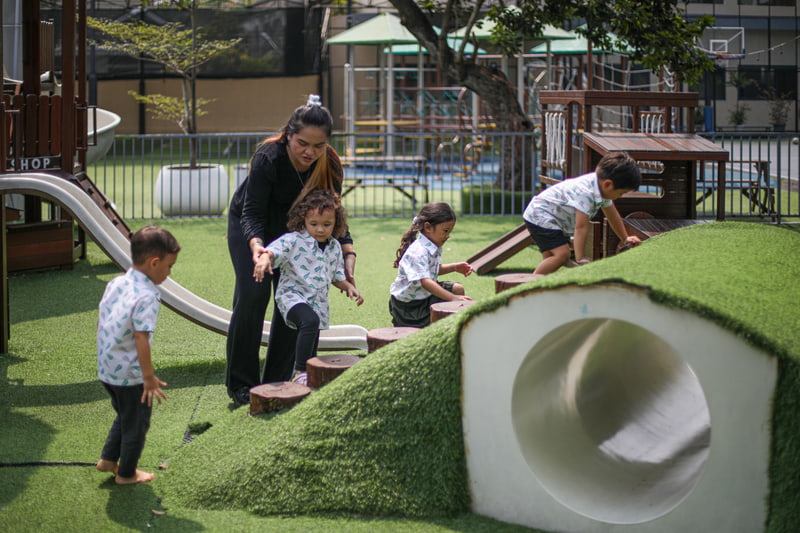
As children play, they investigate how things work, test ideas, solve problems, and negotiate with others. They may build, take apart, experiment, imagine, and start again.
A child playing with blocks might be developing spatial awareness. A pretend restaurant might involve communication, mathematics, and social interaction. A question about an insect in the garden might lead to an unexpected exploration of science.
Learning can begin anywhere when children are given the opportunity to be curious.
The value of a strong beginning
A strong beginning is rarely one big moment. It’s built the same way everything strong is built: slowly, and from many small parts.
This is how young children grow. Not through one lesson or one milestone, but through hundreds of small, ordinary moments woven together: a question asked, a friendly interaction, a failed attempt tried again, the confidence to speak in front of others for the first time.
Individually, these moments may appear small. Together, they form the foundations of how children understand themselves as learners and as members of a community.
This is what makes the idea behind Te Whāriki so meaningful. Like a woven mat, children’s development is strengthened by the many experiences and relationships that come together over time.
The goal is not simply to prepare children for their next year of school. It is to help them grow into confident learners and communicators, healthy in mind, body and spirit, secure in their sense of belonging, and aware that they can make a meaningful contribution to the world around them.
And perhaps that is where good early education begins—not with how much a child knows, but with how confidently they approach what they have yet to discover.

New Zealand School Jakarta
- Jl. Kemang Selatan I No. 1A, Bangka, Mampang Prapatan, South Jakarta 12730
- Website: www.nzsj.sch.id
- Instagram: @nzs.jakarta