



You’re already disciplined. Your training is scheduled, your nutrition is managed, and rest is prioritised. Yet one thing keeps getting in the way: soreness that never fully goes away, muscles that feel stiff the next day, or recovery after an intense session that takes far longer than expected.
Many people assume this is simply part of exercising. In reality, slow recovery and recurring muscle tension may indicate that the body needs more than just rest. It may need support that works from within, rather than only from the outside.
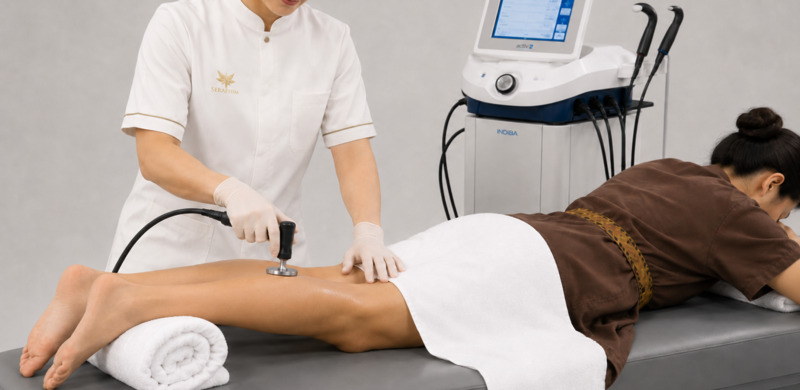
At Seraphim Medical Center, one of the technologies used to support recovery is INDIBA, a radiofrequency-based therapy operating at 448 kHz. Long used in professional sports and medical rehabilitation, it is now available through a personalised treatment approach under the care of Dr Nahum, Dipl. CIBTAC, Sp.KO, a sports medicine specialist.
Why Does Recovery Feel So Slow, Even After Resting?
This is a question that often arises among active individuals: why do muscles still feel heavy even after a period of rest?
The answer lies at a level that is not visible to the naked eye. Intense training can cause microscopic damage to muscle fibres. This is a normal part of the adaptation process through which the body becomes stronger. However, the repair process depends on adequate blood circulation, a sufficient supply of nutrients to the tissues, and overall conditions that support regeneration.
When one or more of these factors is not functioning optimally — whether because of impaired circulation, ongoing tissue inflammation or repeated physical exertion without sufficient rest — recovery may take longer. The body continues to work, but not necessarily at its best.
Dr Nahum, Dipl. CIBTAC, Sp.KO, explains that, in sports medicine, recovery is not simply a matter of waiting.
“Effective recovery is active recovery — one that helps the body complete its biological processes faster and more thoroughly. INDIBA is here to clinically support that process,” says Dr Nahum.
What Is INDIBA and How Does It Work?
INDIBA is a non-invasive physical therapy that uses radiofrequency energy at 448 kHz, known as INDIBA Activ Therapy. This frequency is intended to deliver energy to tissues while managing heat at the skin’s surface. The treatment is designed to support tissue function and recovery, with comfort and safety considered as part of the treatment process. INDIBA is one of the technologies used in TECAR therapy, which stands for Transfer of Energy Capacitive and Resistive.
Think of the muscles and tissues inside your body as an engine that needs to be warmed up appropriately to perform at its best. INDIBA is designed to deliver energy to deeper tissue layers in a controlled manner, generating heat and potentially supporting circulation and the body’s natural repair processes.
The aim is to help relax muscles, alleviate discomfort and support recovery following physical exertion.
“INDIBA doesn’t just work on the surface. Its energy reaches deeper tissue layers — muscles, tendons, joints, even bone — and stimulates biological processes the body already has, but which need the right stimulation to function optimally,” explains Dr Nahum, Dipl. CIBTAC, Sp.KO.
Benefits of INDIBA for Sports Recovery
As a technology used in professional sports environments across more than 70 countries, INDIBA is used to support athletic recovery and performance. At Seraphim Medical Center, the technology forms part of a broader sports medicine approach led by Dr Nahum, Dipl. CIBTAC, Sp.KO.
Muscle recovery after intense training. By supporting circulation and tissue activity, INDIBA may help support the body’s recovery process, potentially helping individuals feel ready to resume training.
Relieving muscle tension and stiffness. The warmth generated by INDIBA is intended to help relax tense muscles and alleviate stiffness, which can occur after demanding training sessions or competitions.
Supporting injury rehabilitation. For individuals recovering from sports injuries — including muscle strains, tendon problems and joint pain — INDIBA may be incorporated into a rehabilitation plan where clinically appropriate.
Preparing the body before training or competition. INDIBA is not used exclusively after exercise. When incorporated into pre-training or pre-competition preparation, the therapy may help support muscle readiness and comfort.
Dr Nahum, Dipl. CIBTAC, Sp.KO, emphasises that these potential benefits cannot be generalised to everyone.
“Every active individual has different tissue conditions, different recovery needs, and different goals. Our approach always begins with an evaluation of the patient’s actual condition,” states Dr Nahum.
INDIBA and Sports Medicine: A Different Approach
What distinguishes the use of INDIBA at Seraphim Medical Center from a standalone physical therapy treatment is the clinical context in which it is provided. The technology is used within a sports medicine framework led by Dr Nahum, Dipl. CIBTAC, Sp.KO, a specialist who understands how the body responds to physical stress during training and sport, how injuries occur, and how appropriate interventions can support recovery while taking long-term performance into account.
Rather than being viewed simply as a massage or conventional physiotherapy treatment, INDIBA is a technology-based option that may form part of a broader medical approach for people who take their physical condition seriously. This includes professional athletes, recreational sports enthusiasts and people with active lifestyles who want to maintain their physical function.
“In sports medicine, we don’t just look at the injury or complaint. We look at a person’s overall movement patterns, training load, and recovery capacity. INDIBA is one of the tools that helps us intervene more precisely,” explains Dr Nahum, Dipl. CIBTAC, Sp.KO.
Who Is INDIBA Therapy Suitable for at Seraphim Medical Center?
INDIBA may be considered for a range of physically active individuals, including:
- People who exercise regularly: Those who participate in gym training, running, cycling, swimming or team sports and feel that their recovery is slower than expected despite getting adequate rest.
- People undergoing sports injury rehabilitation: Those looking to support their recovery with a technology-based treatment as part of a medically supervised rehabilitation plan.
- People seeking to support athletic performance: Those who want to maintain muscle and joint function before and after training.
- People experiencing recurring muscle or joint discomfort: Those whose symptoms are beginning to interfere with their training routines or everyday movement.
However, as Dr Nahum, Dipl. CIBTAC, Sp.KO, consistently emphasises, the first step is not choosing a therapy but understanding the body’s condition.
“A good therapeutic decision always starts with a good diagnosis. Consultation isn’t a formality — it’s the foundation of the entire treatment process,” says Dr Nahum.
Start with a Consultation with a Specialist
If your training and recovery cycle is not progressing as expected, or you have recurring physical complaints that have not been adequately resolved, consider consulting Dr Nahum, Dipl. CIBTAC, Sp.KO, at Seraphim Medical Center.
The aim is not to prescribe a particular device immediately, but to assess your condition thoroughly and determine the most appropriate approach — including whether INDIBA may be suitable for your needs.
About Seraphim Medical Center
As a business unit under Bethsaida Healthcare, Seraphim Medical Center is located in Paramount Gading Serpong. It offers modern facilities and technologies, including INDIBA, Venus Versa, Endymed, Cryo Chamber Therapy, Transcranial Pulse Stimulation (TPS), Hyperbaric Oxygen Therapy, PicoWay Laser, Fotona Laser, a range of intravenous (IV) drip therapies and various other services.
Seraphim Medical Center adopts a functional medicine approach, focusing on identifying and addressing the root causes of health concerns rather than merely managing symptoms. Its medical services are designed around a personalised approach to help the body function optimally, whether the goal is to maintain overall health, support recovery or improve quality of life.
Seraphim Medical Center has three integrated centres of excellence: the Wellness Center, the Beauty & Aesthetic Center, and the Sports & Rehabilitation Center. Together, they support a modern, holistic approach to a healthy lifestyle.