



Beyond the Villa Boom: How Smart Expats Are Securing Land in Bali’s Overheated Market
Drive through Pererenan on a weekday morning, and the sound is unmistakable: rebar being cut, concrete mixers idling, scooters weaving between flatbeds of volcanic stone. The Canggu–Pererenan–Seseh corridor has absorbed more development in the past thirty-six months than in the previous decade, and the saturation is starting to show: in traffic, in drainage failures, and in a growing sense among experienced buyers that the obvious play is no longer the smart one.
That sense is now backed by policy. In late 2025, following deadly September floods, Governor Wayan Koster formalised a construction moratorium covering six districts – Tabanan, Jembrana, Buleleng, Bangli, Karangasem, and Klungkung – restricting new tourism accommodation on agricultural land. On 14 April 2026, the Golkar faction in the DPRD Bali publicly proposed extending the halt to South Bali, citing oversupply and traffic. The following day, the Directorate General of Immigration inaugurated the Dharma Dewata patrol task force in Denpasar, a hundred-officer unit aimed squarely at foreigners operating outside the rules. The message to the property market is consistent: the easy years are closing.
Why land, not turnkey villas, is the conversation now
Against that backdrop, a quiet shift is underway. A growing segment of foreign buyers – particularly those on their second or third Bali transaction – are skipping the off-plan villa marketplace entirely and going directly for land. The logic is not complicated.
Turnkey villas in Canggu and Berawa now regularly list at USD 400,000 to 600,000 for a two-bedroom unit on a 25-year leasehold, with the build component depreciating from year one. Land, by contrast, holds its value, and in emerging corridors it has appreciated 10 to 20 per cent annually over the past three years, according to Bank Indonesia’s residential price survey. A well-chosen plot gives the owner design control, the option to build progressively, and an exit via the land itself rather than a dated villa competing against thousands of near-identical listings on Booking.com.
It is also a hedge against the compliance wave. Under the OSS-RBA deadline of 31 March 2026, rental platforms are now required to verify NIB business numbers, zoning approval, and building permits before keeping a listing active. Industry observers estimate as many as 40 per cent of existing villa rentals are non-compliant. A raw plot with clean certificates carries none of that inherited risk.
The legal reality check
Foreign buyers cannot hold Hak Milik, or freehold, full stop. The Basic Agrarian Law (UU No. 5/1960) reserves freehold for Indonesian citizens, and nominee arrangements, in which a local holds title on a foreigner’s behalf, remain explicitly illegal. Despite their persistence in expat forums, they offer no enforceable protection if the relationship breaks down.
That leaves three legitimate structures, each governed primarily by PP 18/2021 and its implementing regulations.
Hak Pakai, or Right to Use, is the strongest individual title available to foreigners. Under Article 37 of PP 18/2021, it runs 30 years initially, extendable by 20, renewable for a further 30: an 80-year maximum. It requires the buyer to hold a valid KITAS or KITAP (including the Second Home Visa route), and it is capped at 2,000 m² per foreigner or foreign family, one plot only, strictly residential. The minimum property value in Bali, set by ministerial decree, currently sits at IDR 5 billion for landed houses (roughly USD 300,000 at prevailing rates), a figure buyers should confirm with their notary at the time of transaction, since it is updated periodically.
HGB (Hak Guna Bangunan) held through a PT PMA, a foreign-invested company, is the structure of choice for anyone planning commercial rental operations or acquiring multiple plots. It carries the same 80-year maximum. BKPM Regulation 5/2025 meaningfully lowered the bar here: minimum paid-up capital for a PT PMA dropped from IDR 10 billion to IDR 2.5 billion (around USD 150,000), with land and building value now counting toward the investment threshold. That change has quietly repriced the calculus for mid-sized buyers who previously found the PMA route uneconomic.
Hak Sewa, or long-term leasehold, typically 25+25 years, remains the dominant structure in practice, covering an estimated 75 to 80 per cent of foreign-held villa stock in Bali. It requires no residency permit, no corporate setup, and no minimum price. Its weakness is that it is a contractual right rather than a registered title at BPN, which means the quality of the lease deed and the integrity of the landowner matter enormously.
Where people are buying now
The Bukit – Uluwatu, Bingin, Pecatu, Ungasan – is where serious land money is flowing. It sits inside Badung, outside the formal moratorium, and land remains roughly 40 per cent cheaper per square metre than Canggu while commanding equivalent or higher nightly rates for the finished product. Expect IDR 1 to 2.5 million per m² for second-line plots in Ungasan and Pecatu, rising sharply for anything with an ocean view. The July 2025 Bingin demolitions, which targeted only structures on protected land without permits, sharpened due diligence discipline here rather than cooling the market.
North Bali – Lovina, Tejakula, parts of Buleleng – is the speculative play. Land prices start around IDR 480,000 to 3 million per m², and the July 2025 presidential approval of the North Bali International Airport (a USD 3 billion project backed by China Construction Group) has pulled serious capital into Singaraja’s orbit. The moratorium does apply here, so buyers are acquiring for the seven-to-ten-year horizon, not immediate development.
East Bali – Amed, Sidemen, Candidasa – attracts lifestyle buyers rather than yield hunters. Plots remain achievable at IDR 600,000 to 2 million per m², but water rights and subak (irrigation cooperative) land complications are common. This is not a passive investment region.
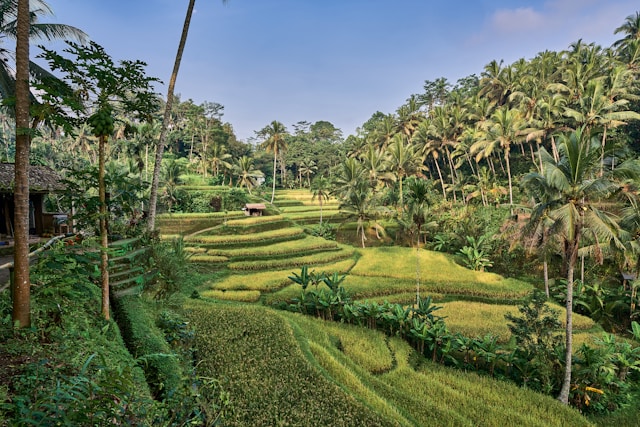
Ubud periphery – Tegallalang, Payangan, northern Sayan – continues to attract wellness-oriented capital. The challenge is zona hijau (green zone) classification on many of the most picturesque plots; a rice-field view often means a rice-field legal status, and building permits simply will not issue.
Due diligence: what actually goes wrong
The standard failures are not exotic. They are routine, and they are why the Bali land market separates careful buyers from expensive ones.
Zoning sits at the top of the list. Zona hijau land cannot host tourism accommodation, regardless of what a seller promises; the July 2025 Bingin enforcement action made the point visible. Zona kuning (residential) and tourism-zoned land are the safe categories, verified against the 2023 RTRW spatial plan. Then come access-road disputes, the plot with no registered easement to the main road, incomplete or split certificates, inherited land with multiple heirs who have not all signed off, Hak Tanggungan (mortgage liens) still registered against the title, and subak land where irrigation obligations transfer with the plot.
With roughly 75 to 80 per cent of foreign purchases structured as leaseholds, the quality of the listing source matters as much as the location. Platforms like BaliPlots that focus specifically on vetted land parcels, rather than mixed villa-and-land marketplaces, have become a starting point for buyers who want to see certificate status and zoning upfront, before engaging a notary. The counterpoint worth naming: no platform is a substitute for an independent PPAT (Pejabat Pembuat Akta Tanah) running a fresh certificate check at BPN on the day of signing. Pre-vetted listings narrow the field; they do not replace due diligence.
Outlook
The direction of travel is toward enforcement, not liberalisation. Dharma Dewata is a visible signal; the March 2026 OSS deadline is a structural one. Discussion of extending the moratorium to South Bali, floated by Golkar on 14 April, may or may not pass, but the regulatory tone is set. Meanwhile, the North Bali airport and ongoing toll road construction are likely to reshape where value emerges over the next five years.
Foreign ownership reform surfaces periodically in Jakarta policy circles, and the 2025 BKPM adjustments hint that the framework is not static. For now, buyers who do the paperwork properly, stay inside the legal structures, and avoid the shortcuts that the new task forces are explicitly looking for will keep finding Bali a workable market. Those who don’t, increasingly, won’t.