



Contributing writer Kartika Sari provides her opinion regarding why occupational safety must be part of Indonesia’s wildfire response.
When forest and land fires break out in Kalimantan, public attention usually turns to one thing: how much land has burned. Headlines focus on hotspots, smoke, and hectares lost. These numbers matter. But there is another side of the story that is too easily overlooked: the people standing closest to the flames.
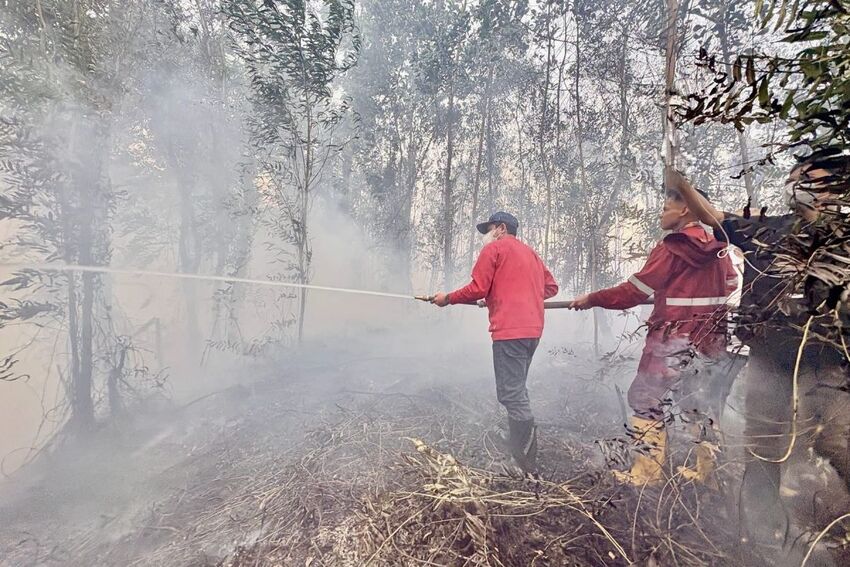
Behind every firefighting operation are responders and volunteers working in dangerous conditions. They face heat, smoke, exhaustion, unstable ground, changing winds, and equipment-related hazards. Yet their safety rarely receives the same attention as the fires themselves. In a country that experiences recurring forest and land fires, this is a serious blind spot.
Recent incidents in Kalimantan make this concern painfully real. On the 12th of September, 2026, two responders suffered burns while fighting a land fire near the former Temindung Airport in Samarinda, East Kalimantan. Local news reports described flames erupting around a water pump after refuelling and restarting. One of the injured men was attached to the city’s disaster management agency; the other was a community volunteer. The precise technical cause should be established through investigation, not assumed. However, the incident raises an urgent safety question: how are equipment and fuel-handling risks assessed before operations begin?
In Palangka Raya, Central Kalimantan, 20-year-old volunteer Maulana Adi Saputra suffered serious burns while helping protect homes from an advancing fire in August. According to his account reported by TIMES Indonesia, a sudden change in wind direction obstructed his escape route. He also described limited protective equipment and the burden of paying for treatment. His experience raises another question that should concern every community: when volunteers step forward to protect others, who protects them?
These risks accompany a large-scale emergency. East Kalimantan’s provincial government reported 2,162 forest and land fire incidents affecting approximately 8,713 hectares by the 13th of October, 2026. Central Kalimantan separately recorded 5,937 incidents and around 17,530 hectares burned by the 8th of October. Because the reporting periods and definitions differ, the figures should not be treated as a direct provincial comparison. They nevertheless show the scale of the work facing local response teams.
The most obvious danger is fire itself, though responders also contend with fine-particle pollution, toxic gases, dehydration, heat stress, mechanical hazards, and fatigue. The US National Institute for Occupational Safety and Health warns that even though properly fitted N95 respirators can reduce exposure to particles, they do not filter gases such as carbon monoxide. Masks matter, but a mask is not a complete safety strategy.
This is why Indonesia should treat wildfire response not only as an environmental emergency but also as an occupational safety challenge. This country already has a useful framework: the Occupational Safety and Health Management System, known locally as Sistem Manajemen Keselamatan dan Kesehatan Kerja (SMK3). Government Regulation No. 50 of 2012 outlines five interconnected elements: safety policy, risk-based planning, implementation, monitoring and evaluation, and continual improvement. The regulation’s formal requirements apply to qualifying enterprises, not automatically to every public responder or volunteer. Its management principles, however, offer practical lessons for emergency operations.
First, safety must be an explicit operational priority. Protecting responders should be part of the mission itself, not an afterthought. Second, each deployment should start with a risk assessment covering weather, wind direction, terrain, equipment condition, safe refuelling procedures, and emergency escape routes. Third, identified risks must be addressed through briefings, reliable communication, appropriate protective equipment, rest breaks, drinking water, and accessible emergency medical care. Fourth, authorities should record more than the number of fires extinguished. They should also examine injuries, near misses, pump failures, smoke-related complaints, and situations that forced teams to retreat. Fifth, each incident should lead to learning and corrective action. A safety system is meaningful only when it helps prevent the next injury, rather than merely responding after someone has been hurt.
Volunteers deserve particular attention. Their contribution is indispensable, especially when fires threaten homes and villages. Yet commitment and courage cannot replace training, suitable equipment, medical follow-up, or clarity about treatment costs and injury protection. East Kalimantan’s 2024 regulation on forest and land fire disaster management provides a policy setting in which stronger coordination and safety reporting could be developed across professional and volunteer teams.
This issue is also about environmental justice. We often talk about protecting forests, clean air, and communities from fire. Those goals must also include the people who risk their health to make that protection possible. A successful wildfire response should not be judged only by how many hectares were saved. It should also be judged by whether the people who fought the fires were protected.
Putting out a fire is a success. So is ensuring a responder returns home safely. Indonesia should be committed to both.

The writer of this opinion piece, Kartika Sari, is a Master of Public Health student at Mulawarman University in Samarinda, East Kalimantan. Her academic interests include occupational safety and health, environmental health, and public health policy. Any opinions expressed in this piece are those of the writer and do not necessarily reflect the views of Indonesia Expat.