



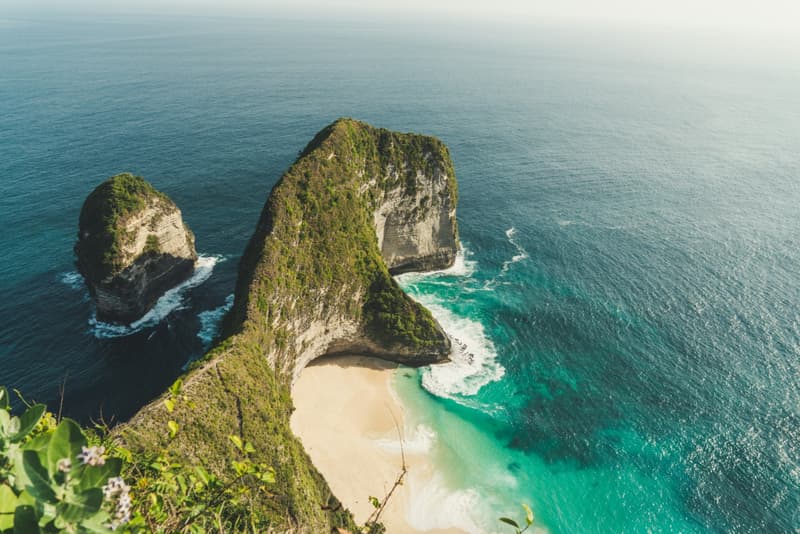
Nusa Penida produces some of the most striking coastal scenery in Indonesia — the dinosaur-spine cliff at Kelingking, the natural infinity pool at Angel’s Billabong, the sheer drop at Diamond Beach — and connects almost all of it with roads that have earned a reputation for eating suspension. That reputation is fading as the main routes are progressively resurfaced, but the island still rewards preparation over improvisation. The day-trip crowd, funnelled off the fast boats and into a convoy of viewpoints, rarely learns this. The visitors who stay longer and ride at their own pace end up on an island that feels almost unrelated to the one in the brochures.
The equipment matters more here than almost anywhere in Indonesia. A tired 110cc with soft brakes and bald tyres is not a bargain on gradients this steep; it is a liability waiting for the wrong moment. The harbour touts offering machines at half the going rate are offering exactly what the price implies, and the saving evaporates the first time the brakes fade on a descent. The condition of the bike, in other words, is not a detail to be haggled over but the single most important decision of the day.
Visitors who rent scooter nusa penida from operators that actually maintain their fleet — working brakes, real tread, a helmet with a functioning strap — spend the day looking at cliffs rather than at the road surface with mounting concern. On an island where the eastern gradients identify any weakness in a clutch within the first few hundred metres, a well-kept machine is what separates a memorable ride from a nervous one, and it costs remarkably little more than the roadside gamble.
The two loops
The western loop — Kelingking, Angel’s Billabong, Broken Beach, and Crystal Bay — runs roughly forty kilometres round trip from Toyapakeh and is now largely well-surfaced. Kelingking’s viewpoint is a short walk from the parking area, while the descent to the beach below is a near-vertical scramble on a bamboo handrail that should be treated as a serious hike rather than a quick photo stop.
The eastern side — Diamond Beach, Atuh, and the Thousand Islands viewpoint — is rougher, emptier, and, for many riders, better. Mobile signal becomes decorative out here, so an offline map downloaded before leaving the harbour is basic competence rather than paranoia, and the final approaches involve gradients that reward a confident hand on the throttle.
Rules of the road
Fuel early, as stations are sparse and the roadside bottles vary in quality. Ride in the morning, because afternoon rain and steep concrete ramps combine badly. A motorcycle-endorsed licence, or an International Driving Permit covering category A, is required; enforcement is lighter here than on Bali, but the insurance consequences of riding unlicensed are far worse than any fine. Two nights on the island and independent transport turn a rushed, convoy-bound day trip into a genuinely different and far more rewarding experience.