

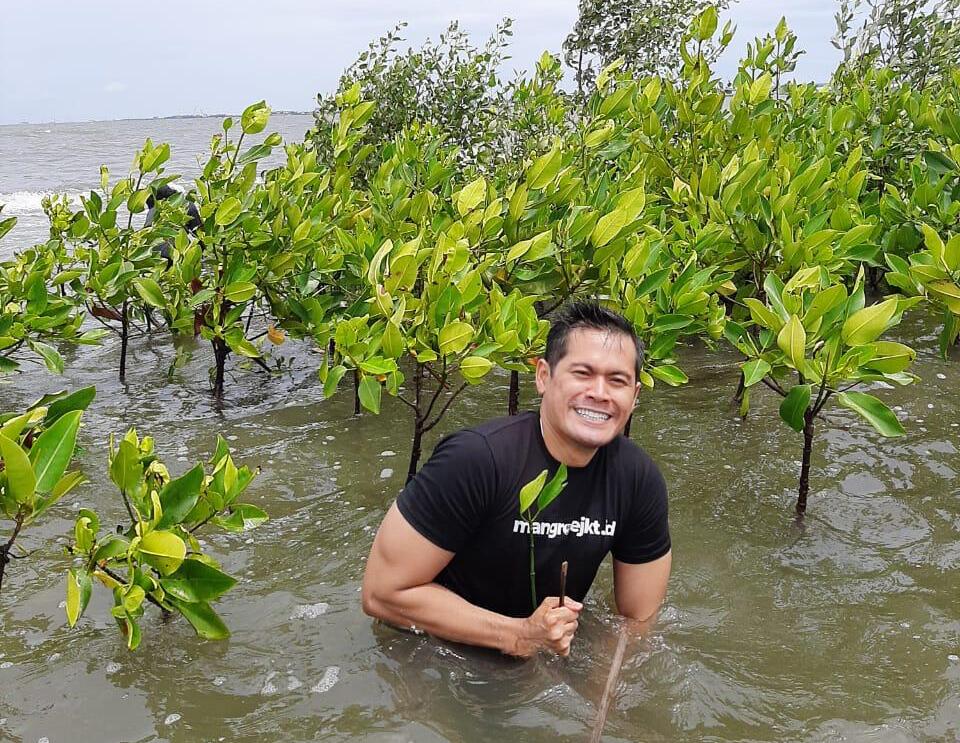
Indonesia Expat has recently established a partnership with Mangrove Jakarta Impact, a Jakarta-based foundation focusing on mangrove planting and coastal ecosystem restoration.
Mangroves around the world are fortunately beginning to show signs of improvement. According to research titled “Unexpected expansion and regrowth in Earth’s mangrove forests over the past four decades” by Zhang et al., which was published in June 2026, global mangrove extent has shifted from net loss to net gain since around the year 2010. This global turnaround provides a source of hope, though it does not signify the full recovery of mangrove ecosystems. There is still more work to be done, and Indonesia will undoubtedly serve as a key player in the regrowth of the world’s mangrove forests. According to the 2025 National Mangrove Map, Indonesia has 3.45 million hectares of mangroves, or around 23% of the world’s total mangrove coverage.
Given those figures, Indonesia Expat felt compelled to spread awareness of the significance of mangrove restoration, particularly among the nation’s expat population. Paundra Hanutama, the founder of Mangrove Jakarta Impact, is kind enough to assist in realising our cause by explaining what mangrove restoration entails, why it is more crucial than ever, why Indonesia’s expatriate community should support the mangrove restoration movement, and much more. In addition to his impressive work as the founder of Mangrove Jakarta Impact, Paundra holds a Master of Science in Sustainable Finance degree from Schiller International University Paris, France.
Hi, Paundra. For the general public, could you explain what is meant by ‘mangrove restoration’?
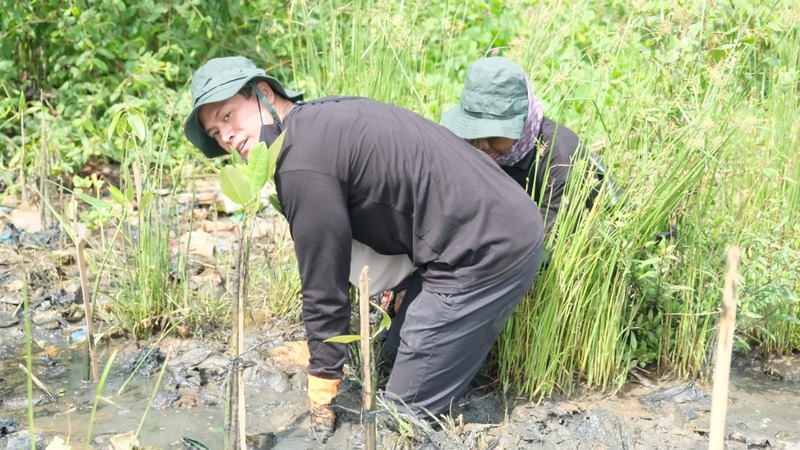
In my view, mangrove restoration is simple: it is not just about planting mangrove trees, but about restoring the mangrove ecosystem so that it can once again live and function naturally. Many people think that once we have planted 1,000 or 5,000 mangroves, the restoration is complete. However, that is not necessarily the case. We must ensure that the site is truly suitable for mangroves, consider water and tidal conditions, check for debris or other disturbances, and—most importantly—verify whether the planted mangroves can survive and grow.
So, for me, mangrove restoration begins with understanding nature, improving ecosystem conditions, and then helping the mangroves regrow. Even after planting, monitoring and maintenance are essential. If any plants die, we must evaluate the cause rather than simply replacing them without understanding the underlying issue. And one thing we often overlook is the local community. Mangrove restoration must involve the surrounding community because they are part of the ecosystem. When the community derives benefits and develops a sense of ownership, the project’s sustainability is significantly strengthened.
So if I had to explain in one sentence: mangrove restoration is not about how many trees we plant, but about how we restore the ecosystem, involve the community, and ensure that nature can function again for current and future generations.
Why is mangrove restoration increasingly necessary today—especially given the reality of recent pollution, which has become increasingly complex and difficult to anticipate?
In my opinion, mangrove restoration is increasingly needed because the pressure on coasts is increasing due to rubbish, pollution, climate change, and habitat destruction. Mangroves are not just trees on the edge of the sea, but natural ecosystems that help protect the coast and provide a home for a variety of life. Therefore, mangrove restoration must be carried out not just by planting, but by restoring ecosystem function and involving the community.
We are not only planting mangroves today, but we are safeguarding coastal protection and life for future generations.
Could you summarise the activities of Mangrove Jakarta Impact so far in 2026? Are there any specific activities or initiatives that stand out as key milestones in the journey of Mangrove Jakarta Impact?
If I look at Mangrove Jakarta Impact’s journey in 2026, we’ve been trying to expand our approach from just planting mangroves to a more comprehensive conservation movement. We carry out various activities with companies, communities, academics, and the younger generation, ranging from mangrove planting, environmental education, and beach cleanups to coastal ecosystem restoration. One important part is our consistency in providing education, including the National Webinar “Mangrove SOS!” which was attended by around 100 participants from various regions in Indonesia.
One of our key milestones this year is the increasing number of long-term collaborations with the business world. For example, the collaboration with Ascott Indonesia is entering its fourth year, with the planting of 2,000 mangroves on Tidung Kecil Island, as well as the fourth collaboration with Digital Edge Indonesia, which combines planting 5,000 mangroves, restoration of 500 coral reefs, releasing fish, and a beach cleanup that collects around 300 kilograms of rubbish.
That makes a good segue to my next question: who are the high-profile partners of Mangrove Jakarta Impact that have participated in realising the foundation’s vision and mission thus far?
To date, we are grateful that Mangrove Jakarta Impact has been entrusted to collaborate with a wide range of stakeholders—from national and multinational corporations, educational institutions, and government bodies to local communities. These include Ascott Indonesia, Indonet and Digital Edge Indonesia, Sysmex Indonesia, Medtronic Indonesia, Telkominfra, Midea, G4S Indonesia, and various other partners. We also receive support for our international programmes from Schiller International University Paris, as well as from various government institutions and the academic community.
We believe that the environment cannot be saved by a single organisation acting alone. Our true strength lies in our ability to bring together corporations, government bodies, academia, communities, and the general public to take collective action.
Mangrove Jakarta Impact has just established a Corporate Social Responsibility (CSR) partnership with the media outlet Indonesia Expat. Could you explain the motivation behind this partnership?
We are interested in collaborating with Indonesia Expat because we share a common vision of disseminating information and raising awareness about social and environmental issues in Indonesia. For Mangrove Jakarta Impact, conservation efforts cannot be limited to fieldwork alone; messages and education regarding the environment must also reach the wider public.
Indonesia Expat boasts a diverse audience, including the international community living and active in Indonesia. We view this as an opportunity to bring issues such as mangroves, climate change, waste management, and sustainability to a broader audience, while simultaneously fostering collaboration among communities, the business sector, the media, and the international community.
For us, this collaboration is not merely about publication; it is about how the media can serve as a bridge to transform awareness into action. We hope that more people will come to understand the importance of mangrove ecosystems and, ultimately, participate in protecting Indonesia’s environment.
In your opinion, why should the expatriate community in Indonesia participate in the mangrove restoration movement?
In my view, the expatriate community is also part of Indonesian society. They live, work, and go about their daily lives here, meaning they have the opportunity to contribute positively to the local environment. Mangroves are not merely a local issue; they are part of global concerns such as climate change, biodiversity, and coastal protection.
The involvement of the expatriate community, therefore, can serve as a highly positive bridge. They can participate in direct actions—such as mangrove planting and monitoring—while also bringing experience, networks, and awareness from the international community. To me, protecting mangroves transcends nationality, because when we safeguard Indonesia’s environment, we also safeguard our shared future.
If you are a corporation that is interested in joining Indonesia Expat and Mangrove Jakarta Impact in our CSR partnership, feel free to send your request or inquiry to the following email address: dian@indonesiaexpat.biz