



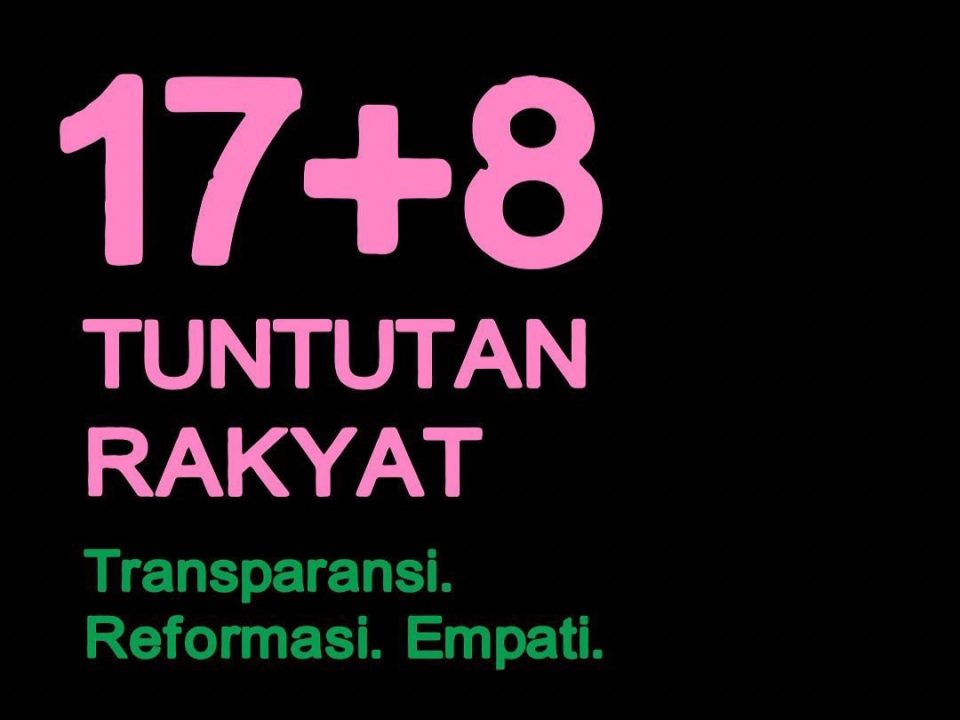
The wave of public aspirations has continued to grow following the student and civil society demonstrations that began on the 28th of August. One of the most recent aspirations to go viral on social media is ‘17+8 Tuntutan Rakyat’ (17+8 People’s Demands).
These aspirations were first introduced during a peaceful demonstration in Jakarta on Monday, 1st of September, when content creators Jovial and Andovi da Lopez unfurled a poster titled “17+8 Tuntutan Rakyat: Transparansi, Reformasi, dan Empati” (17+8 People’s Demands: Transparency, Reform, and Empathy). The poster outlined 17 demands for the DPR and the government to address within one week, and eight demands to be fulfilled within one year.
From the list, 17 urgent demands were given a deadline of the 5th of September 2025, while eight reform agendas were targeted for completion by 2026. These demands were divided into several segments, each directed at state institutions and agencies: the President of the Republic of Indonesia, the House of Representatives (DPR), the Chairpersons of Political Parties, the National Police (Polri), the Indonesian National Armed Forces (TNI), and the Ministry of Economic Affairs.
For the President:
- Form an independent investigative team regarding the cases of Affan Kurniawan, Umar Amarudin, and other victims of violence during the 28th–30th of August demonstrations.
- End the involvement of the Indonesian National Armed Forces (TNI) in civilian security and return them to their barracks.
For the House of Representatives (DPR):
- Release all detained demonstrators without criminalisation.
- Arrest and prosecute officers who commit violence transparently.
- End police violence and adhere to crowd control standard operating procedures (SOPs).
For Political Party Chairpersons:
- Freeze DPR salary/allowance increases and cancel new facilities.
- Proactively publish DPR budget transparency.
- Investigate problematic DPR members’ assets through the Corruption Eradication Commission (KPK).
For the National Police (Polri):
- Encourage the House of Representatives’ Ethics Council to investigate members who insult the people’s aspirations.
- Firmly impose party sanctions on cadres who incite public anger.
- The party’s commitment to siding with the people amidst the crisis.
For the Indonesian National Armed Forces (TNI):
- Involve members of the House of Representatives in public dialogue with students and civil society.
- Enforce internal discipline so that the TNI does not take over the functions of the National Police.
- The TNI’s public commitment not to intrude into civilian space during the democratic crisis.
For the Ministry of Economic Affairs:
- Ensure a living wage for teachers, healthcare workers, labourers, and online motorcycle taxi drivers.
- Take emergency measures to prevent mass layoffs and protect contract workers.
- Open dialogue with labour unions regarding minimum wages and outsourcing.
Meanwhile, the remaining eight systemic reform agendas are:
- Cleansing and implementing major reforms in the House of Representatives.
- Reforming political parties and strengthening executive oversight.
- Planning for fairer tax reforms.
- Passing the law on the confiscation of corruptors’ assets, strengthening the independence of the Corruption Eradication Commission (KPK), and enforcing the Anti-Corruption Law.
- Reforming the police to be more professional and humane.
- The Indonesian National Armed Forces (TNI) will return fully to their barracks, without exception.
- Strengthening the National Human Rights Commission (Komnas HAM) and independent oversight bodies.
- Reviewing policies in the economic and employment sectors.