




Long-term villa search in Bali is still fragmented across agents, chats, duplicate listings, and different prices. RUDI pulls fragmented rental information into one structured system.
Booking a place for three nights in Bali takes about five minutes. Finding a villa for three months can mean weeks of messages, dozens of screenshots, and conversations with five different agents offering the same property at different prices.
In the end, the decision is often made based on limited information, after repeated manual comparisons.
This gap is not accidental. Short-term rentals have long had convenient platforms: ratings, reviews, standardized photos, and clear cancellation policies. Airbnb and Booking.com solve the “rent for a week” problem well. But renting for a month or longer is a different market.
Properties are scattered across Facebook groups, Telegram channels, WhatsApp chats, and agent networks. The same villa may appear in several places, sometimes at different prices. Comparing options becomes difficult very quickly. What is the real price compared to the market? What is actually included? Why is the villa next door cheaper? Is the property genuinely a strong option, or simply well presented?
Not every agent has a full view of the market. For renters, collecting and comparing all this data manually is even more difficult.
RUDI was created to close this gap: to pull fragmented rental data into one structured system and help renters formulate their request faster, find relevant options, compare them, and understand how well a property’s price and characteristics match the market.
Here is how it works.
AI Assistant: search that starts with a question, not filters
Long-term villa search rarely starts with a simple checklist. People aren’t just looking for “two bedrooms in Canggu” or “a villa under a certain budget.” They’re trying to understand where they can actually live well.
A family with small children may need a calm ocean, a washing machine, nearby cafés, and an area that’s easy to live in day to day. A remote worker may care more about commute patterns, work-friendly layouts, and access to certain neighbourhoods. Someone coming for several months may want privacy, views, and a quieter pace.
Traditional filters can help, but they often miss this context.
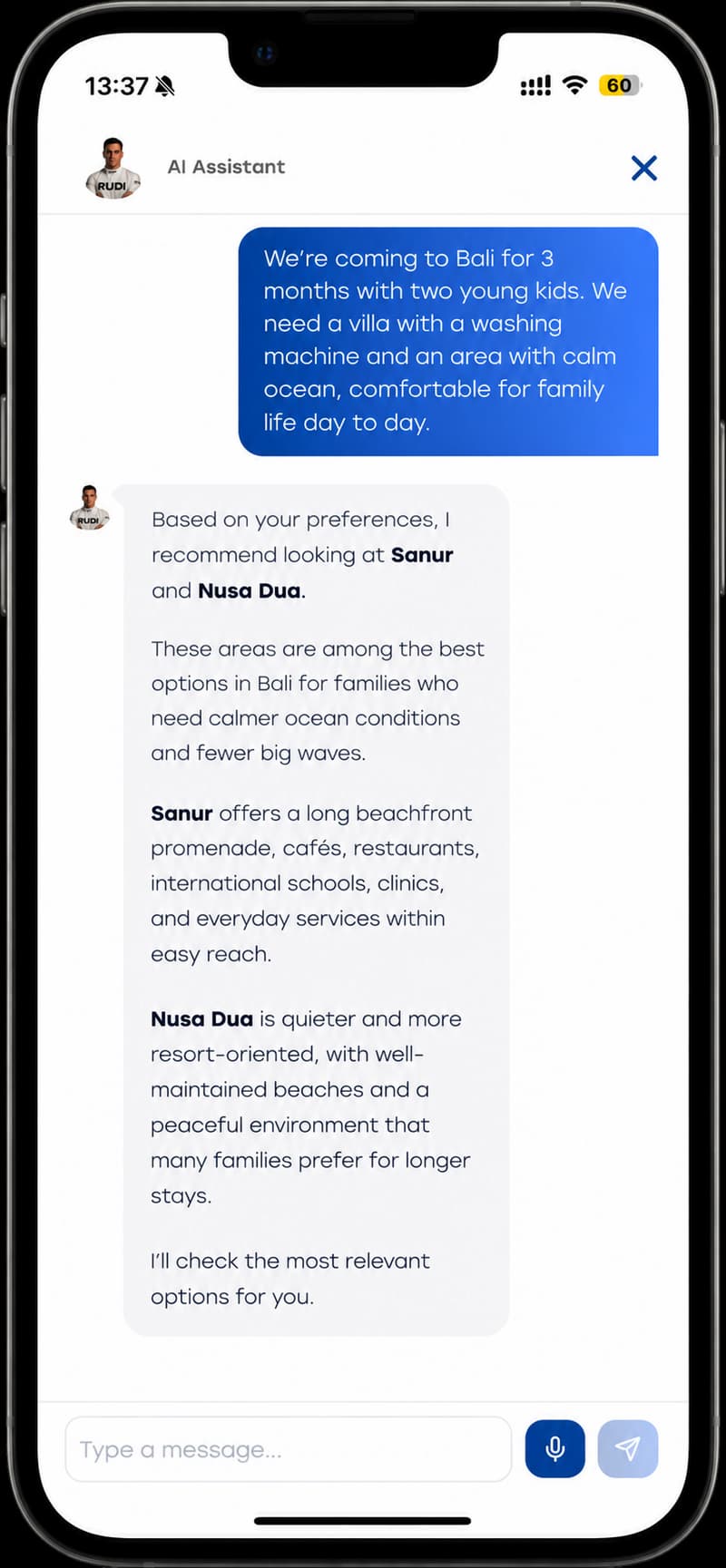
Here is a real example. A family writes to the assistant: “We are coming for three months with two small children. We need a villa with a washing machine and an area with a calm ocean, developed infrastructure, and cafés nearby.” The request can be entered by text or voice. AI Assistant works in multiple languages.
First, the assistant explains the logic behind the search: for a calm ocean with children, Sanur and Nusa Dua are usually the best fit, and it describes how the two areas differ. Then it checks the availability of washing machines and reports that no suitable options were found in those areas.
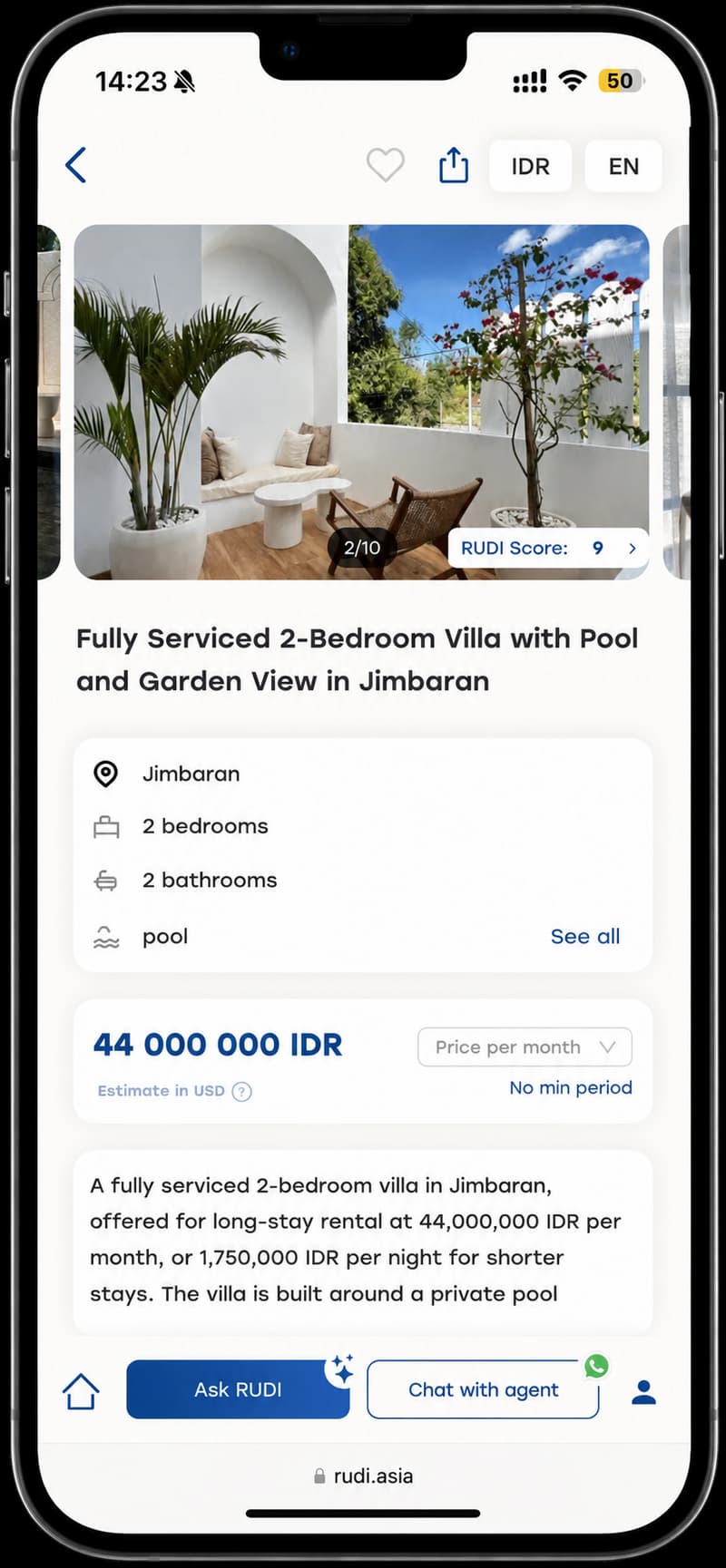
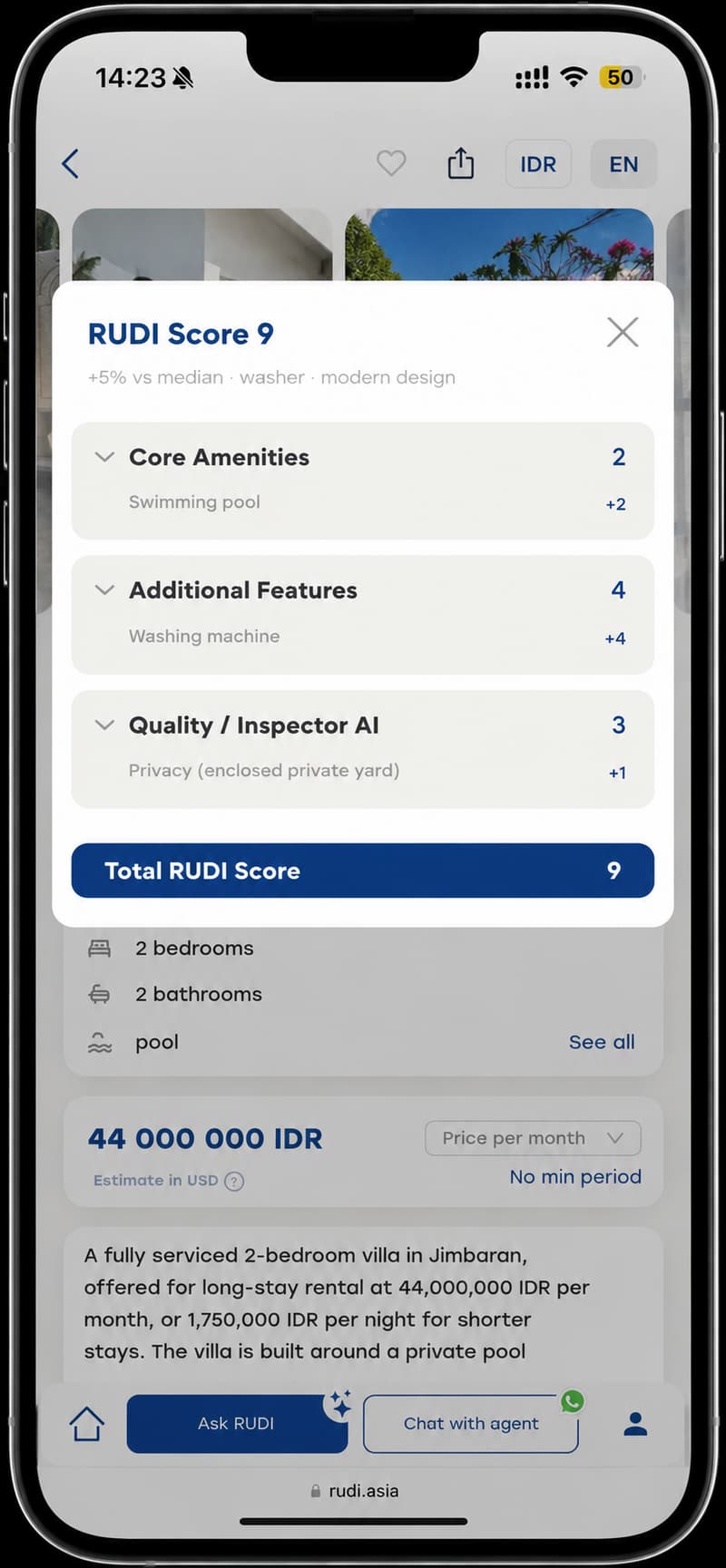
After that, it suggests a villa in Jimbaran, where the ocean is also calm and the area can work well for family life, although the infrastructure is less developed than in Sanur.
As a result, AI Assistant provides one specific villa with its RUDI Score and all key parameters. This is the individual Best Offer: not just a filter based on selected criteria, but a recommendation with an explanation of the trade-offs.
If the suggested option doesn’t work, the user can change the conditions directly in the chat, narrow or expand the search, and ask the assistant to find other options. The catalogue then shows the remaining suitable properties, ranked by RUDI Score from highest to lowest.
RUDI Score: a rating that cannot be bought
Each property card displays the RUDI Score — an AI-based evaluation that does not depend on paid promotion, an agent’s recommendation, or sponsored placement.
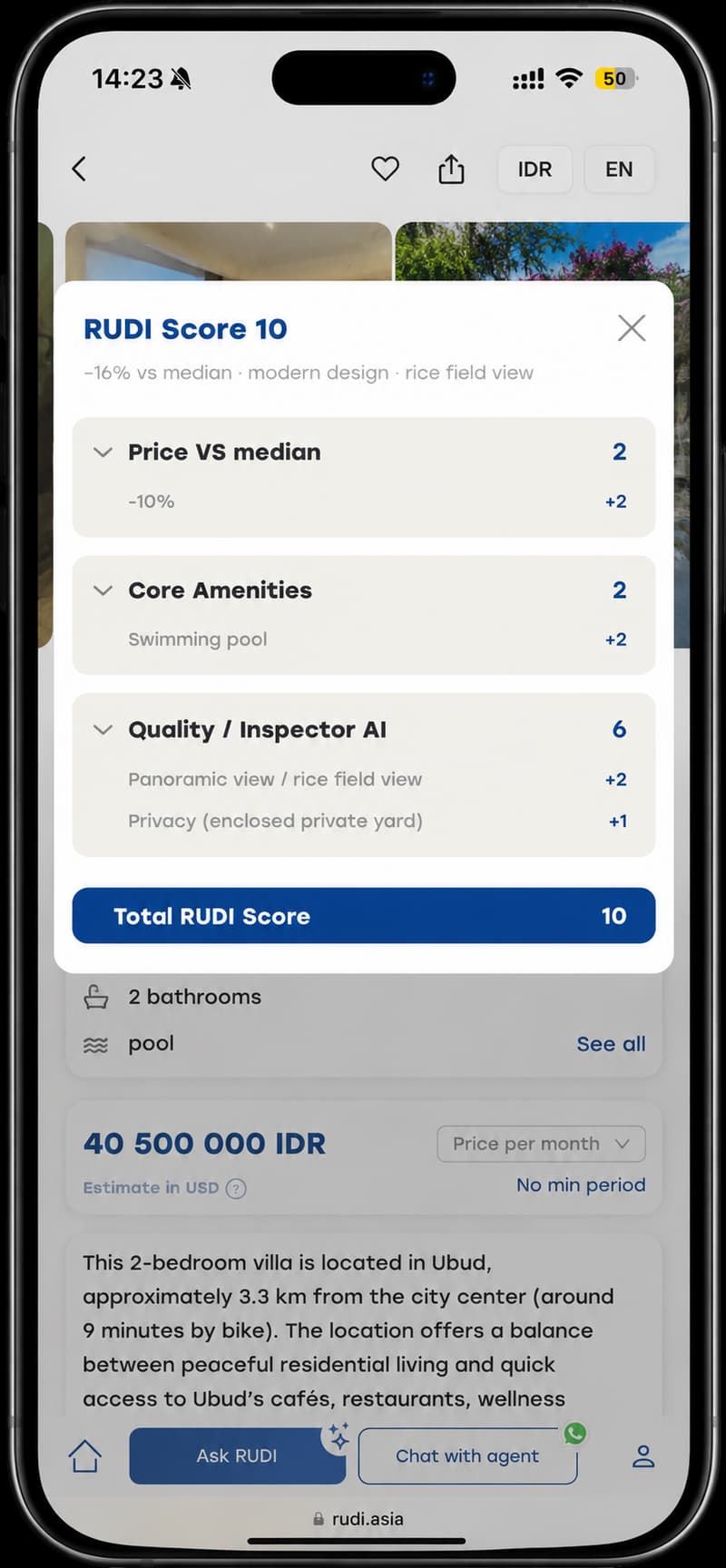
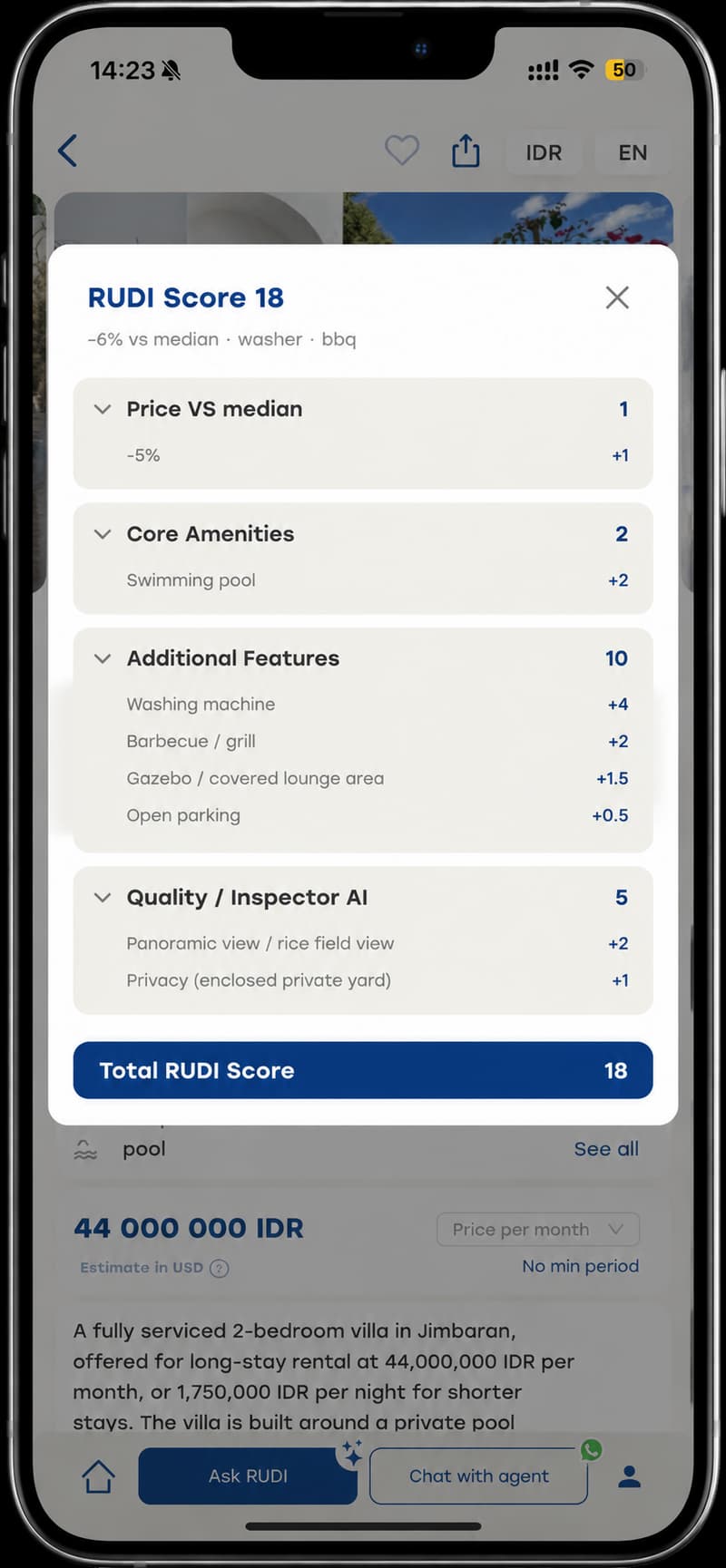
Users can open the scorecard and see a detailed breakdown: what formed the final rating and why one property ranked higher than another.
RUDI Score is based on four blocks.
Price compared to the market. RUDI compares the villa’s price with similar properties in its group: area, number of bedrooms, property type, and price segment. If the price is below the median, the score goes up. If it is above the market, the score goes down. If there are too few comparable properties in the group, the price block is counted as neutral, so that rare listings in smaller areas are not unfairly penalized.
Basic amenities. This is the essential minimum for long-term rental: a swimming pool, air conditioning, a TV, and other basic features. If the standard is met, the property receives the full score. Missing key items lower the score.
Additional amenities. A washing machine, barbecue area, gazebo, parking, workspace, rooftop, and other confirmed features all count toward the score. Each item is visible in the open scorecard.
Visual Analysis / AI Inspector. RUDI’s AI Inspector reviews each photo and video against a defined checklist and identifies visual signals about the property’s condition. Fresh renovation, modern furniture, and well-maintained interiors can improve the score. Signs of wear, outdated interiors, or visible defects can lower it. If the visual materials are not clear enough to support a conclusion, this block stays neutral.
To show how this works, here are two real examples from Ubud.
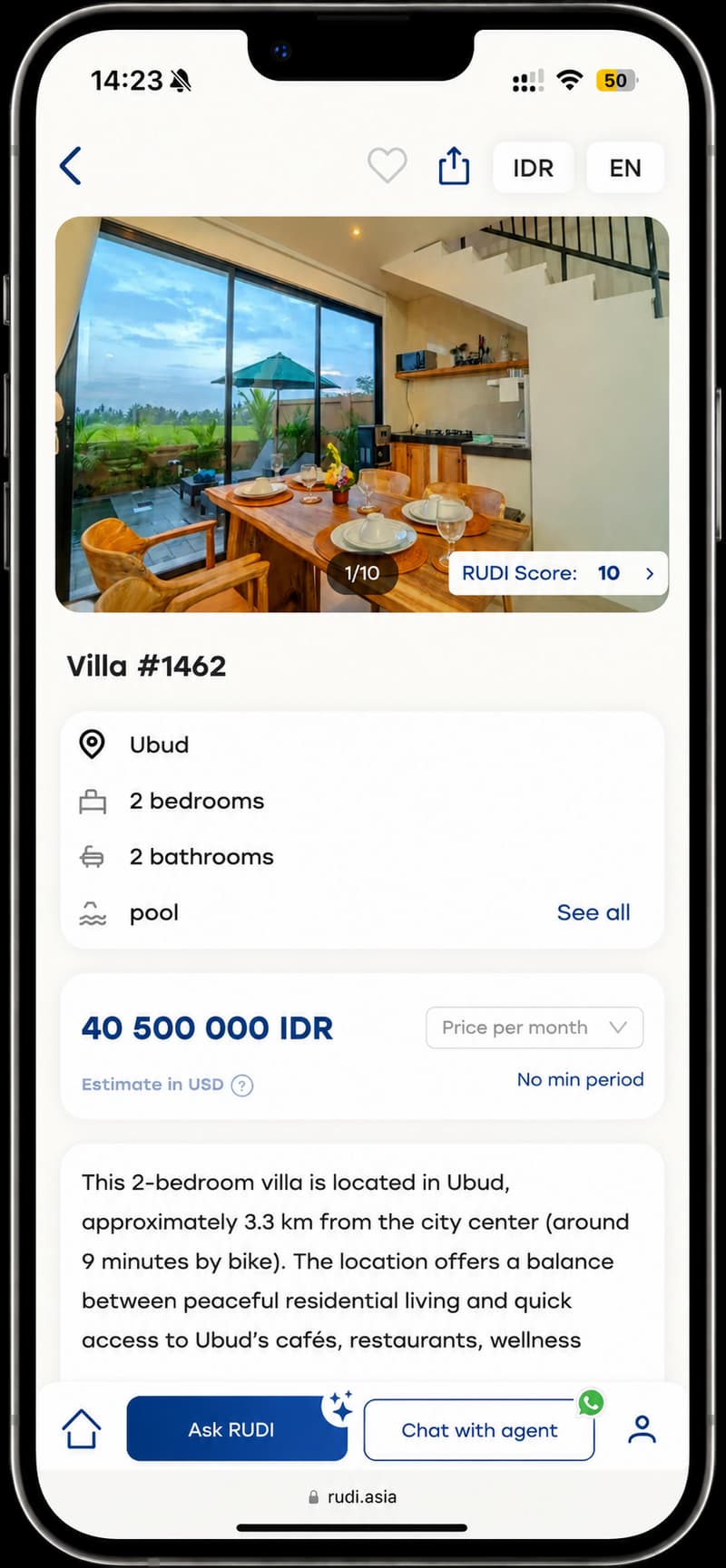
The first villa has two bedrooms and costs IDR 40.5 million per month, or around USD 2,500. Its price is below the median, and it offers a swimming pool, rice field views, and privacy. But it has almost no additional amenities.
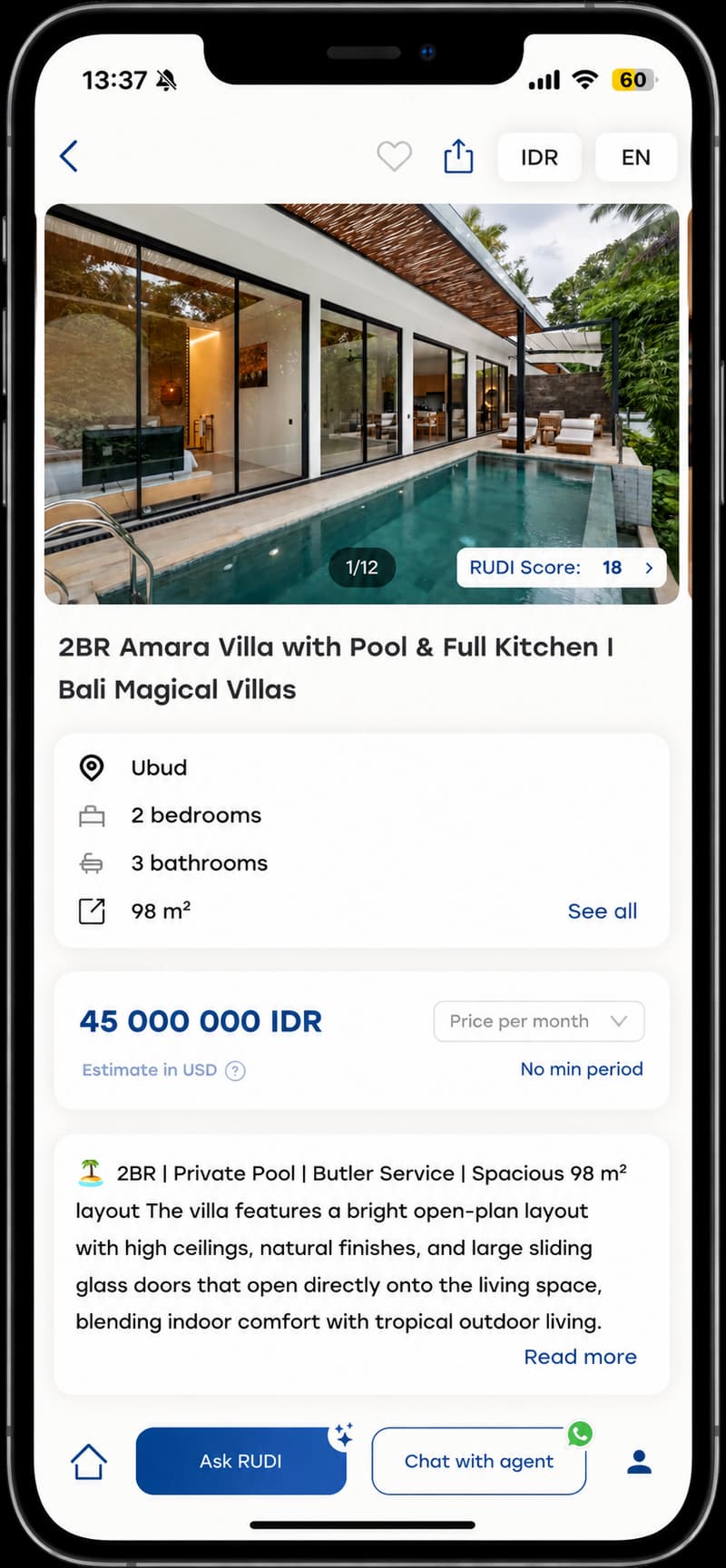
The second villa also has two bedrooms and costs IDR 45 million per month, or around USD 2,800. The price difference is about USD 300 per month, but it offers more amenities: a washing machine, barbecue area, gazebo, parking, and a more modern, better-maintained appearance.
This is exactly where RUDI Score becomes useful. A cheaper villa is not always the better option for long-term living, and a more expensive one is not always overpriced. Sometimes the opposite is true.
RUDI Score helps users see the facts behind the listing: the price compared to the market, confirmed features, condition signals, and how the option compares with similar villas.
RUDI does not allow listings to be commercially promoted or artificially pushed up in the ranking. The only way to improve a RUDI Score is to adjust the price in line with the market, add premium features, renovate or upgrade the property, or upload photos and videos that confirm its amenities and condition.
Best Offer: finding the best offer based on your criteria
If you prefer the usual filter-based search, Best Offer is also available without starting a conversation with AI Assistant.
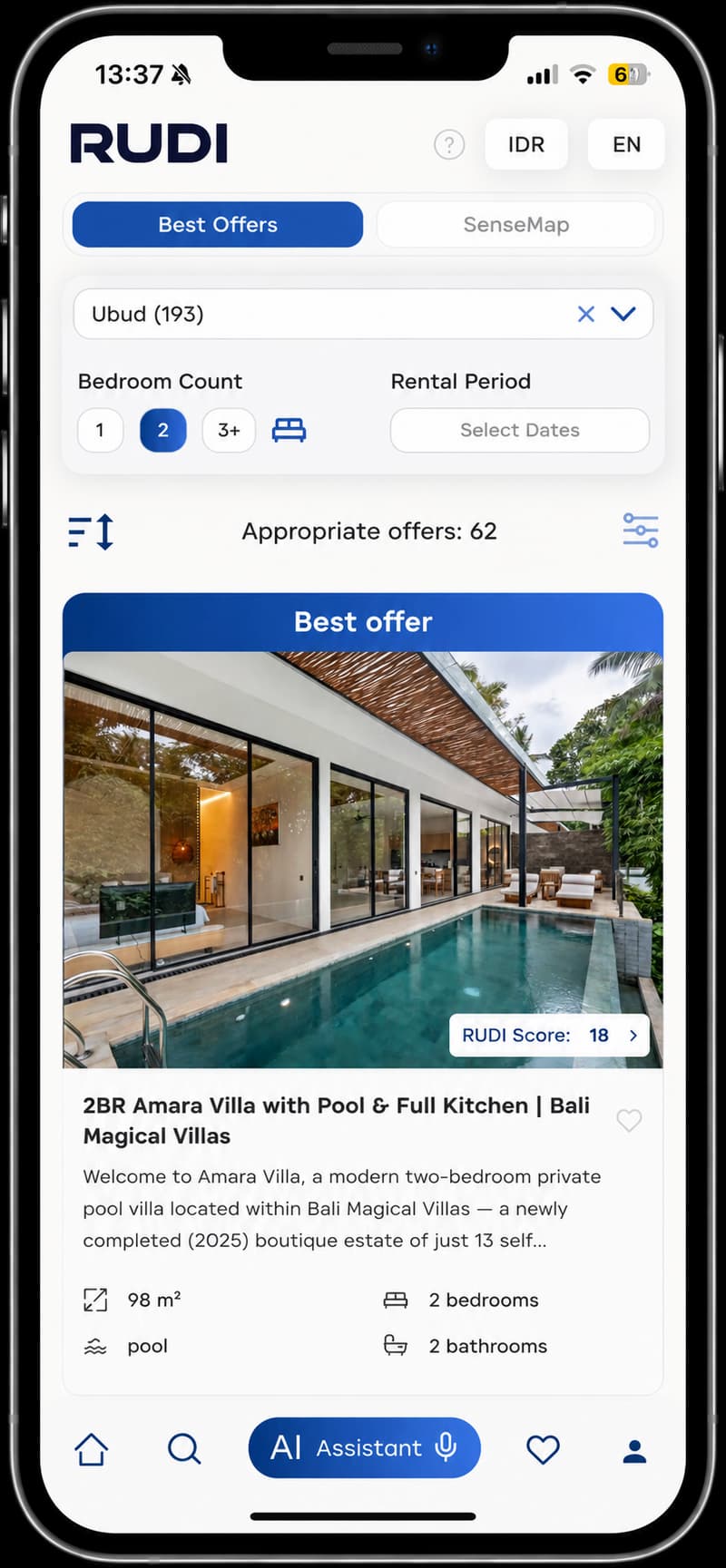
The user sets the key parameters: budget, number of bedrooms, and preferred locations. The system then compares all matching properties and, based on RUDI Score, identifies the best offer within the selected segment.
This is not necessarily the cheapest villa. Best Offer highlights the property with the strongest combination of price, characteristics, amenities, condition signals, and overall value among the options that match the user’s criteria.
For long-term rental, this distinction matters. A villa is not just a place to sleep for a few nights. It becomes a home base. The decision affects daily routines, transport, work, family logistics, and how easy or difficult the first months on the island will feel.
SenseMap: understanding the area before choosing a villa
Before looking at specific properties, it’s worth figuring out which area actually fits your life. In Bali, choosing the right area can be as important as choosing the villa itself.
A beautiful property in the wrong location may not work for someone’s daily life. Someone new to Bali may not yet understand the practical difference between Canggu, Sanur, Uluwatu, Ubud, Jimbaran, or Seminyak. Each area has its own rhythm, price level, infrastructure, commute, and overall feel.
RUDI’s SenseMap is designed for this stage of the search.
It is a map of Bali with heatmap visualization showing price levels across different areas. But it is not simply an administrative map of the island. It is a behavioural map built on the experience of living in Bali, the island’s development history, and how people actually use different areas.
The average price level in each zone is visible immediately, before the user even starts looking at individual properties.
For renters, this helps answer an important first question: not “which villa is available?”, but “which area actually fits my life?”
Who stands behind the listings
Another important part of the long-term rental process is knowing who stands behind the listing.
RUDI works only with verified providers: agencies, agents, property management companies, villa complexes, owners, and developers of completed and occupied residential projects. These are partners who have the right to offer properties for rent and whose real activity in the market is checked before they are added to the platform.
Each provider goes through RUDI’s internal verification process: a personal introduction to the RUDI team, confirmation of the right to offer properties for rent, and verification of real market activity. For agencies and property management companies, the process also includes an office visit.
For renters, this adds another layer of structure to a market that can otherwise feel fragmented and informal.
Who RUDI is for
RUDI is designed for people coming to Bali for longer stays: families coming for several months, remote workers, people on sabbatical, expats looking for a new home, and those planning relocation.
The platform features properties across different categories — for different family setups, lifestyles, and personal preferences.
Bali now, Thailand next
Today, RUDI offers more than 1,800 properties from verified providers across Canggu, Seminyak, Uluwatu, Ubud, Jimbaran, Sanur, and other areas of Bali. Thailand is next.
“We did not want to build just another villa catalogue. After six years of living in Bali, I realized that the long-term rental market needs a new infrastructure, one where the chaos of listings, agents, and different prices turns into a transparent decision-making process. This is why we created RUDI: a platform where 85% of key processes are handled by artificial intelligence,” says Alexey Dorosh, CEO and co-founder of RUDI.
For anyone planning a longer stay in Bali, the challenge is no longer only finding a villa that is available. It is understanding which option is actually right for the way they want to live.