


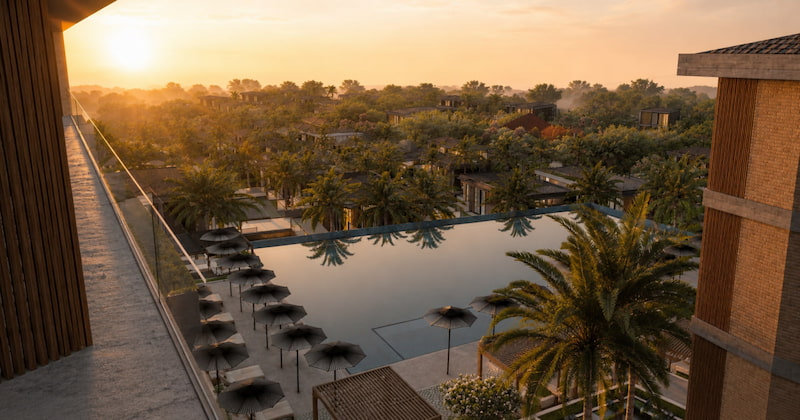
For many overseas buyers, Bali property still begins with a familiar image: a villa near the ocean, a pool framed by palms and sunset access within minutes. It remains powerful, and it still sells. But as Bali’s market matures, that image is no longer enough. The more useful question is whether projects such as EVERY Bali have the execution quality, legal structure and operating model to support value over time.
That shift is especially visible on the Bukit Peninsula, the limestone plateau at Bali’s southern edge. Once considered quieter and more remote than Seminyak, Canggu or Sanur, the Bukit is now one of the island’s most closely watched residential and hospitality zones. Its appeal extends beyond cliffs and surf beaches: destination dining, beach clubs, wellness venues and international schools are deepening the lifestyle offer, while younger buyers seek space without giving up nightlife.
Leasehold changes the question
Foreign buyers in Indonesia need to approach property with care. Hak Milik, Indonesia’s freehold title, cannot legally be held by foreign individuals. Leasehold, by contrast, allows an overseas buyer to secure the right to use a property for a defined period. The agreement and wider ownership structure should always be reviewed by qualified Indonesian legal advisers.
The value of a leasehold lies in the rights it provides. The duration of the lease, extension terms, transferability, zoning, permits, management quality and likely resale demand all matter. A lower entry price is not automatically better if the property lacks the necessary approvals, is poorly managed or is located in a market with limited long-term appeal.
Conversely, a premium leasehold property can make sense if the legal structure is clear, the usable term is long enough, the management is credible and the location benefits from improving infrastructure. In Bali, where villa performance can vary dramatically from one lane to the next, what sits behind the property can be as important as what is in front of it.
EVERY Bali offers an initial 40-year lease with a guaranteed mechanism for a further 20-year extension. This gives buyers a horizon of up to 60 years in which to use the property, generate rental income and plan a future sale. For an expatriate buyer, those clearly defined rights may be more relevant than the idea of perpetual ownership itself.
From coastal escape to serious submarket
The Bukit’s rise reflects a broader evolution in Bali. The island’s established lifestyle corridors have become more crowded, more expensive and more competitive. Buyers who once defaulted to central coastal districts are increasingly looking for privacy, space and a stronger sense of destination. The Bukit answers that demand in a way few other areas can.
Uluwatu and Bingin helped define the peninsula’s global image, but buyer interest has widened into Ungasan, Balangan and Nyang Nyang. This is not simply a search for cheaper land. It is the pattern of a destination becoming more sophisticated: the first wave creates the brand, while the next looks for better access, larger sites, privacy and integrated amenities.
The investment backdrop reinforces that shift. Bali’s role as host of the 2022 G20 Summit placed the island at the centre of international attention. According to Antara, the summit generated about US$8 billion in investment commitments for Indonesia as a whole, while Bali received more than Rp800 billion in infrastructure improvements, including work at Garuda Wisnu Kencana Cultural Park, the Bali Mandara Toll Road and several transport and public-space projects. These infrastructure upgrades in southern Bali strengthened the wider tourism and transport network supporting the peninsula’s growth.
The sea is only part of the story
Beachfront and cliff-front homes will always carry emotional power in Bali. Yet the best investment case is not always the closest address to the water. In mature resort markets, durable assets often combine access to the destination’s attractions with privacy, space for amenities and a stronger operating concept.
On the Bukit, that distinction matters. An inland property can still be within easy reach of Melasti, Pandawa, Balangan, Padang Padang and Uluwatu, while avoiding some of the constraints of limited coastal land. For owner-users and investors alike, the question is whether the site is close enough to the sea to capture demand, but far enough from it to offer privacy, scale and operational flexibility.
How EVERY Bali fits into Bukit’s next phase
That balance is central to EVERY Bali’s proposition in Ungasan. Set across five hectares, the project is conceived as a complete residential and hospitality environment rather than a collection of individual villas and apartments. Its scale allows for privacy and landscaped grounds alongside the sports, recovery, social and family infrastructure needed to support everyday life. The coast remains within easy reach, while much of daily life can take place within the development’s own grounds.
Hotel-style services and Colliers-managed rental operations underpin the residential concept. A 25-metre sports pool, a 1.5-kilometre running track and fitness facilities sit alongside recovery, coworking, dining and family spaces. Rather than standalone amenities, they form a connected environment in which residents can move naturally between exercise, work, rest and social activity.
Community is another part of the proposition. Private events, training sessions and collaborations with figures from international sport and business are intended to bring together residents and guests with shared interests.
Vsevolod Karabaev, Executive Director of EVERY Bali, describes the aim as balancing personal appeal with professional operation. A residence should feel compelling as a place to live, while also functioning as a well-managed property when its owner is away. That combination reflects the needs of a growing number of international buyers who expect a Bali home to support both their lifestyle and their longer-term plans.
Infrastructure will decide winners
The peninsula’s potential is clear, and current investment interest is being driven by infrastructure and tourism development as much as by views or lifestyle demand. Traffic and access remain persistent concerns, especially on routes linking Jimbaran, Uluwatu, Ungasan and the airport. Proposed road improvements matter not because they guarantee appreciation, but because better connectivity can broaden a destination’s appeal to residents, guests and operators, while helping the Bukit absorb growth more sustainably.
At a regional level, Badung Regency is preparing a South Ring Road running for more than 10 kilometres from the Jimbaran area towards Uluwatu, together with a planned connection between Uluwatu and Melasti. According to Bali Post, these projects are intended to reduce congestion and improve connectivity between the peninsula’s growing residential and tourism areas.
That is why the Bukit should be read as a set of submarkets rather than a single address. Uluwatu has global recognition, Bingin has cliffside cachet, Balangan has surf appeal, and Ungasan offers space, relative value and access to everyday infrastructure as well as the beaches.
For EVERY Bali, the Ungasan location is therefore significant. It places the development within the wider Bukit story while offering a different proposition from the busiest beach pockets. Well-known beaches, Garuda Wisnu Kencana Cultural Park, schools and established residential communities are all within reach, while the site retains enough separation to support a more private resort-residential environment.
Buying with clearer eyes
The strongest story about the Bukit is not that it is simply “the next place” in Bali. The peninsula is forcing buyers to become more sophisticated. The best opportunities are not defined by one view, one low price or one promise of quick returns. They are defined by whether a property sits inside a credible long-term location story and whether its legal, operational and lifestyle fundamentals support that story.
For international buyers, that means moving beyond familiar assumptions. Freehold is not available to them as individuals in Indonesia, just as the property closest to the water is not always the strongest long-term choice. A clearly documented lease can provide the time and flexibility an owner needs, while a site set back from the coast may offer greater privacy, more extensive facilities and a stronger environment for everyday life. Buying with clearer eyes means judging the complete proposition rather than the most familiar label attached to it.