


There’s a lot to be thinking about these days, what with civil unrest, external interventions, international military conflicts, economic upheaval, and the rise of the machines.
But if you’re an expat living in Indonesia, it’s also worth keeping one eye on what’s happening here.
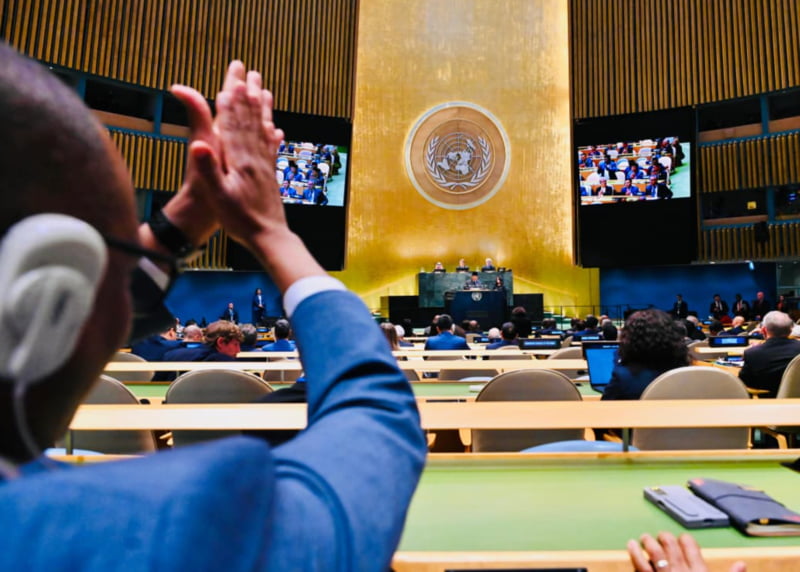
On the 23rd of September, 2025, Indonesia’s President Prabowo Subianto addressed the 80th United Nations (UN) General Assembly, earning a standing ovation for a speech underscoring the UN’s founding principles, as well as for urging global unity amid conflicts in Ukraine, Gaza, and the Middle East, natural disasters, and growing economic divides.
Subianto also touted domestic achievements and reaffirmed support for Palestine, framing Indonesia as a voice for the Global South and underscoring Indonesia’s rising diplomatic clout. The applause, noted by outlets covering the event, marked a high-profile moment for Indonesia, recalling the 1955 Bandung Conference, where the first President of the Republic of Indonesia, Sukarno, rallied 29 Asian and African nations to launch the Non-Aligned Movement.
Cut to seven decades later, Subianto’s address at the UN General Assembly highlights Indonesia’s bid to shape global discourse as a bridge-builder, echoing the 1955 Bandung Conference’s vision, in an era increasingly seen as Asia’s century. This UN appearance also evoked a deeper familial legacy for Subianto, as his father, Sumitro Djojohadikusumo, led Indonesia’s delegation to the UN in 1948-1949 — a pivotal effort that mobilised international pressure against Dutch aggression, condemned violations of the Renville Agreement, and helped secure sovereignty through the Round Table Conference in December 1949.
This article examines how Indonesia’s ascent aligns with its 20-year development plan, the Rencana Pembangunan Jangka Panjang Nasional (RPJPN) 2025-2045, and assesses the opportunities and challenges of its non-aligned leadership.
Bandung’s Legacy and Subianto’s Pitch
The 1955 Bandung Conference was a defining moment for a newly independent Indonesia. Sukarno’s call for unity among newly decolonised nations laid the groundwork for non-alignment, advocating collective strength over superpower dominance. Leaders from countries representing half the world’s population attended the summit, shaping a multipolar vision that rejected Cold War allegiances in favour of a united Global South.
Subianto’s 2025 UN speech channels this spirit forward, blending pragmatism with idealism. His call for global cooperation mirrors Sukarno’s rejection of division, but it’s tailored to 2025’s complexities. The parallels do have limits, though. The 1955 Bandung Conference was a defiant stand by a newly formed nation, breaking the chains of hundreds of years of colonialisation. Today, Indonesia wields measurable clout: 280 million people, control of vital sea lanes, and the world’s largest nickel reserves.
Indonesia’s G20 role and ASEAN leadership, furthermore, have amplified its voice, and its non-alignment is still central, allowing Indonesia to engage China, the United States (US), and emerging economies without being ensnared in their rivalries. But it’s a risky strategy if not backed by action.
The 2045 Plan: Bold or Overreaching?
Indonesia’s global moment is underpinned by the RPJPN 2025-2045: a 20-year plan to transform the nation into a high-income economy by its 2045 independence centennial. The vision, rolled out under then-President Joko Widodo and now led by Subianto, seeks a ‘sovereign, progressive, and sustainable maritime nation,’ and targets a GDP per capita of US$25,000 by 2045, which is up from US$5,000 today, through five pillars: social transformation, economic growth, equitable development, governance, and stability.
In its first phase, the RPJMN 2025-2029, is aiming for 6-7% annual GDP growth, cutting poverty to 6-7% and unemployment to 4.5-5%. Key economic strategies focus on Indonesia’s strengths. Industrialisation, leveraging nickel and other minerals for EV supply chains, expanding the maritime economy, and investing in human capital to leverage a 70 million-strong youth workforce, with exports projected to grow 8% annually.
Tourism, targeting a US$50 billion in GDP contribution by 2045, fuels real estate in established markets such as Bali, as well as emerging destinations like Lake Toba, Labuan Bajo, and Sumba. Digital land registries and the Second Home Visa ease foreign investment, aligning with global demand for sustainable assets. The maritime focus, rooted in Indonesia’s archipelagic identity, prioritises fisheries and port upgrades, aiming to make coastal regions economic hubs.
The plan’s scale, however, invites a degree of scepticism. Indonesia’s growth hinges on execution, and history has shown mixed results. The new capital, Nusantara, absorbs billions but faces delays and investor hesitancy. Corruption scandals, like the most recent ones hitting state firms, erode trust. Meanwhile, anti-graft measures like e-governance remain unproven at scale. Environmental goals—net-zero by 2060 is the idea—clash with coal’s 60% share of energy production, and illegal fishing undermines maritime sustainability. Inequality also persists, with eastern provinces lagging far behind Java’s urban centres. Moreover, rising sea levels are endangering low-lying areas like Jakarta, prompting calls for a Rp1,280 trillion (with a ‘T’), 480-kilometre-long Giant Sea Wall along Java’s north coast.
Opportunities and Risks
RPJPN indeed offers solid prospects for investors. Real estate, particularly in areas earmarked for tourism development, benefits from streamlined regulations and growing demand. The plan’s focus on equitable growth opens opportunities in underserved regions, where infrastructure like rural electrification draws Small and Medium-sized Enterprise (SME) investment. Emphasising skills training and gender equity, the plan also aims to boost women’s SME participation, creating a dynamic labour market for businesses. Adopting a non-aligned stance also fosters economic stability. By balancing relations with China (via Belt and Road projects) and Western partners (through trade agreements), Indonesia mitigates risks from global trade wars.
But there are still risks.
Despite the optimism, Indonesia faces hurdles that could derail its 2045 vision. Implementation across a sprawling archipelago is complex. Corruption remains a persistent issue, undermining investor confidence. Bureaucratic red tape, despite reforms and transparency, as well as land disputes, frustrate investors. Politically, Subianto’s coalition faces pressure from alleged 2024 election issues, and there are fears of a return to a more military-controlled style of governance.
Geopolitically, balancing China’s Belt and Road projects with US partnerships is delicate, and vocal stances like Palestine support may strain ties with certain allies.
Non-Alignment in a Polarised World
Ultimately, Subianto’s UN speech and the RPJPN 2025-2045 reflect Indonesia’s ambition to lead as a non-aligned power and to position itself as a broker in conflicts, such as in Myanmar. The plan’s global outlook, strengthening South-South trade and UN SDG reporting, builds on the 1955 Bandung Conference’s legacy, but non-alignment today demands navigating a web of economic dependencies and regional rivalries. Indonesia’s ASEAN centrality helps, but its influence depends on delivering domestically and hinges on effective execution — curbing corruption, balancing growth with sustainability, and bridging regional disparities.
Subianto ended his UN speech on global unity with this message: “Let us work toward this noble purpose. Let us continue humanity’s journey of hope—a journey begun by our forefathers, a journey we must complete.”
For investors and observers, Indonesia’s trajectory offers a compelling case. The RPJPN’s clarity provides a roadmap for engagement, particularly in real estate, green energy, and tourism. But vigilance is still necessary: robust due diligence, local partnerships, and ESG compliance are non-negotiable.
As Asia’s century unfolds, Indonesia stands not just as a participant but as a pacesetter, its UN moment being a testament to a nation carving its own path.
If you’d like more insights and advice on developing your investment roadmap in Indonesia, reach out to us at Seven Stones Indonesia via hello@sevenstonesindonesia.com
Sources: Kementerian Perencanaan Pembangunan Nasional/Bappenas Republik Indonesia, ANTARA News, Kompas, the South China Morning Post, India Today, The Times of Israel, PrabowoSubianto.com, The President of the Republic of Indonesia’s website
Image courtesy of BPMI Setpres/Laily Rachev.