




Contributing writer Pramod Kanakath takes a closer look at the fascinating ways modern Indonesian teenagers—particularly those who are currently enrolled in international schools— adopt English as their second language.
In the noughties, there was a rise of expressions caught from English-language movies—phrases and words that characterised the last of Gen Z. Come the 2010s, social media took over, going one or two notches further than the Hollywood dialogues. While the more illustrious students benefited from the linguistic variety provided by books, the vast majority depended on audio-visual sources that muttered and loud-speakered a host of English-language neologisms.
With that in mind, as we have just whizzed past the first quarter of this century, where do Indonesian students—especially the teenagers—stand in terms of English-language proficiency, with a focus on speaking and writing?
Speaking and writing serve as the focus here for a simple reason: because those are the productive skills. While reading and listening may reveal what the students understand, speaking and writing reveal what they can actually do with the English language. A student may comprehend a Netflix series or a TikTok clip with ease, but it is only when they stand before an audience or put pen to paper that their linguistic competence is truly tested. Moreover, speaking and writing are the skills most visible to teachers, parents, and employers, making them useful indicators of how the English language has evolved among Indonesian teenagers.
Effective communication over traditional notions
To gauge these changes, I conducted a survey among teachers in Indonesian international schools. The findings subsequently painted a largely positive picture.
Most survey respondents believed that the students’ spoken English had improved significantly since the early 2000s. Teachers also reported that today’s students are more confident when speaking in class and possess a broader vocabulary than previous generations. The students’ English writing skills were similarly viewed as having improved, although perhaps not as dramatically as their English verbal proficiency. Overall, the survey suggested that English is no longer merely a school subject for many Indonesian students; it has become a language that they actively use, consume, and, in many cases, inhabit.
The improvements, furthermore, are evident. Two decades ago, classroom presentations delivered in English often sounded rehearsed, with Indonesian students relying heavily on memorised phrases. Today, many students are capable of delivering presentations with a degree of fluency and spontaneity that would have been less common in the past. On top of that, exposure to podcasts, YouTube channels, and streaming platforms has introduced students to a wider range of English-language vocabulary and expressions.
Academic essays also frequently display a richer lexical range. Words such as “perspective”, “narrative”, and “sustainable” now appear naturally in writing rather than being reserved for vocabulary lists and examination preparation. English has become less of a classroom artefact and more of a living language.
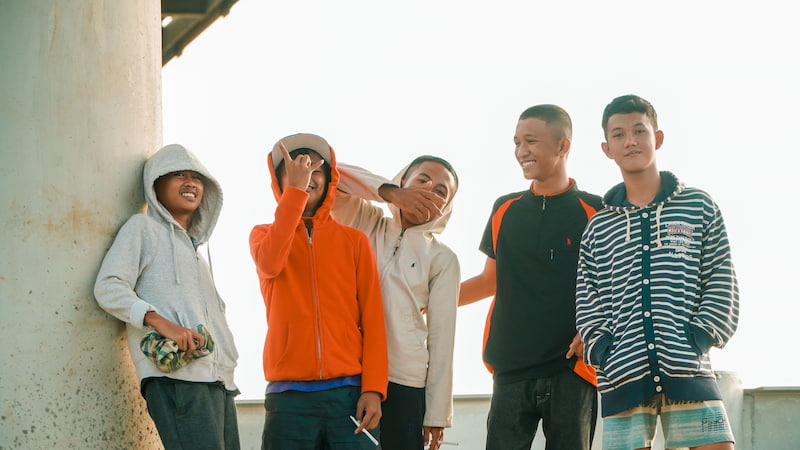
A similar improvement is being seen in casual conversations, though with accuracy a little undermined. Donna Margaret, a Jakarta-based teacher who also runs a tutorial centre, Little Wonders Learning Space, observed, “Teens these days are more confident but with less control over their grammar, vocabulary, and pronunciation. They’re more confident because of the high exposure to the language and speak merely to get their points across and not worrying so much on accuracy.”
My own experience validates this, and I believe, like Donna (who adds), that this is not necessarily poor communication. Instead, this often reflects a departure from traditional notions of standard English.
One afternoon, while walking past a group of students during recess, I overheard a conversation that might have baffled many English teachers from the early 2000s. One student said, “Bro, that presentation was low-key, but the ending was kinda cringe.” Another student replied, “Nah, you’re just being dramatic.” The exchange was neither entirely standard English nor entirely Indonesian, yet communication flowed effortlessly. Such exchanges are now commonplace in international schools, illustrating how social media has helped shape a more hybrid form of the English language—one that may sacrifice conventional notions of accuracy while remaining effective for communication.
The rise of code-switching and expletives
Code-switching between Indonesian (Bahasa Indonesia) and the English language has become equally commonplace. A conversation may begin in Bahasa Indonesia, acquire an English adjective, borrow an American slang term, and conclude with an Indonesian particle. Phrases such as “gue literally capek banget” or “that’s so nggak masuk akal” would puzzle language purists but seem perfectly natural to today’s teenagers.
The survey that I conducted revealed that teachers regard code-switching as highly prevalent, reflecting the hybrid linguistic identities that many Indonesian students possess. It would be tempting to regard this simply as evidence of declining accuracy. Instead, it is better understood as evidence of how the English language has become woven into the everyday linguistic repertoire of Indonesian teenagers.
A veteran teacher recently recalled a moment which would have been almost unthinkable 20 years ago. Having accidentally dropped a stack of books in class, the teacher heard a student mutter a four-letter expletive under his breath. What was perhaps more surprising was that none of the surrounding students appeared shocked; they simply carried on with their conversations. Such reactions illustrate how attitudes towards taboo language have shifted. In the early 2000s, English swear words were used in a hushed manner. Today, thanks largely to social media, gaming communities, and streaming platforms, students encounter such language daily.
Words that once shocked can now function as casual intensifiers, expressions of frustration, or even terms of camaraderie. Furthermore, even though profanity remains uncommon in formal classroom settings, teachers acknowledge that it has become a regular feature of student interactions outside the classroom.
The story of the English language among Indonesian teenagers is therefore one of both expansion and adaptation. Students today are generally more fluent in English and linguistically resourceful than their counterparts from the 2000s—while social media has blurred the boundaries between formal and informal language, English and Indonesian, and acceptable and taboo expressions. The more interesting question is not whether today’s teenagers speak better or worse English. Instead, it is whether we are still using the same yardstick to measure their English proficiency.
What is undeniable, though, is that English within the context and environment of Indonesian international schools is no longer simply the language of textbooks and examinations. It is the English of gaming platforms, social media feeds, and global youth culture—a variety evolving at a pace that would leave even the dictionary editors struggling to keep up.
All images are courtesy of N. Sopyan & Rendi iD.