



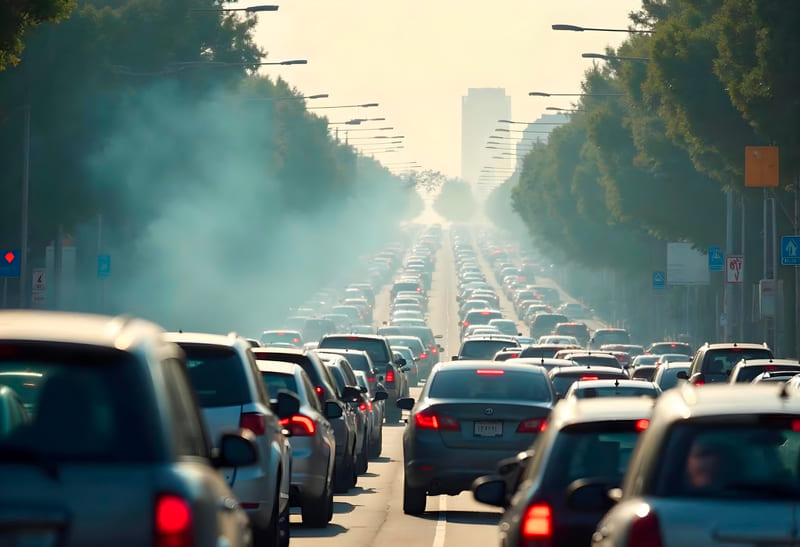
Air pollution has emerged as a silent, pervasive threat to public health and sustainable development worldwide, and Indonesia is certainly no exception.
Of bustling metropolises, vibrant hubs of economic activity and cultural exchange, frequently grapple with air quality levels that far exceed international safety guidelines. This issue, often overshadowed by immediate economic concerns, carries profound long-term implications for our population’s health, particularly our children, and ultimately, our nation’s productive capacity.
The Thing about NO2
A recent study, published in Environmental Research, offers compelling insights into the effectiveness of targeted traffic restriction interventions in significantly improving air quality around schools in two of Italy’s largest cities, Milan and Rome. While the geographical context differs, the underlying principles and the demonstrated efficacy of these interventions provide a powerful blueprint for Indonesia’s urban future.
The aforementioned study employed a sophisticated approach, integrating citizen science monitoring data with advanced machine learning models (Land Use Random Forest or LURF models) to assess the spatial distribution of nitrogen dioxide (NO2) concentrations. NO2, a highly irritating gas, is a key component of traffic-related air pollution and contributes to the formation of secondary particulate matter and atmospheric ozone. The researchers measured NO2 levels in Milan and Rome using passive samplers within a citizen science project called “NO2, No Grazie!”. This collaborative model, empowering citizens to participate in data collection, not only facilitated extensive data acquisition but also significantly raised public awareness about air pollution.
The findings revealed alarmingly high average NO2 levels in both cities, at 47.1 µg/m3 in Milan and 42.6µg/m3 in Rome. These figures stand in stark contrast to the World Health Organization’s daily mean recommendation of 25µg/m3.
The study’s core contribution lies in its rigorous evaluation of various traffic restriction scenarios around schools. By simulating a 100% reduction in traffic on all roads within 50-metre and 100-metre buffers (Scenarios 1 and 2), and a 100% reduction on only minor roads within the same buffers (Scenarios 3 and 4), the researchers quantified the potential improvements in air quality. The results were unequivocal: All traffic restriction scenarios led to significant NO2 reductions around schools.
The most impactful scenario, involving a 100% traffic reduction on all roads within a 100-metre radius, resulted in average NO2 reductions of 2.7µg/m3 in Milan and 1.9µg/m3 in Rome, with maximum observed decreases reaching 11.1g/m3 and 16.1g/m3, respectively. These seemingly modest average reductions are, in fact, highly significant when considering their impact on public health, especially for vulnerable groups like children. Even small improvements in air quality can have a substantial positive effect on children’s respiratory health, cognitive development, and academic performance.
From Italy to Indonesia
This research holds immense relevance for Indonesia, a nation grappling with the environmental consequences of rapid urbanisation and an increasing vehicle population. According to data from the Central Statistics Agency and the Indonesian National Police, the number of motorised vehicles in Indonesia has continued to rise steadily, contributing significantly to urban air pollution. Jakarta, in particular, consistently ranks among the most polluted cities globally. While national policies like the National Energy Policy (Kebijakan Energi Nasional) and the National Medium-Term Development Plan have emphasised sustainable urban development and environmental quality improvement, concrete and effective interventions at the local level are still evolving.
Indonesia’s geographical and demographic landscape presents both challenges and opportunities. Our cities, much like Rome, can be sprawling, with diverse urban layouts and varying levels of traffic congestion. However, local sources, especially traffic emissions, play a dominant role in shaping NO2 concentrations, often outweighing other environmental factors. This implies that localised interventions, even in less compact urban areas, can yield substantial benefits.
The concept of “green buffers,” where vehicular traffic is prohibited around schools, is a particularly attractive strategy for Indonesia. Such pedestrianisation policies offer multifaceted benefits beyond just air quality improvement. They can lead to decreased noise levels, increased public space utilisation, enhanced social interactions, and foster greater physical activity among children. Imagine the transformation of school zones in Indonesian cities: vibrant, safe spaces where children can breathe cleaner air, play freely, and walk or cycle to school without navigating hazardous traffic. This vision aligns perfectly with the government’s broader agenda for creating healthier and more livable cities.
The success of the “NO2, No Grazie!” citizen science project in Italy underscores a vital element for successful environmental policy in Indonesia: public engagement. Citizen science initiatives could empower communities, raise awareness about local environmental challenges, and provide invaluable data for policymakers.
In Indonesia, where community participation is deeply embedded in our cultural fabric (e.g., gotong royong), leveraging citizen science for air quality monitoring could be a game-changer. Imagine students and parents actively participating in measuring air quality around their schools, contributing to a nationwide dataset, and advocating for cleaner air. This bottom-up approach, combined with top-down policy directives, could foster a powerful movement for environmental change.
Furthermore, the integration of machine learning techniques, as demonstrated by the LURF models, offers a powerful tool for Indonesian urban planners and environmental agencies. By utilising readily available data on population density, land use characteristics, road networks, and traffic volumes, alongside localised air quality measurements, we can develop highly accurate predictive models for NO2 distribution across our cities. This would enable policymakers to identify pollution hotspots, prioritise interventions, and quantitatively assess the impact of proposed policies before implementation.
The Health Consequences on the Economy
While the Italian study focused on potential air quality improvements, acknowledging that their models might underestimate the true impact during school hours due to monthly averaging, the implications for Indonesia remain profound. The long-term health consequences of even seemingly small reductions in NO2 concentrations are significant. Children, with their developing respiratory and immune systems, are particularly susceptible to the adverse effects of air pollution, which include higher rates of asthma, allergies, respiratory inflammation, impaired cognitive development, and poorer academic performance.
By safeguarding the air around our schools, we are not only protecting our children’s health but also investing in their future well-being and academic success, which directly translates into a more productive and skilled workforce for Indonesia’s economy.
Of course, implementing comprehensive traffic restriction policies in Indonesian cities will not be without its challenges. Issues such as public acceptance, the need for robust public transportation alternatives, and effective enforcement mechanisms must be carefully considered. As Indonesia continues its trajectory towards becoming a developed nation, the quality of life in its urban centres will be a defining factor.
By embracing lessons from international research, leveraging technology, and fostering strong community engagement, Indonesia can pave the way for a future where its cities are not only economic powerhouses but also havens of clean air and vibrant, healthy communities.
This piece was written by Taufiq Ihsan, an assistant professor at the Environmental Engineering Department of Universitas Andalas, Indonesia. Any opinions expressed in this article are those of the author and do not necessarily reflect the views of Indonesia Expat.