


Contributing writer David Nesbit reminisces about how living in Indonesia has changed his perspective towards the arts.
After all, in Indonesia, art doesn’t wait to be framed. Here, art breathes, blesses, and belongs to everyone.
Growing up in England, at the age of nine or ten, my younger self would be treated to trips to museums and art galleries — and so would commence an hour or two of reluctant glances at what seemed to be baffling and obscure blobs of paint and chunks of stone, interspersed with requests to visit the souvenir shop or café.
Contrast these shudder-inducing experiences with my first exposure to Indonesia and its wealth of artistic merit in the early 1990s, and the comparison was both shocking and illuminating.
Like many expats, my first encounter with Indonesia’s cultural scene was through the artistic hub of Bali. Although a bit of a cliché, I was immediately aware that art here feels alive — woven into daily existence through dress, ceremony, and street life. And, although far from being a particularly arty type of person, my years here have left me reflecting that living in Indonesia forces one to redefine what counts as art — not merely something hung on walls, but something lived, worn, and shared.
Traditional Forms: Storytelling and Symbolism
Good art should reach out and seize the observer. It should convey something meaningful, not merely be visually pleasing. Never has this philosophy been stronger than in the case of Indonesia’s most famous and traditional artistic expressions: its batik, wayang, carvings, and temples.
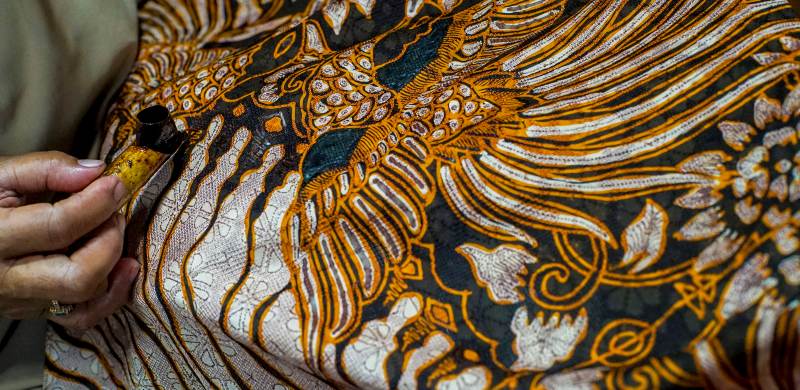
Batik, in particular, is conveyed through its myriad patterns, with each region telling its own story. Examples include Parang, Mega Mendung, and Kawung.
Parang is a classic diagonal motif of curved knife shapes, derived from the Javanese word perang (war or conflict). It symbolises strength, power, and perseverance, and was traditionally worn by royalty or warriors. Mega Mendung literally means “clouds in the sky”. It’s a pattern from Cirebon, on Java’s north coast, representing peace, calm, and patience — just like the clouds that bring rain and life. Kawung is a symmetrical pattern of overlapping ovals, said to be inspired by the aren palm fruit, symbolising purity, honesty, and self-control — values highly regarded in Javanese philosophy.
Contemporary Expression: The New Indonesian Canvas
Move to the modern scene — murals, installations, and pop-art hybrids that line the streets of cities such as Yogyakarta, Bandung, and Jakarta. Street artists like Darbotz and Heri Dono use walls as canvases to express humour, social commentary, or pride. They have garnered a well-deserved reputation in recent years for creating illustrative and thought-provoking works on natural canvases.
Draw a parallel with Banksy — both use public spaces, yet their messages differ. Indonesia’s street artists often celebrate identity and optimism, while Western urban art tends to lean towards cynicism or protest.
Moreover, I’ve seen how Indonesian youth remix batik patterns or wayang figures with graffiti or anime influences — a confident blend of tradition and innovation. Events like ArtJog and Museum MACAN stand as markers of Indonesia’s evolving art ecosystem.
The modern art scene in Indonesia represents a fusion of the past and the new — a vibrant mix of talent, styles, and expression. Alongside traditional forms of art, contemporary murals, installations, and pop-inspired hybrids bring colour to the nation’s cities. This combination of past and present creates an artistic juxtaposition still relatively uncommon in the West.
The Expat Eye: Seeing Through Two Lenses
Living in Indonesia for a period of time inevitably transforms one’s view of art and beauty. Those accustomed to Western concepts may once have valued technical skill, framed perfection, or abstract statements — but upon exposure to Indonesia’s artistic soul, one learns to appreciate patience, imperfection, and symbolism.
In my day job as a teacher, we strive to expose students to a wide range of experiential learning. At times, this involves joining a batik workshop, chatting with street artists, or visiting local galleries — giving both students and teachers alike (namely, me) the chance to experience art that is process-driven, spiritual, and communal.
For us expats, this process is humbling: instead of being mere spectators, we become learners — absorbing art’s connection to faith, community, and place.
Conclusion – Redefining ‘Art’
Living in Indonesia has quietly reshaped how I think about art. It’s no longer something confined to frames or galleries, but something that breathes — in fabric, faith, and everyday life. The longer you live here, the more you realise that creativity is not a pastime but a rhythm, echoing through the ways people decorate, celebrate, and communicate.
When I pass a mural on a Jakarta street or watch the shimmer of a batik cloth drying in the sun, I see not just beauty but belonging. Art here isn’t about ownership or prestige — it’s about connection.
Perhaps that’s Indonesia’s greatest lesson for any expat artist or observer: art isn’t something you go looking for. It finds you — in the colours of the market, in the shadows of the puppets, and in the patterns of the rain.
In Indonesia, art doesn’t wait to be framed. It breathes, it blesses, and it belongs to everyone.