




In their latest album, AntiNRML’s Suisei and Kirohta join forces to shake up the ennui of Indonesia’s present music landscape, resulting in a sonic playfulness that is flawed but leaves a remarkably strong impression.
One sentence immediately intrigued me when I read the press release of Suisei and Kirohta’s latest joint album, #KLABMUSIK, released on April 28. That sentence goes: “#KLABMUSIK presents an engaging contrast: emotional, introspective lyrics wrapped in upbeat, fun, and dynamic production—a breath of fresh air amid today’s often safe and mellow sound trends.” It is a sentence that suggests both a declarative thesis statement and a criticism towards the current state of the Indonesian music scene. True to the typical character of artists under the AntiNRML collective-slash-movement, here industry rules are not only meant to be broken—but also rewritten.
In actuality, does #KLABMUSIK make do with its thesis statement? The answer is yes. The Indonesian music scene is in desperate need of more genre variety, including, as presented on this album, emo rap and hyperpop. From start to finish, Suisei, aided by Kirohta’s ample production, demonstrates assured and confident command over his craft in #KLABMUSIK. Considering the ambition underlying the album, it is as though #KLABMUSIK had been meant as a reintroduction for Suisei, in particular, who had previously released three LPs and two EPs. Personally speaking, I have been patiently waiting for this reawakening moment from Suisei, ever since I first got to know him from his team-up with hyperpop artist Reikko in “hate us” back in 2022.

Arguably, the track that basically encapsulates the thesis statement, as well as the creative fire, of #KLABMUSIK is “bukan love song”. The two-minute-46-second number deliberately leaves no room for the music audience to breathe thanks to its brisk tempo and swervy production. On top of that, Suisei and Kirohta are not too proud to bring along some of their pals for the pulsating ride—in this case, hip hop artist Lucidrari and another music producer, Alva Gracia—bringing “bukan love song” to a bigger and even more bombastic proportion. And then, there is Suisei’s deadpan delivery, a contrast to the lyrics’ emotional agony. As a cherry on top, “bukan love song” ends on such a surprisingly smooth note that the music audience would be immediately seduced to automatically listen to the next number, the anti-ballad “diriku:dirinya”.
That last part is also another creative middle finger that makes #KLABMUSIK fascinating to take a deep dive into. Regardless of whether Suisei and Kirohta are deliberate about this move or not, many of the album’s tracks are basically what I would personally like to label as ‘anti-ballad’. Even though the lyrical narrative presented in this record would traditionally be brought to life in the form of sweeping ballads, the artists in question—which, in this case, are Suisei and Kirohta—decide to sonically flip the script instead. Removing the sonic direction and the music production altogether, the narrative essence in #KLABMUSIK is predominantly about love gone wrong. The catch here, however, is that Suisei and Kirohta refuse to either play the victim or conform to what is traditionally expected.
For instance, the love triangle drama in “diriku:dirinya” is imbued with laptronica-esque electricity—with just enough hint of ironic piano appendage—that the final product ends up bringing forth a more accurate emotional complexity than if it had been presented as a conventional power ballad. Suisei and Kirohta also showcase their instinct for cohesive storytelling by making it as though the subsequent track, “5 pagi”, were the next chapter following what is previously narrated in “diriku:dirinya”. Moreover, Suisei and Kirohta also understand that no happy ending should be forced simply because that is what the Indonesian music audience would typically wish for, as illustrated in the album’s closer, “masih disini”. It is a song about love hang-ups, but in the hands of Kirohta and co-producer Mino, “masih disini” turns out to be a summery mid-tempo affair that accentuates the song’s bittersweet message.
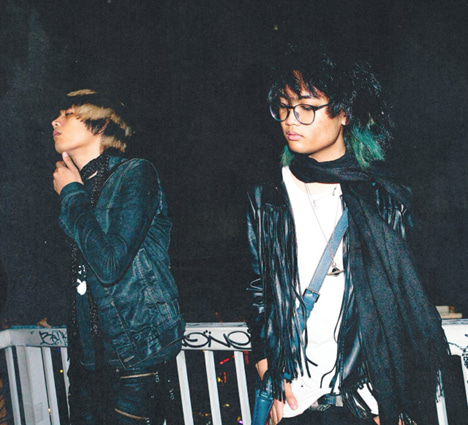
A separate applause should also be given to Suisei, who has solidified his emo-rap style with originality and recognisability as demonstrated in #KLABMUSIK. Finally—someone who can execute emo rap without imitating Juice WRLD.
Does Suisei and Kirohta’s decision to bring along several collaborators in #KLABMUSIK pay off? Unfortunately, no. In “alergi”, Suisei’s delivery is already charming and distinctive enough—so much so that Yung Caters’s vocal presence, as talented as he is, comes across as redundant. The same also goes for “cuma satu”, in which Tenxi’s vocal presence feels unnecessary. Suisei, Kirohta, Kidsteph, and Mino manage to make “5 pagi” sonically slender—instead of overstuffed, which usually happens when there are too many chefs in the kitchen—but it is difficult to discern who ultimately contributes to what. As proven by the hyper-pop masterstroke “duniakitaberdua”, #KLABMUSIK actually shines the brightest when it is just Suisei and Kirohta. Music, just like writing an article, requires appropriate editing.
Although it is palpable that Suisei and Kirohta genuinely aimed to create something unique, #KLABMUSIK also reveals that these innovators still face the same struggles common among most Indonesian artists of their generation. After everything has been added up, #KLABMUSIK shows what Suisei and Kirohta intended to produce as artists, but not who they are as individuals. Despite their efforts to include emotional and introspective lyrics, the album lacks the more unflinching human touch that would help listeners identify more deeply with Suisei and Kirohta. A fuller sense of wit, wisdom, and ‘nakedness’ can help assert how, on a deeper level, Suisei and Kirohta are more than just playful creators. In a world where AI threatens to replace human artists, that kind of raw intimacy between artists and their audiences has become more valuable—and more essential—than ever before.

Is #KLABMUSIK a perfect album? Nope. However, is #KLABMUSIK necessary to exist in today’s Indonesian music landscape? Definitely. Indonesia is known around the globe as the forefront of diversity—and that should be reflected in our artistry as well. In the eyes and ears of the sceptics, Suisei and Kirohta’s #KLABMUSIK might be ignorantly dismissed as a loud record indulging in too much rebelliousness. In reality, Suisei and Kirohta’s #KLABMUSIK is a testament to why artists must not comfortably continue any existing tradition; instead, they must begin a new one.
All images are courtesy of AntiNRML.