



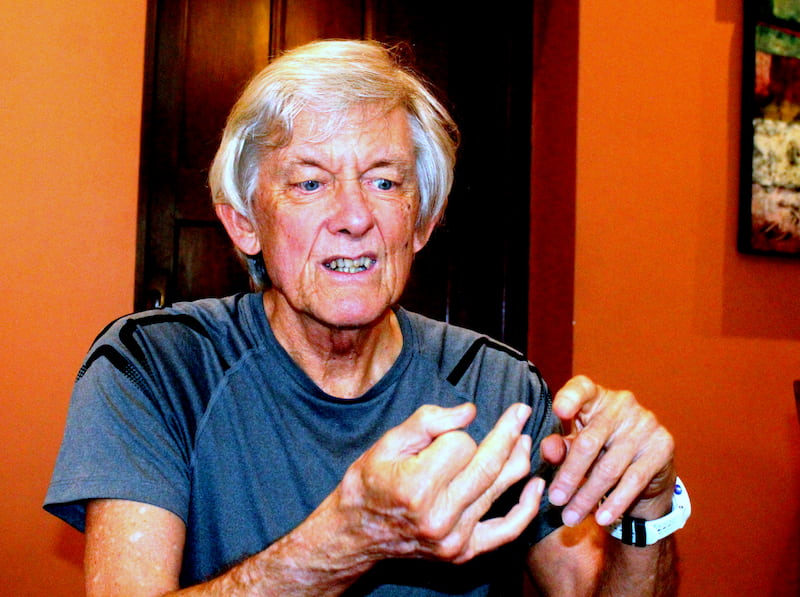
Dutch-born Professor Geert Arend, also known as Gerry van Klinken, is a late-arrival greenie—a person who campaigns for protection of the environment.
Gerry van Klinken grew up Down Under after his family migrated when he was 14 years old.
In the current culture of simple dualism, Van Klinken would likely be either ridiculed as a woke lefty challenging vital development or congratulated on his stand against carefree capitalism and throwaway unwanted ‘necessities’. Then, there are the cheap put-downs by his opponents: Van Klinken is an enemy of progress or, more derisively, a naive idealist living behind ivy-clad campus walls detached from the real world of smoke-stacks and chemical run-offs. Van Klinken, however, says he’s now too old and independent to care.
Attitudes depend on the politics of climate care and global warming—issues that are getting bashed around the world, including Indonesia. And, in the heartland, is the youth—fearful and angry.
Van Klinken says environmental damage is particularly severe in Central Sulawesi, where nickel miners and processors are allegedly trashing the jungle and poisoning the waterways with little government oversight. However, the social scientist, author, and academic—who has a desk at the Royal Netherlands Institute of Southeast Asian and Caribbean Studies or better known as KTILV after the Dutch language title—isn’t just wringing his hands.
Van Klinken is also ringing ‘time’s up’ on the careless, the indifferent, and the denialists.
“My turnaround came after I was retired from Amsterdam University—because I was over 67 [years old] and started thinking about the world where our grandchildren will live and hopefully enjoy,” he said in Malang.
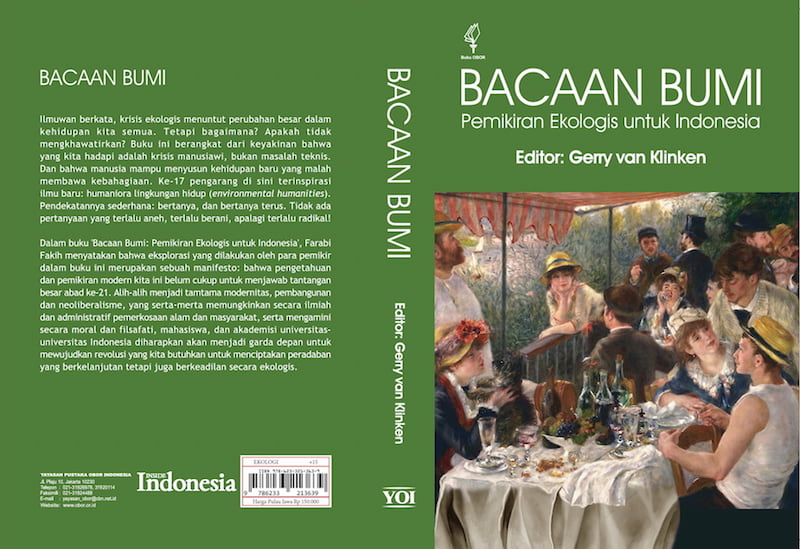
The East Java city is one of 30 locations around Java where Van Klinken has been pushing for rethinking ways to avoid doomsday while promoting his latest book, Bacaan Bumi (Reading the Earth). It’s subtitled Pemikiran Ekologis untuk Indonesia (Ecological Thinking for Indonesia), and consists of a collection of 17 essays by Indonesian greenies, mainly academics.
“The days of isolating disciplines in engineering, health, science, or whatever are going,” he said. “We must start asking questions like who generates all the rubbish and why? Where’s it going? This is the responsibility of all; we must work together.
“We’re facing an international human crisis that won’t be solved by technology. In Europe, all the great transformations of civilisations—the Renaissance, the Enlightenment, the Romantic Movement—have come from the humanities, like philosophy, literature, and art.”
Seeds for the project were planted two years ago at a summer school in Yogyakarta’s Gadjah Mada University. Students and activists came from across the country. Van Klinken said he was impressed by young intellectuals wanting to do something positive beyond debate and degrees. Together, they grew a plan for Indonesian humanities and social sciences students to develop new ideas and skills through “provocative essays”.
As Van Klinken was talking to a group of about 50 in a Malang café, news arrived that more than 300 had perished in Sumatra floods and landslips. Tragically, these catastrophes are often caused by over-clearing mountain sides of natural vegetation that has kept volcanic soils stable.
“There are no climate-change deniers in Indonesia. People in the poorer Global South are becoming aware of the dangers of not caring for nature,” he said. “But they feel helpless when confronted by powerful multi-nationals and governments deaf to their concerns, and determined to plunder for short-term profit, leaving future generations to repair the wrongs.
“Polls show 80% of Chinese prefer renewable energy to fossil-fuel power, while only half of the surveyed Americans want change. The figure is similar in Indonesia, but things are moving fast. As a secular Australian, I was surprised to learn about the commitment of people from the Muhammadiyah and Nahdlatul Ulama Islamic organisations. They see protecting the earth as a religious responsibility, with scholars re-examining translated passages in the holy books to better reflect modern issues.”
There’s also eco-marhaenism, which is an expansion of a political philosophy promoted by the first president of Indonesia, Soekarno. The story goes that as a young, upcoming revolutionary challenging the colonial Hollanders, Soekarno met a philosopher-farmer named Marhaen in the late 1920s. The two men verbally wrestled with the problems of primary production, market demands, feeding families, caring for the land, improving children’s lives, and struggling to better the community.
New and often contentious terms are starting to build the vocabulary of environmentalists—ecopsychology, degrowth, moral animals, ecofeminism, ecocracy, and panpsychism. The latter tongue-tangler has been around since the 16th century. It’s a mix of two Greek words: pan (all) and psyche (soul or mind). Panpsychism means that sensitivity isn’t restricted to humans—in other words, we’re one with the natural world. It’s a notion that doesn’t appeal to religious fundamentalists who think only Homo sapiens has a soul.
Some also flinch at the idea of ecosocialism as a left-wing threat to the so-called ‘established order’, where animals are reared to be eaten just as rice is grown to cook. The often-heard phrase also means ‘doing things the way they’ve always been managed’ because, say the reformers, it suits the interests of those seeking cheap ways to lay waste to the land.
Van Klinken tosses such fears aside, though, as he argues that we must open our minds to all ideas if humanity is not to disappear into man-made deserts—drowned by flood waters and under mountains of trash and avalanches of topsoil.
“We mustn’t be at war with nature,” he said. “What we need is harmony, and I detect that young Indonesians are the people to drive that change. The next age group must speak out to the world they’re inheriting.”