




A glowing example of what an equal creative partnership looks like, the 11-track album ‘Blue.’ finds Gloria Jessica and Ade Govinda at their top form as they deliver a passionate rhapsody that is too catchy to resist.
Imagine that you are given an assignment: you must paint a broken vase of blue roses in front of you—however, instead of producing one painting, you must produce 11 paintings of the said object. On top of that, you must make sure that, while your paintings capture the same broken vase, none of them is identical to one another. Each painting must capture the same essence but be rendered from different perspectives. This metaphor is basically what Gloria Jessica and Ade Govinda tried to accomplish as they developed what would eventually become their joint full-length album, Blue.
At first glance, this idea might seem easy enough to execute. Sad songs are nothing new in the Indonesian pop music landscape, let alone songs about broken hearts. But to deliberately illustrate a broken heart in the form of an 11-track studio album? That would be a very mad idea. On top of that, to have all of the songs composed by the same key songwriter, then produced by the same key producer as well? Even a madder idea. If this idea were executed recklessly, the result would end up being sonically monotonous and emotionally tedious. To put it in more layman’s terms: the album could get really boring.
But to my relief and most sincere delight, Gloria Jessica and Ade Govinda’s Blue. is not boring at all. Even more so, Blue. turns out to be a pop record that is both euphonically enticing and astutely constructed.

First of all, Blue. collectedly presents itself as a showcase for Ade Govinda not only as a songwriter-music producer, but also as an idea executor. In our music industry, a lot of artists can come up with fresh and brilliant ideas, but it doesn’t necessarily mean that they can afterwards manifest such ideas in the form of a proper execution. In the case of Blue., it is as though Ade Govinda knew that the key element that would make or break his mad idea is the melody. The songs had to be irresistibly catchy, so much so that the songs must occupy a space in the brain of the listeners after the first listen—literally. And boy, oh, boy, the melodies of Blue. turn out to be too addictive for the eardrums to withstand.
Blue. opens with the currently chart-climbing “Terbelah Jadi Dua”. Is the ballad the best song Ade Govinda has ever written in his career? Nope. (That honour still belongs to “Tanpa Batas Waktu” and Astrid’s “Terpukau.) But is “Terbelah Jadi Dua” hypnotically catchy? Most definitely—especially the song’s bridge and final chorus. Furthermore, the ballad effectively sets the tone of the album, which also demonstrates Ade Govinda and Gloria Jessica’s A&R intellect. And sure enough, “Terbelah Jadi Dua” is followed by “Timpang”, which is more emotionally gut-wrenching and more melodically spellbinding than the former. Any artist worth their salt would know all too well that, when it comes to tracklist curation, in order to sustain the listeners’ interest, the album’s second track must be stronger than the first track. Thank goodness Ade Govinda and Gloria Jessica understood that.
From the third track onwards, Ade Govinda is more than keen on putting his lyrical bravery to the test, as he shows no hesitancy in writing ballads that may hit a nerve. “Dominasi” directly delves into a romance that suffers from a lack of power equality, and how romantic annoyance and aggravation can actually be far more bitter than your usual Sunday Break-Up. “Baik-Baik”, a song originally released by Astrid in 2020 (to low impact, unfortunately), is reintroduced here in Blue., this time with a more lush production and more subdued tempo that, ultimately, better delivers the nuanced message that has always been underneath this song all along: that amicable goodbyes always come with a touch of self-denial and a case of forced rationalisation. Ouch…

As a songwriter, Ade Govinda may come across as too unpoetic at times—especially in this day and age, where the most celebrated songwriting style is either the Taylor Swift-like exposition, the Sabrina Carpenter-like repartee, or the Coldplay-like vers libre. That being said, Ade Govinda’s songwriting style clicks very well with the tone of this album. The great thing about having a direct and straightforward style as a songwriter is that the songs can never be misunderstood. And everyone who has ever had their heart broken would know all too well that pain is oftentimes direct, straightforward, and should never be misunderstood.
There are a couple of weak spots in Blue., though. “Kepastian” may have trouble resonating with the listeners, as the ballad’s subject matter touches on a very specific insecurity that typically plagues people of a certain age at a certain impasse point in their relationship. Furthermore, in comparison to the other tracks in the album, “Kepastian” harbours lower emotional stakes and, henceforth, less drama. The inclusion of “Dominasi (Acoustic Version)” feels awkward and unnecessary, as it would have been more appropriate as a bonus track instead.
Fortunately, the chosen epilogue helped Blue. stick the landing. The album’s final track, “Blue.”, which features Mew guitarist Mads Wegner, is an seven-minute-36-second instrumental track that, depending on how the listeners experience it, can be alternatively interpreted as the physical and emotional sensation that a human being goes through once the tears have dried, the heart has returned to beating, and the sun is rising again. As ironic as this might sound, Ade Govinda is at his most poignant when there’s nothing left to say.

And then, there is Gloria Jessica—and Blue. emerges as a much more fitting debut to her talent and artistry than her actual debut album, the below-the-radar Harlequin (2021). Blue. does great justice to Gloria Jessica, as it allows her to showcase her unique gift as a singer: an ageless vocal texture, fortified by dynamic interplay that would amaze Reza Artamevia and steely power that would make Agnez Mo proud. Gloria Jessica’s vocal performance in Blue. also demonstrates how age and life experience can positively contribute to a song’s conviction.
“Jika Bertemu Lebih Cepat”, another potential streaming hit for Blue., has Gloria Jessica entering the pop-diva zone, bringing forth both elegance and melodrama with her vocal delivery alone. In “Jika Kau Bukan Cinta”, which could be a crowd-pleaser among Gen Z music listeners, Gloria Jessica sounds both believably young and readily mature. Here, her vocals practically time-travel between the age of innocence and the treacherous terrain of adulthood, which is an ideal match for a song about romantic doubt.
Gloria Jessica also goes ride-or-die with Ade Govinda when the latter decides to try something quirky and retro, as shown in the unexpectedly energetic “Lebih Hati-Hati.” The song’s rockabilly vibe pops completely out of the blue—no pun intended—which, unfortunately, disrupts the album’s tonal cohesiveness. That being said, fans of Ade Govinda’s other band, the Beatles-inspired Kirribilly, wouldn’t be so surprised by this particular twist.
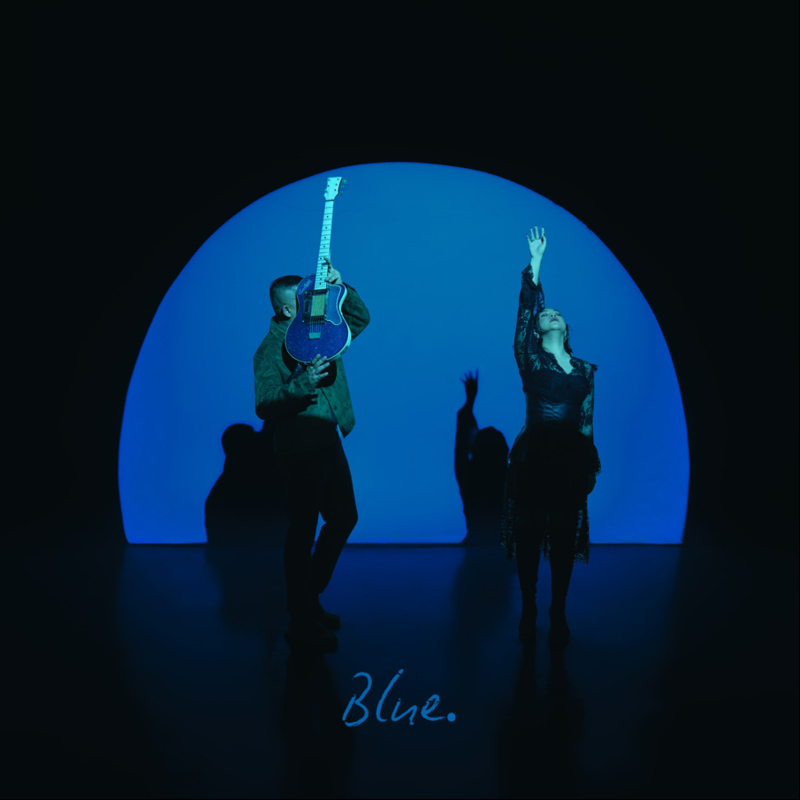
After everything has been said and done, Blue.‘s combination of brazen tone, raw emotionality, and poppy production will most likely part the album’s listeners into two major groups: one group consists of listeners who fall deeply in love with the album, whereas the other group consists of detractors who would scoff at the album but secretly cannot escape the album’s irresistible catchiness. Regardless of what kind of listeners that Blue. will bring, this is the type of pop record that would have no trouble attracting listeners, for sure. Even more so, thanks to Blue., Gloria Jessica and Ade Govinda may have unintentionally turned themselves into pop pioneers. If Blue. manages to generate a splashy commercial impact, I have a strong feeling that there will be more Indonesian pop albums in the future that adopt similar concepts and execution.
All images are courtesy of MyMusic Records/Babam Bramaditia.