



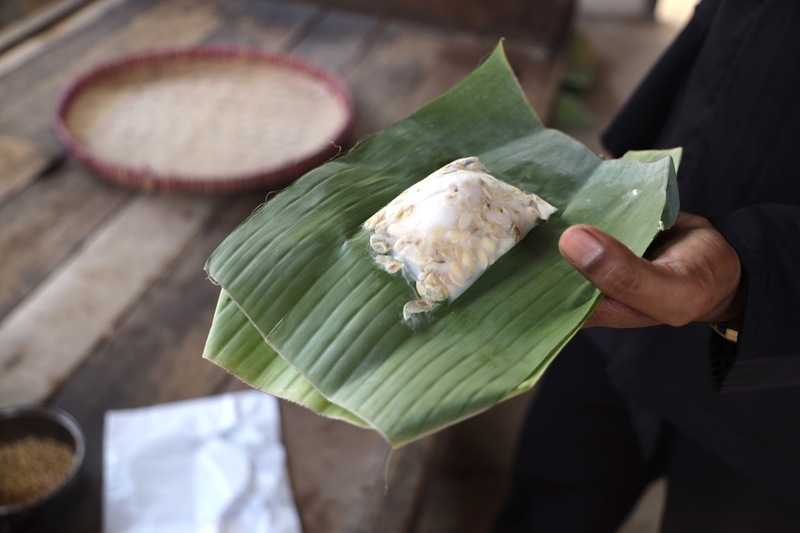
Contributing writer Pramod Kanakath shares his experience witnessing first-hand the science behind tempeh as cooked, prepared, and demonstrated by the Candirejo villagers.
It is sunrise in the village of Candirejo in Magelang. Mbah Sumiati is busy in her kitchen, standing over a low table, her hands moving rhythmically and with certainty. In front of her, on the floor beside the table, are rows of soybeans wrapped in banana leaves, stacked symmetrically. She presses her palm gently against one of them and nods to herself after an assuring pause. The soybeans are ready, measured by feel, not by clock.
This is how Indonesia’s most favourite side dish, tempeh, is made here. Not measured, not timed in the strictest sense, but understood.
This practice has been part of a generational relay of ideas, handed down purely by word of mouth. No notebooks or recipes, nor instructions pinned to the wall, are available. The whole effort is a habit, repeated daily and trusted wholeheartedly.
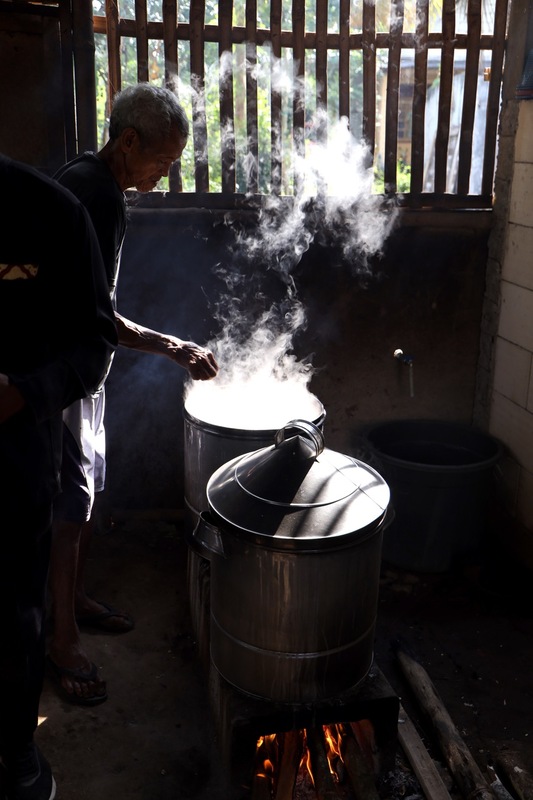
Pak Paijo comes into the picture by mid-morning, and the kitchen gets a little busier. He takes hold of the rinsed soybeans and boils them in long and large steel containers. Steam rises in the dimly lit room, carrying an earthy scent. Mbah Sumiati then drains the beans and spreads them out to cool. Throughout this process, every step looks simple. Being hot and cool is realised by feel. Too hot, the beans spoil. Too cool, they don’t transform. The couple don’t check the thermometer. Instead, they reach out and touch them.
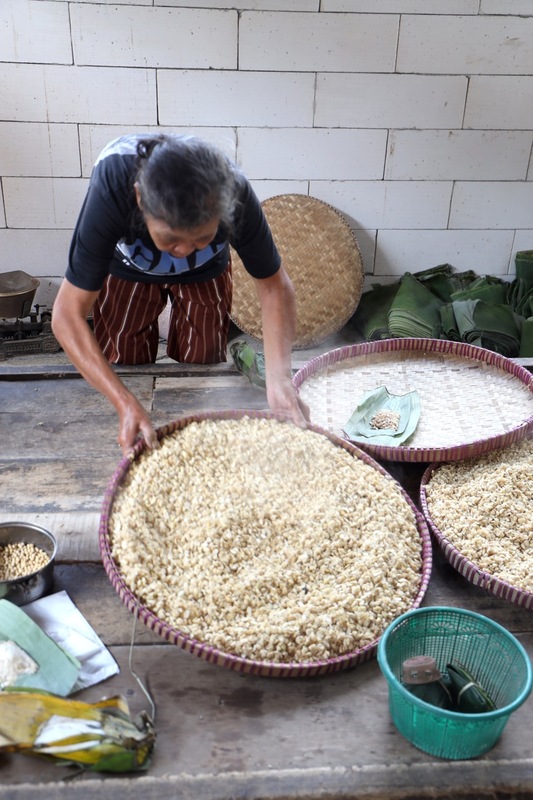
When the temperature feels right—warm, but no longer steaming— Mbah Sumiati mixes in a small amount of starter. Then comes the wrapping. Some are folded into banana leaves, their surfaces slightly glossy, their edges pinned with tiny wooden sticks. Others are packed into perforated plastic. The difference is subtle but important. While the banana leaves breathe, plastic must be helped along.
By afternoon, the parcels are stacked on wooden shelves. This is where the waiting begins. But even waiting, here, is active.
As the hours pass, the bundles begin to warm from within. The transformation is invisible at first, then gradual, then complete. Mbah Sumiati checks them often, rearranging the stacks, shifting them slightly—closer together on cooler days, further apart when the air feels heavy. Nothing is written, but everything is known.
In the evening, she leans in and inhales. The aroma has changed. It is no longer just beans—it is deeper now, nutty, almost like mushrooms. She smiles faintly. This is how she knows it is working.
Not every batch succeeds. Sometimes the smell turns sharp. Sometimes the texture softens too much. When that happens, she shrugs, sets it aside, and begins again the next day. Failure is part of the learning, just as much as success.
In recent years, tempeh has travelled far beyond these kitchens. It appears now in cafés and restaurants across the world, praised for its nutrition, its versatility, and its place in plant-based diets. Scientists describe its benefits in careful terms, explaining how fermentation changes the soybean, how it makes nutrients easier to absorb, and how it supports gut health.
Here, none of that language is needed.
For the woman in Candirejo, tempeh is simply what she has always made. It is what her family eats. It is what she sells in the market each morning, wrapped and ready, its surface firm and white. Customers come early, selecting pieces by sight and touch, trusting the same quiet signals she does.
By late afternoon, most of the day’s tempeh is gone. The kitchen is cleaned, and the next batch is already soaking. The cycle continues, as it always has.
There is something easy to overlook in this routine. From the outside, it might seem like repetition—an unchanging process carried out day after day. But look more closely, and it becomes something else entirely: a way of knowing that does not announce itself.
Mbah Sumiati and Pak Paijo may never call it science. They may never need to. Yet in their hands, in the way they read warmth, smell, and time, there is a kind of understanding that is precise, responsive, and deeply learned.
Long before fermentation became fashionable in distant cities, it was already alive here, in kitchens like this one—guided not by instruments or measurements, but by memory, instinct, and the quiet confidence of knowing what feels right.
Think about the ancient sailors who navigated their way from land to land, reading the position of the sun and the stars. Not a compass was in sight!
All images are courtesy of Pramod Kanakath.