



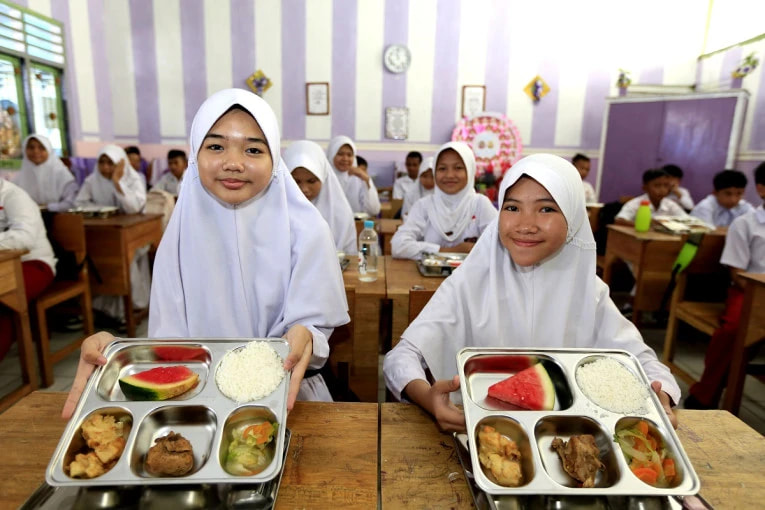
If the free meal programme is to succeed, it must do more than deliver food. It must build standards, trust, and a system that schools and communities can sustain.
Indonesia’s free nutritious meal programme (known as Makan Bergizi Gratis or MBG) begins with an idea few would dispute: nutrition matters. Children learn better when they are not hungry, and schools are among the most reliable ways to reach them consistently and at scale. But at this stage, the more important question is not whether the programme is well-intentioned; it is whether it is being built with a clear long-term purpose.
Is the aim simply to distribute meals each day? Or is it to build a system that, five years from now, improves children’s health, supports readiness to learn, and earns public trust?
That distinction matters.
More Than a Delivery Programme
A school meal programme of this scale should do more than place food in children’s hands. It should support attendance, concentration, wellbeing, and the conditions in which learning becomes easier. It should also create a framework that schools and communities can understand and take part in responsibly. That is where the conversation needs to deepen. A programme may begin with delivery, but its lasting value lies in the system it creates around children.
Recent data from the National Nutrition Agency (Badan Gizi Nasional or BGN) shows that enforcement has already begun. On the 11th of April, 2026, BGN said that the suspended Nutrition Fulfilment Service Unit (Satuan Pelayanan Pemenuhan Gizi or SPPG) units in Region II, which were supposed to cover the Java region, had reached 362, as they cited issues such as missing supervisors, unfit menus, renovation delays, management problems, and suspected digestive incidents. That number may raise concern, but it can also be read another way. In large public programmes, early correction is not automatically a sign of failure. It can indicate that monitoring has started, that standards are being tested, and that intervention is possible when compliance slips.
The real question, however, is whether this early corrective phase leads to a more reliable and trusted system over time.
Defining Success Clearly
A programme of this scale should not only respond to problems; it should also define success more clearly. What measurable improvements in child nutrition are expected over the next three to five years? How will this affect learning conditions in schools? And how can communities contribute without weakening standards? These are not hostile questions; they are necessary ones.
Oversight bodies have raised similar concerns. In September 2025, Ombudsman RI identified four maladministration risks in MBG implementation and noted that only 26.7% of SPPG units were functioning at that point, alongside concerns about transparency, operating procedures, and quality control.
Without clear goals, a programme risks remaining reactive. With clear goals, it has a better chance of becoming trusted, efficient, and sustainable.
A Place for Local Communities
Across Indonesia, local producers, including dairy farmers, could potentially support nearby schools. If integrated properly, this could strengthen both nutrition delivery and local economies. But participation cannot rest on goodwill alone, as it needs clear standards for food safety, nutrition, procurement, and accountability. In other words: enthusiasm is valuable, but structure is essential. A successful programme should not only feed children; it should also create a responsible pathway for communities that genuinely want to help.
There are useful lessons Indonesia could adapt from the school food policy in England. The point is not to copy another system wholesale, but to borrow practical habits that connect nutrition with school culture. England’s school food guidance recommends daily fruit and vegetables, a daily dairy portion, lower-fat milk availability during the school day, and free drinking water at all times. It also encourages schools to use fresh, sustainable, and locally sourced ingredients, including produce from a school garden where possible.
Such an example offers practical ideas for Indonesia. A school garden, even on a small scale, can help children understand where food comes from and make vegetables and fruit more familiar. Simple menu benchmarks—such as a daily fruit or vegetable component, a suitable dairy component, limits on heavily fried foods, and water as the default drink—can also make standards easier to communicate and monitor. These are not grand reforms; they are practical disciplines.
Schools should not be viewed merely as delivery points; instead, they are learning communities. If nutrition is to improve outcomes, meals should be linked to healthy habits, education, and trusted adult guidance. Food provision works best when it connects with what children are taught, what adults model, and what families gradually reinforce. This is where I would push back against the idea that “the school can only do so much”. Actually, it can do a great deal.
A school may not control national policy, but it can create a system that gives that policy meaning. It can shape routines, expectations, and behaviour. It can connect meals to classroom learning, build food awareness, involve families, and even create partnerships with nearby producers. That is not a small role. It is the difference between a programme being distributed and a programme being lived.
A School Leader’s Reflection
From a school leader’s perspective, this is not about assigning blame too early; it is about asking what kind of system is being built for children over time. Nutrition matters, but schools should not have to choose between feeding children and funding learning well. A strong programme should support both.
If Indonesia wants this initiative to succeed in the long term, it should not be measured only by how many meals are served. It should also be measured by whether it builds a system that is trusted, safe, sustainable, and open to responsible community participation.
The writer of this opinion piece, Sandra Dewi The, is an international school leader in Indonesia and an investment consultant. Any opinions expressed in this article are those of the writer and do not necessarily reflect the views of Indonesia Expat.