

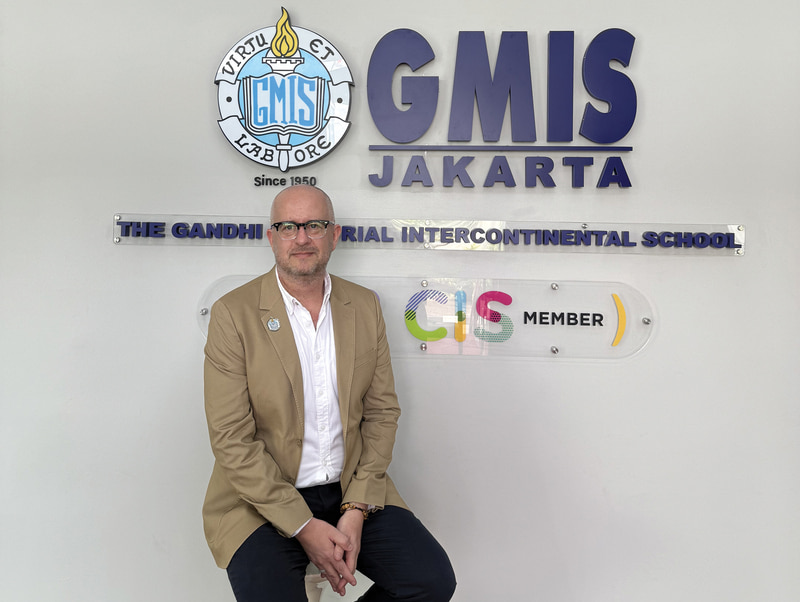
As Gandhi Memorial Intercontinental School (GMIS) enters a new phase of growth and renewal, Director of Education and Operations, Piero Botha, shares how GMIS is strengthening teaching standards, expanding student opportunities, and preparing its diverse community for the future.
For more than seven decades, Gandhi Memorial Intercontinental School (GMIS) has been part of Indonesia’s international education landscape. Founded in 1950, the school has grown into a diverse community spanning Jakarta, Bali, and Semarang, with students representing more than fifty nationalities. And today, GMIS is entering a new phase of growth and renewal.
In this interview, Botha discusses how GMIS brings together different curriculum pathways, encourages students to take ownership of their learning, strengthens teacher development, and uses its diverse international community as an important part of the educational experience.
Hi, Piero! First of all, could you please briefly introduce yourself?
I am South African and graduated with a Master’s degree in Educational Leadership from the University of Cyprus. I have been working in education for a little over twenty years. I started out as a Geography teacher, which is probably still the best training I ever had. Then I grew up to become the Head of Department, Deputy Principal, and Principal.
I used to work in South Africa, in Iraq, and now in Indonesia. In Jakarta, I was the whole-school Principal at Sampoerna Academy L’Avenue, where we secured IB World School authorisation and WASC member school status. Then, in July this year, I joined the Gandhi Schools group as Director of Education and Operations, working across our five schools.
For those who are not familiar with GMIS, how would you introduce your school? What makes GMIS unique in comparison to other international schools?
GMIS opened in 1950. It is the oldest international school in Indonesia, and the Jakarta campus alone has close to 2,000 students from more than fifty nationalities, with sister campuses in Bali and Semarang.
I would be careful about claiming we are unique. Every international school in Jakarta has good facilities and a glossy brochure, and most of them have good teachers. What we have that cannot be bought is seventy-six years of history and the name above the door. Being named after Gandhi sets a standard you have to live up to in front of children who will notice the moment you do not.
The other aspect is our diverse community. In one of our primary classrooms, you will find Indonesian, Indian, Korean, Chinese, and Japanese children working on the exact same task. That is not a diversity statement we wrote for a website. That is simply a Tuesday morning at GMIS, and it has been for decades.
GMIS combines four different curricula. How does the school bring these pathways together while maintaining a consistent standard of education?
First, an honest clarification: we do not run all four at every campus, for every child. They are pathways, and families choose the one that fits where the child is going next.
The IB continuum runs from the Primary Years Program through to the Diploma and Career-related Program. Cambridge sits through Checkpoint and IGCSE.
The Board of Secondary Education Indian Schools Indonesia (BSEISI) pathway matters enormously to our community. It serves families who may move back into the Indian system, but it is also an exceptionally strong academic foundation in its own right. Because of its rigour, it gives our students a very smooth route into university applications across India, the UK, Australia, New Zealand, and beyond.
And we prepare our Indonesian students for national examinations across SD, SMP, and SMA levels. Semarang, for instance, currently runs Cambridge and the national curriculum rather than the IB.
What holds it together is not the curriculum documents; it is what happens in the room. A well-planned lesson operates at the same high standard across any pathway—the teacher knows what the child should be able to do by the end of it, and knows who in that room needs extra support.
So, we standardise the layer underneath the curricula: how we plan, how we assess, how we give feedback, and how quickly we step in when a child needs help. Get that consistent, and the four pathways stop competing with each other—they simply give our families clarity, choice, and confidence.
IB places strong emphasis on inquiry-based learning and independent thinking. How does GMIS encourage students to take ownership of their learning?
Inquiry is simple enough to talk about, but the real joy happens when we put it into practice every day. True student ownership isn’t built through big speeches—it simply takes root in those small, quiet moments of trust between a caring teacher and a child.
A simple example: A teacher can hand a Grade 3 class a pre-selected topic, or she can ask them what they are genuinely curious about and help them talk through their choices with one another. That second approach takes a bit more patience and brings a livelier, joyful energy to the room. But it is also the moment where a child truly catches the spark of learning for themselves.
By the Diploma years, this process becomes remarkable to watch. The Extended Essay is four thousand words built on a question the student chose for themselves. No one else can walk that path for them, and when they finish, they step forward with a real, lasting sense of independence.
It takes dedicated, thoughtful teachers who know how to guide gently while giving students room to lead—and supporting our team in that work is one of the best parts of what we do.
GMIS is going through a period of growth and renewal across its three campuses. What are the key priorities shaping this new phase?
There are three main priorities that are guiding this work right now:
First, we are modernising our learning spaces and classroom tools. This isn’t about flashy upgrades; it’s about equipping our teachers with better resources for their daily work, while expanding our facilities with dedicated Makerspaces, upgraded music and art studios, and thoughtfully designed play areas for our youngest learners.
Second, we are investing in our teaching standards across every campus. By supporting our faculty and refining our internal processes, we ensure that families in Jakarta, Bali, and Semarang experience the exact same warmth, care, and high standard of instruction every single day.
Finally, we are bringing our school community closer together. Aligning our campuses should never mean flattening what makes each one special—our three locations serve distinct, wonderful communities. Through our newly established Parents Association, we are creating real, welcoming space for parents to collaborate with us and help lead our school and cultural life.
GMIS places significant emphasis on student-led competitions and extracurricular activities. How does this help students develop practical skills?
For us, the real value of any activity comes down to a simple principle: real learning happens when the student leads the way.
I tend to be very straightforward about this because it matters so much to our families. There is a vast landscape of competitions today, and while some are truly exceptional, others are more focused on awards than genuine learning. We try to be very thoughtful and selective about where we direct our students’ time and energy.
The experiences worth choosing are easy to spot once you see them in action. In the World Scholar’s Cup, a nine-year-old learns empathy and quick thinking by defending a perspective different from her own. At our student-led events like TEDxYouth@GMIS, our young people take full ownership—managing the schedule, hosting speakers, and navigating unexpected moments together. Programs like Model UN encourage teenagers to understand complex global viewpoints with maturity and respect.
None of this is about accumulating trophies. The measure we use is simple and humble: did the student genuinely own their effort, and did they walk away with a meaningful lesson—especially on the days when things didn’t go as planned?
GMIS is introducing a new teacher evaluation framework this year. What prompted this, and how will it strengthen teaching quality?
It was a commitment to clarity and respect for our teaching staff. Every teacher deserves a clear path to professional growth, a shared understanding of what excellence looks like here, and the exact support to get there.
This year, we are launching EDGE across our three GMIS campuses. It is designed to be a developmental framework first and foremost: structured observation, open conversation, agreed goals, and continuous support.
The most vital piece of EDGE is the growth attached to it. An evaluation framework without genuine professional development is just paperwork. For us, the coaching, training calendar, and ongoing mentorship matter just as much as the classroom visits. When we invest heavily in supporting our teachers, they naturally bring their absolute best to our students every day.
GMIS is looking to broaden its international student demographic. Why is having students from different nationalities and cultures important to the educational experience?
People often talk about “global citizens,” but I prefer a more practical view. A child who works alongside peers from different backgrounds learns that her own perspective is one of several sensible ones. You cannot teach that from a textbook; you need those diverse perspectives right there in the classroom.
The real key is how we nurture those connections every day. Diversity on an enrollment sheet is just a statistic—the real value happens in how our students interact. It has to be intentional: creating mixed groups on purpose, building a strong house system that cuts across nationalities, teaching languages with real depth, and having staff who pay attention to daily social dynamics.
Are there any upcoming events, plans, or projects you can share?
Celebrating Gandhi Day on the 2nd of October remains a central highlight of our calendar. We are also expanding how we welcome our youngest learners by introducing a new Toddler Class for children aged two to three, creating a gentle, nurturing entry point into our school community.
Beyond our early years and physical facilities, we are actively enriching the broader student experience. We believe a busy student is a healthy student, so we are building out our programs outside the traditional classroom, including expanded after-school activities, experiential field trips, and cross-campus student exchange.
How can readers get in touch with you and GMIS?
If you would like to know more about GMIS, please visit:
- Website: gmis.sch.id
- Instagram: @gmis.jakarta, @gmis.bali, @gmis.semarang
- WhatsApp: +6281111801448 (Jakarta), +62 877-5833-2234 (Bali), +62 811-2788-080 (Semarang)
- Address: Jl. HBR Motik, Blok D6 No. Kav. 1, Kota Baru Bandar Kemayoran, Central Jakarta 10630
Visitors are genuinely welcome. A brochure will tell you what a school claims to be.