



Many cancer patients only discover their illness when it has already reached an advanced stage, making early detection extremely important in improving the chances of successful treatment.
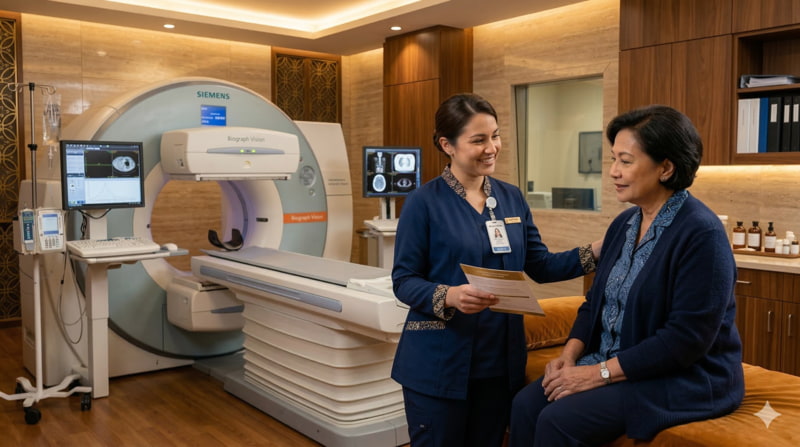
One of the medical innovations now being used is nuclear medicine technology, such as PET-CT scans and SPECT-CT scans, which can detect cancer cells more precisely than conventional examinations. This technology is already available in Indonesia, although it is still limited to several hospitals.
PET-CT (Positron Emission Tomography–Computed Tomography) and SPECT-CT (Single Photon Emission Computed Tomography–Computed Tomography) are nuclear-based imaging technologies that not only show the structure of organs but also detect cancer cell activity within the body. These examinations use radioactive tracers to track the activity of cells and tissues, allowing affected areas to be seen more clearly.
As explained by dr Lim Andreas, SpKNTM, Subsp. Onk. (K), FANMB, at Mayapada Hospital Jakarta Selatan,
“With this examination, doctors are able not only to see how active the disease is, but also to assess the spread of cancer (metastasis), determine the stage, and evaluate the response to therapy. These results form the basis for developing a more precise and personalised treatment plan for each patient.”
In addition to initial diagnosis, PET-CT and SPECT-CT scans also play an important role during treatment, particularly in monitoring the patient’s response to therapy.
“PET-CT focuses on assessing cellular metabolic activity, including detecting active cancer cells and monitoring their spread. Meanwhile, SPECT-CT evaluates organ function and distinguishes between normal and abnormal tissue to support diagnosis and enable more accurate treatment planning,” added dr Lim Andreas.
Based on their benefits, imaging is usually performed on patients with suspected cancer, patients who have undergone treatment and are suspected of recurrence, or patients who require disease mapping before or after therapy. In this way, treatment can be planned more precisely according to the biological characteristics of the disease.
Further explained by dr Yustia Tuti, Sp.KN, at Mayapada Hospital Jakarta Selatan, the examination uses radioactive tracers in low doses, administered in accordance with medical safety standards.
“The radiation exposure is very low and will be naturally eliminated from the body within a few hours. This technology also produces sharper images while keeping radiation under control, so the benefits of the examination far outweigh the risks,” said dr Yustia.
To support faster and more accurate cancer diagnosis, Mayapada Hospital Jakarta Selatan will soon introduce PET-CT and SPECT-CT services, scheduled to begin operating in April 2026 on the 1st Floor, Tower II MHJS. These services are integrated with the Oncology Center, providing comprehensive tumour and cancer treatment through collaboration within a multidisciplinary team from various subspecialties to ensure precise and well-directed care.
During the treatment process, the Tumour Board actively develops the most appropriate care plan for each patient, while the Patient Navigator assists patients in understanding every stage of the service, from screening and evaluation of results to treatment planning. This guidance is part of the Comprehensive Cancer Care approach, ensuring that patient care is more comfortable, personalised, and well-coordinated.
For those who require early detection or a comprehensive cancer evaluation using PET-CT or SPECT-CT, consultations with nuclear medicine specialists are available at Mayapada Hospital. Information and registration can be obtained through the Call Centre 150770 or via the MyCare application.
Health information from Mayapada Hospital doctors is also available in the Health Articles & Tips feature on the MyCare app. In addition, the Personal Health feature can be used to monitor fitness by tracking heart rate, steps, calories burned, and Body Mass Index (BMI).