


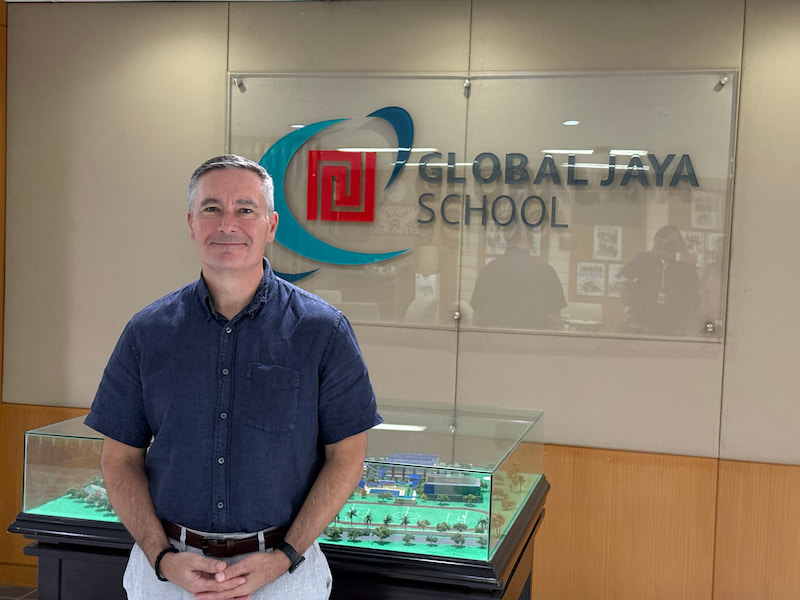
It has been a year since the last time Indonesia Expat had a chat with Dr. Howard Menand, the Head of School at Global Jaya School, Bintaro, Tangerang.
We delved into the school’s incredible accomplishment in 2025 and its glowing vision for 2026. On top of that, during our conversation, Dr. Howard Menand also dug deep into the delicate transition upon which the Year Six students of the Primary Level must embark before finally entering their Secondary level, which coincides with the beginning of their adolescent years as well.
It is both an academic transition and a social-emotional metamorphosis that should never be taken lightly. Fortunately, for the students at Global Jaya School, Dr. Howard Menand and his incredibly dedicated educators know exactly how to establish the smoothest transition possible. The class is in session!
Hi, Howard! It has been a year since the last time we had a chat (which was back in March 2025). Can you share with our readers and us what you have been up to for the past year?
Global Jaya continues to be a busy place—because the school is always very active. We were busy hosting the IB Asia Pacific workshop for educators, which took place back in October. On top of that, over the long holidays, we installed a STEM lab in the primary school. We’re currently in the process of finalising the lab, and then, we’ll work with our teachers on curricular implementation so they can use that lab to support the learning of their students. Additionally, we recently celebrated the 30th anniversary of Global Jaya. As part of that celebration, we have established the Global Jaya Excellence in Citizenship Scholarship: a scholarship that provides financial support to students in Year 12 as they graduate to put towards their university tuition.
This year marks your third year as the Head of School. What does that milestone mean for you, personally?
Personally, it’s been a nice opportunity to really connect with the Global Jaya community. It takes time to really understand all of the different dynamics of the school as well as the nuances. But now that I’ve been here three years, I feel that I have a good connection and understanding of our community, which means it’s a little easier to be responsive to the needs of the students, the needs of the teachers and the needs of the parents. This third-year mark is such a nice professional milestone in the sense of me being really connected to Global Jaya.
Now that the dust has settled, how would you assess and evaluate the journey of Global Jaya School back in 2025? What was your proudest accomplishment last year?
One major accomplishment for us last year was how we led the way—in this region and Indonesia at large—with the full implementation of eAssessments for the Year 10 students. Our structure brings a lot of rigour and support to the teaching and learning for students, which subsequently really helps prepare them for Year 11 as well as Year 12. We’re hoping that moving forward, we’ll see the impact or the benefit of having eAssessments in strengthening the students’ learning experience for our students.
Moreover, now that we have entered a new academic year, is there any particular vision that you, as the Head of School, would like to manifest in 2026?
I would say this year is all about balance. Our vision right now is balancing out our intense focus over the past few years on academic excellence while also making sure that we support the well-being of our community. We’ve put a lot of attention on ensuring that our students have the best possible opportunities academically at the school, so that moving forward, when they graduate and go to university, they’re well-prepared for what’s in store for them. Having said that, at the same time, student well-being, as well as community well-being, is really important. Now we have a team focusing on how to develop a well-being policy that supports students, the faculty and community members—with the idea that well-being is equally important to academic success.
As everyone must have already understood by now, transitioning from one level of academic to another is never an easy feat—especially if we are talking about students who are about to graduate from the Primary level and enter their Secondary level. As the Head of School, how important is it to ensure a smooth transition? And is a smooth transition even possible in the first place?
To both questions, the simple answer is yes. This transition comes down to the academic and social-emotional needs of the students. We feel that, as an IB school, the Year Six students should be in the Secondary side of the school because the IB-MYP programme is a five-year programme, which also means that we want our Secondary level students to have access to all five years of that curriculum experience.
For us here at Global Jaya, that transition leads to a pod-like experience. The Year Six students will be part of a learning pod where they’ll spend the majority of their time with their classmates. Within the pod, they will have a more focused group of teachers to support the students’ social-emotional development—especially in navigating the change in geography, now that the students are no longer in the Primary level environment. This, ultimately, will ensure the students’ safety and security, but in a way that enables them to develop their sense of independence as well. Those steps, on our part as educators, will help ensure that smooth transition.
Let’s look at it from the student’s point of view. What do you believe that the students (and perhaps their parents as well) need to pay particular attention to in navigating that particular transition?
The parents need to know that, once the students enter Year Six, they will have many different teachers during the school day. Even though we’re going to limit the number of teachers they will have, it will still be more than what they usually have in the Primary level. That means, for both parents and students, they need to be ready to navigate all of the teachers’ different personalities and expectations.
This transition also relates to this idea of ‘failing forward’. We’re okay if students make mistakes or don’t get things right the first time. In fact, we feel those are the best learning opportunities for our students. What I always advise parents is to let their children make mistakes—and the safe place to ‘fail forward’ is at school.
Let’s now look at it from the educator’s point of view. How would you prepare the teachers, especially the ones who will be in charge of these new adolescents?
To make sure that we’re ready, we provide our teachers with social-emotional learning in order to know what to look for in students and how to support them at such a critical age in their lives. At the same time, however, our curriculum is very well-mapped out so that the Year Six students will be able to learn at an appropriate level as well as at the right pace.
What advice can you give to parents who may feel especially anxious in raising and guiding their children who are about to enter adolescence?
I’m the Head of School, but I’m also a parent—so I understand that anxiety. And I think what’s most important is that your kids at that age will definitely show signs of independence. They will show signs that they want to do things their way, and that they don’t necessarily want their parents to be involved the way that they used to be. The reality, however, is that they actually need you—even more so at this point in their lives. Your kids need to know that you love them unconditionally.
Adolescence usually entails the so-called ‘rebellious phase’. As an educator, do you think that parents should be concerned with this aspect as well?
Even as your children go through that ‘rebellious phase’, you, as their parents, should let them know that you care for them and that you love them regardless. At the same time, however, boundaries and discipline are always important. Yes, children may go through a ‘rebellious phase’, but there are still limits that should be clearly outlined in the family. It’s a way of showing your children that you love them—because you’re not letting them get to a point where they can’t turn back.
Last but not least, how can our readers get in touch with you and Global Jaya School?
You can always email me directly, contact our admissions team, or contact our marketing team. The school is very responsive, so please feel free to reach out to us. We have also scheduled an Open Day in February and April.

- +62 811 1202 3761
- gjs_society
- admission@globaljaya.com
- www.globaljaya.com