



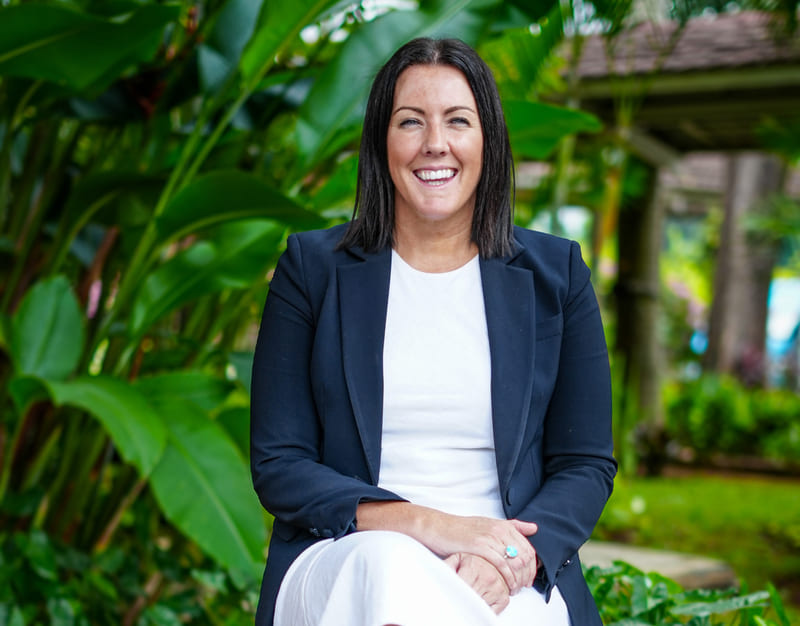
Get to know Andrea Downie, the Head of Wellbeing at the celebrated British School Jakarta.
At British School Jakarta (BSJ), the students’ wellbeing is part of the education — and it is a part never to be taken lightly. Indonesia Expat had a chance to chat with Andrea Downie, the Head of Wellbeing at BSJ, as she shared, among many things, her professional background, why learning doesn’t happen without wellbeing, what people often misunderstand about the word “wellbeing” itself, and how BSJ guides its students, mental health-wise.
Hi, Andrea! Let’s get started by introducing yourself a bit. What can you tell us about yourself?
In January 2024, I relocated from Australia with my family and joined British School Jakarta (BSJ) as the Head of Wellbeing on the Board of Executive. My background is in psychology, education, and applied positive psychology. I taught for a number of years in Australia and held numerous leadership positions, then pursued my Master of Applied Positive Psychology. I was always very interested in wellbeing science, and after completing my Master’s, whilst a Deputy Principal, I fell in love with the space of Applied Positive Psychology and Wellbeing Science, and deeply understood the importance of this in education — particularly for young people.
From my understanding, you also have a background in “positive psychology”. For our readers who might not have necessarily heard of this field of psychological study, could you briefly explain what it is?
Positive psychology, sometimes known as ‘wellbeing science’, is very much an evolving field. It is the scientific study of optimal human functioning and wellbeing. It focuses on human strengths, virtues, and positive experiences to promote a meaningful and thriving life. It seeks to complement traditional problem-focused psychology by investigating the conditions and processes that contribute to happiness, life satisfaction, and the development of individual talents and positive institutions. Instead of traditional approaches to wellbeing — looking at what’s going wrong and trying to fix it — it is a strengths-based approach that also focuses on what’s going well to nurture and heighten wellbeing.
Head of Wellbeing remains a job title relatively rare to be seen in Jakarta’s schools nowadays. What does this job entail, to be exact? What is the difference between a Head of Wellbeing and a guidance counsellor?
They are different roles. In Indonesia, different to other parts of the world, such as Australia, it is relatively unique as there has not been much attention on wellbeing. It is also a wildly misunderstood concept. Wellbeing is a term that often gets confused with wellness — wellness being one aspect of wellbeing, but wellbeing is that whole continuum of what makes people feel good, function well, and helps them to live optimal lives.
My role is incredibly diverse and highly strategic. Counselling sessions or a guidance counsellor work one-on-one or with specific groups of students to support challenges and navigate a future focus. The Head of Wellbeing, however, works alongside leadership across the whole school strategically to activate our vision for wellbeing now and into the future.
Perhaps due to the sensitive subject matter as well as the generational gap, there remains a discourse concerning to what degree the parents should be involved in their children’s mental wellbeing and to what degree the school should be involved in their students’ mental wellbeing. How is your perspective regarding such a discourse?
Between the ages of 0-5, the brain is really firing and wiring, and 90% of brain development occurs during this time. This is a crucial time in a child’s life. Present parents are crucial during this time. For example, research shows that a father’s presence literally rewires a child’s brain. Kids securely attached to their dads have a 50% lower risk of depression. Being in a school where creativity, connection and exploratory learning are present, such as BSJ, does wonders for a child’s social and emotional development.
In over 300 schools all across the world, I’ve never worked with a school where mental health has not been significantly important and on the radar. So important is it that it is even included as one of the global goals in United Nations Sustainable Development Goals. We work really hard to bring parents on the journey and support them in learning more about this space, as their understanding and partnership are fundamental for their child.
What do you think that parents, especially those of the older generations, often misunderstand when it comes to their children’s mental health?
In my own experience working with thousands of parents, thousands of educators, and hundreds of schools, I believe one of the biggest challenges is the idea that you ‘just got on with things’, or you didn’t talk about things, and so on.
But the reality is the world has changed significantly — it’s volatile, uncertain, complex, and ambiguous. I think there’s a misconception that wellbeing is a ‘happyology’, all about feeling good. In fact, wellbeing is about feeling a wide range of emotions and acknowledging the tough stuff. For older generations, awareness of this topic was minimal, and research demonstrates that the mental health concerns were a lot less prevalent.
One of the hottest topics regarding mental health issues nowadays is the burden of unrealistic expectations, which seem to hit the hardest on children as well as adolescents. What makes the danger of “unrealistic expectation” so deserving of consideration, by both the school and the students’ parents, these days?
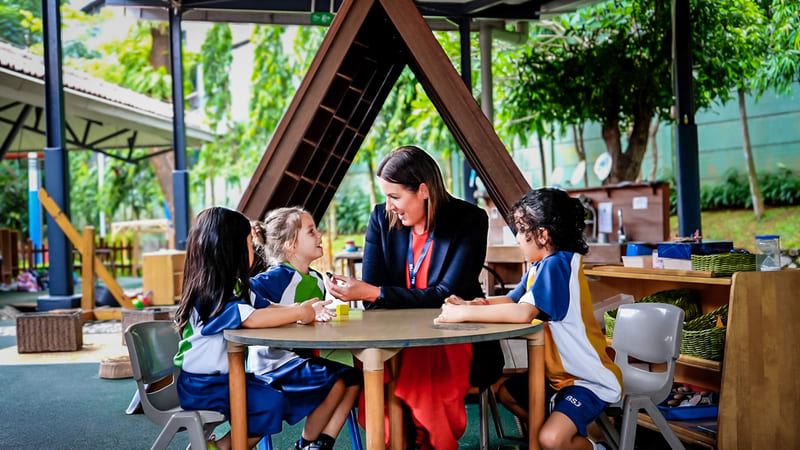
Without a doubt, we know that pressure on young people today is much bigger than ever before. In particular, the upper year levels are where the focus is often on academic results, university destinations, and the ‘next steps’. I find this fascinating because effective early learning is fundamental to long-term academic success. Creativity, play, joy, and all of those things from a young age are crucial, and that’s why at BSJ, we focus on play-based, experiential learning, using hands-on, kinesthetic creativity to build strong foundations in mental health.
Sadly, wellbeing often gets neglected in the upper years, where the focus generally sits with academic success. The student may get into the university of choice, but research clearly shows it does not mean that they will thrive. Learning doesn’t happen without wellbeing.
Still and all, for the children to live eternally free from all kinds of adversity and pressures is also, ironically, an “unrealistic expectation”, correct? How do you find that fine line between building the children’s mental resilience and, contrastingly, over-indulging their fragilities?
One of the biggest misconceptions is that wellbeing is about being happy all the time. This is not the case at all. At BSJ, we link it with outdoor education, with sport, in all areas of authentic learning, because it is about doing the hard stuff, the heat experiences, and the stretch moments. When we live a life free of challenges, it does more damage to us in the long term than when we are put in situations that stretch and challenge us to take responsible risks. Thus, we don’t want children to live free from adversity and pressures because that’s not realistic. However, we want to draw a line between the difference between a natural level of anxiety and when it becomes a problem or a disorder.
Lastly, how would you describe BSJ’s approach in guiding its students, mental health-wise?
We are at the forefront in Jakarta because we take a systems-informed positive psychology lens. I was fortunate enough to be one of the founders of this stream of systems-informed positive psychology at the University of Melbourne with an incredible team, including the Associate Dean of the Graduate School of Education, Professor Lindsay Oates, Dr Rachel Colla, Dr Peggy Kern, who worked with Martin Seligman on positive psychology in the United States, and several other key people.
We’ve started from a whole cultural perspective. Culture is the first piece, and that can take time, ensuring that you’ve got the right people who understand the importance and value of wellbeing. And then we start looking at the environment. How are we designing and constructing our buildings? Are our spaces conducive to wellbeing? It’s not just about light and brightness, but also about sensory, space configuration, refuge, and the things that we know have a really positive impact on our mental health.
Our motivating, engaging and relevant learning spaces include green spaces, getting students outside, and understanding that learning happens beyond the classroom. Instead of having a really prescriptive curriculum or programme, we’ve created an innovative, bespoke scope and sequence of learning intentions, so these are the themes and the areas that we know we want our students to learn at each age and stage across BSJ — from 2 years old to 18 years old.
We want to set the global benchmark for international education in wellbeing and personal growth, uniting timeless excellence with a future-focused relevance that transforms our students’ lives. We don’t say that lightly; we say that very intentionally and deliberately that we want to be that global benchmark across the world.
BRITISH SCHOOL JAKARTA
- Address: Bintaro Jaya Sektor 9, Jl. Raya Jombang, Pondok Aren, Tangerang Selatan 15427
- WhatsApp: +62 811 1991 8162
- Instagram: @britishschooljkt
- Website: www.bsj.sch.id