



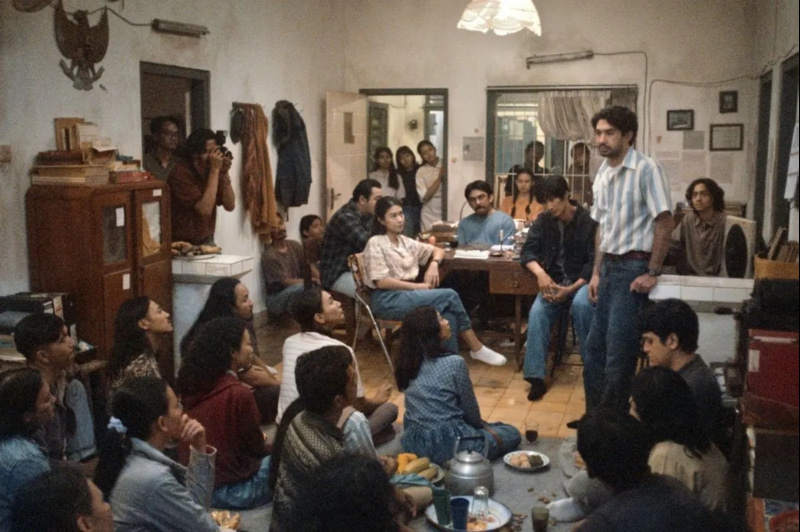
Yosep Anggi Noen’s approach to Leila S. Chudori’s literary activist-turned-outlaw leans dangerously close to outlandish canonisation, but The Sea Speaks His Name remains a worthy cinematic experience thanks to its cinematography, technical attention, and poignant performances from Yunita Siregar, Aksara Dena, and Dian Sastrowardoyo.
[This review contains spoilers.]
The challenge of reviewing films like The Sea Speaks His Name (Indonesian title: Laut Bercerita) is that one could easily hold back their sharpness and focus on the film’s virtuous merit as opposed to its artistic merit. What many cinephiles and film critics out there frequently forget, however, is that all pieces of cinematic work should be subjected to the same depth of appraisal as well as inquiry—whether it is a cinematic adaptation of a sociopolitically charged novel or a 90-minute romantic comedy. That’s what makes the art of filmmaking so enthralling as well as terrifying. At the end of the day, there is no immutable guarantee of which kind of film can actually move its audience.
At least on paper, The Sea Speaks His Name has the notional ingredients of what an extraordinary feature film is supposed to be. It is helmed by the celebrated auteur, Yosep Anggi Noen (Solo, Solitude, 2016), who has had enough experience handling the complex subject matter that this film presents. It is adapted from a well-known, best-selling novel, whose author, Leila S. Chudori, is also involved as the film’s producer and screenwriter alongside Noen. The film’s cast is stacked with acclaimed thespians, festival darlings, and rising stars. On top of that, the film’s marketing roll-out had kicked off for approximately 11 months before its eventual theatrical wide release in Indonesia on the 29th of October, 2026.
As a piece of cinematic work, The Sea Speaks His Name is a pretty good film. And if its impressive box-office numbers are to be believed, The Sea Speaks His Name should give enough confidence for other Indonesian filmmakers to tackle a similar subject matter in their respective projects. That being said, despite the pedigree of everyone involved, The Sea Speaks His Name is not as compelling and thought-provoking as it could have been.
Perhaps the most shocking thing about The Sea Speaks His Name is how its screenwriters, Leila S. Chudori and Yosep Anggi Noen, transform the story’s knotty, at times uncomfortable subject matter into a highly digestible smoothie—one that should satisfy every moviegoer’s taste and level of tolerance. The film unravels in a very straightforward manner, complemented by Noen and Chudori’s decision to avoid anything graphic or downright mawkish. Noen and Chudori also went on such a limb—especially in the first 40 minutes of The Sea Speaks His Name—to make their lead protagonist, Biru Laut, as cinematically likeable as possible. Biru Laut is a good son, a doting big brother, a loyal friend, a loving boyfriend, a consummate bibliophile, and a diligent student. He also radiates natural charisma, classic handsomeness, and what appears to be a God-tier talent in writing. Everything about Biru Laut screams “main character energy,” and therefore, should be more than noble enough for the audience to root for. It is as though Noen and Chudori were too worried that even one slight character flaw of Biru Laut’s would immediately discourage prospective moviegoers from purchasing a ticket.
That being said, Leila S. Chudori and Yosep Anggi Noen’s approach to Biru Laut actually works—that is, until The Sea Speaks His Name reaches its final 60 minutes. The problem with outlandishly likeable characters who overstay their welcome on the silver screen is that they slowly revert to becoming a token rather than an actual flesh-and-blood person, and Biru Laut is no exception. Even at the film’s most desperate moments, Biru Laut continues to be presented as the ideal, almost saintly rebel, which subsequently makes him admirable but also the least interesting and the least relatable character in the film.
All things considered, especially now that the film is out in theatres, is Reza Rahadian the right actor to give body and voice to Biru Laut in the first place? Rahadian delivers a decent enough performance, but Biru Laut’s over-the-top uprightness restricts the actor’s freedom to make his character more intriguing. At the end of the day, Rahadian is usually at his peak powers as an actor when his character allows him as big a playground as possible.
The cinematic depiction of Biru Laut also hints at another, even more awkward flaw of The Sea Speaks His Name. The film’s duration of two hours and 15 minutes actually provides ample opportunity for Leila S. Chudori and Yosep Anggi Noen to address the more untouched aspects of the 90s-era activism, which could have consequently turned The Sea Speaks His Name into a genuinely thought-provoking cinema. The Sea Speaks His Name could have been a great opportunity to collectively examine how it was not just an authoritarian regime and internal treachery that harmed youth movements such as the fictional Winatra, but also the recklessness and naïvety that come from being young and inexperienced. Instead, as the director, Noen decided to keep a tight lens on Biru Laut and his fellow freedom fighters until the very bitter end, avoiding framing Winatra’s actions and legacy from a broader and more critical perspective.
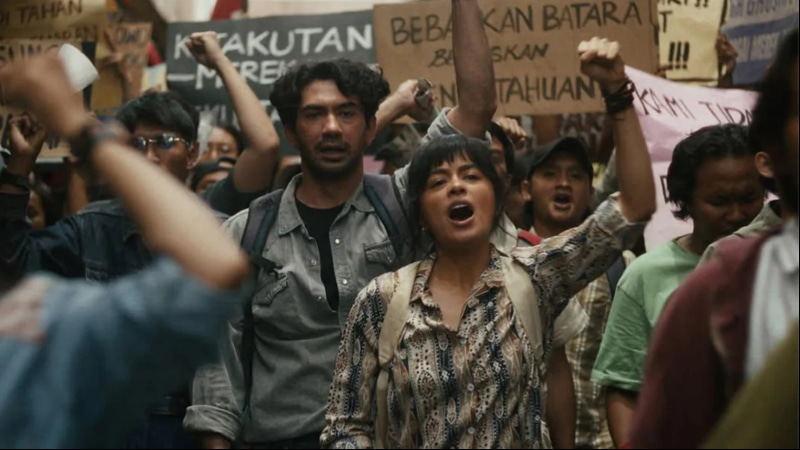
Fortunately, Yosep Anggi Noen’s collaborators did not forget to add the much needed, substantial nuances to The Sea Speaks His Name. Costume designer Retno Ratih Damayanti dressed up the Winatra crew in conspicuously bright colours and gear when the latter visited the corn farmers’ village in Blangguan, which subtly hinted at these young activists’ lack of thought and self-awareness regarding how dangerous the cause they had decided to pursue as their life’s calling. The film’s MVP title undisputedly belongs to cinematographer Batara Goempar, who had previously proven his ability to turn the most grotesquely bloody spine-chiller into a memorable feast for the eyes (The Shadow Strays, 2024). Balancing creativity with irony, Goempar cleverly photographs the scene of students’ demonstration with an arrestingly warm hue, reflecting the somewhat romantic nature of youthful rebellion. Meanwhile, Goempar photographs the scene of self-isolation more grimy and suffocating than actual imprisonment, which also reflects Biru Laut’s transition from promising youth into sour adulthood. Danu Suryo Sukotjo also delivers an excellent work as the film’s set decorator; his sets in The Sea Speaks His Name are authentic without coming across as alienating to modern-day viewers.

Notwithstanding Reza Rahadian, several actors step up to the plate with remarkable results. The Sea Speaks His Name serves as a mesmerising showcase for Dian Sastrowardoyo in delivering a nuanced and layered performance. A testament to great talent is when an actor’s absence is felt greatly throughout the rest of the film, and Sastrowardoyo’s charisma as Kasih Kinanti—one of the Winatra founders—affectingly shifts and switches from calming to haunting. As far as hot takes go, one of the most memorable scenes of The Sea Speaks His Name is when Kasih Kinanti parts ways with her fellow freedom fighters in the dead of night; Sastrowardoyo’s face and physicality quietly vibrate with both guilt and terror. Sastrowardoyo also imbues disarming gentleness and eloquence to her character, which suggests that Kasih Kinanti may or may not have more knowledge of what lies ahead than what she lets on.
In a small yet pivotal role, Aksara Dena brings calm and composure to Gusti Suroso, which ultimately makes his character more absorbing and memorable than other characters with more potent scenes and significance. Anyone who has seen Bambang “Ipoenk” Kuntara Mukti’s Aum! (2021) would vouch for his talent as an actor. And if more directors and filmmakers out there are willing to trust him with equally challenging roles (and much bigger screen time), I see a bright future ahead for Aksara Dena.
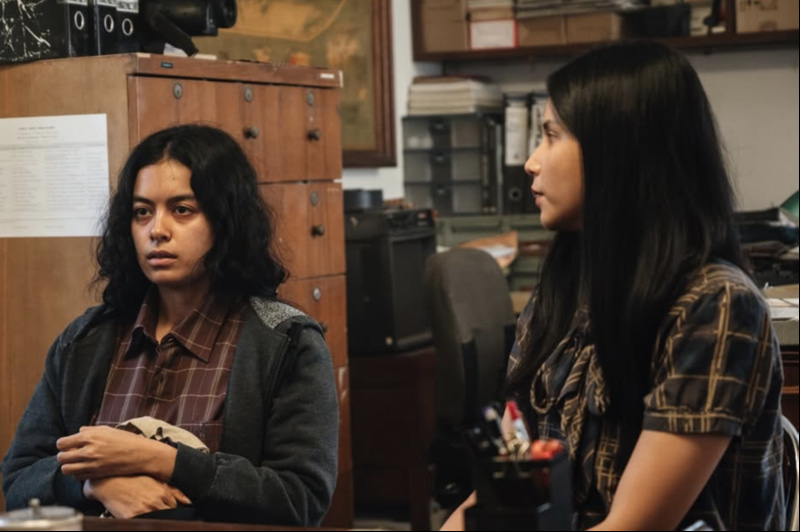
Still and all, it feels most appropriate to reserve the last paragraph of this review to my praise for Yunita Siregar, whose stirring performance is solely responsible for helping The Sea Speaks His Name redeem its clunky final act and stick the landing. As Biru Laut’s younger sister, Asmara Jati, Siregar successfully walks the tightrope between logic and grief, between dread and responsibility, between honouring the past and facing the future—oftentimes via her ability, very rare among her actor peers, to convey a storm of emotion with merely a faint shift of an eyegaze. In fact, The Sea Speaks His Name would have been a much richer film had Leila S. Chudori and Yosep Anggi Noen decided to firmly focus on Asmara Jati’s journey in its final act, as Siregar seems to be the one who understands best that while Biru Laut is remembered as the heroic saint, it is women like Asmara Jati who become the decisive conscience.
All images are courtesy of Pal8 Pictures.