


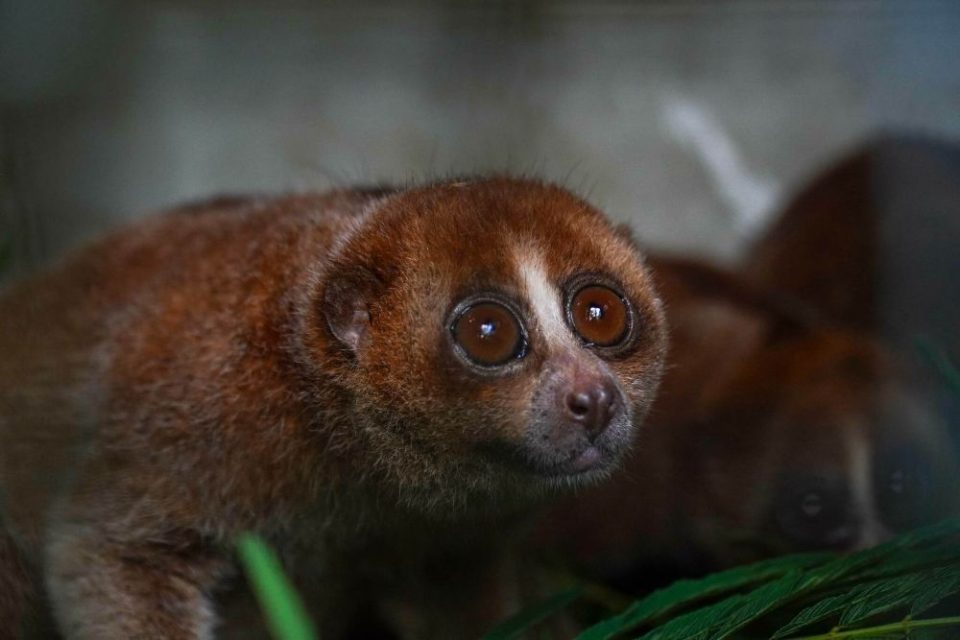
For the first time since the 1930s, the tree-dwelling Bangka slow loris has been officially mentioned in scientific publications.
According to a press statement from Re:wild on Tuesday, 20th of October, the scientific journal Spixiana has published a new study confirming that the Bangka slow loris still survives across much of Bangka Island. The study was co-authored by the Alobi Wildlife Rescue Center, Haus des Meeres Aqua Terra Zoo in Vienna, and Taman Safari Prigen Conservation Breeding Ark.
“A big-eyed, venomous primate that had not been documented in scientific literature since the 1930s has been hiding in plain sight on the Indonesian island of Bangka, turning up in backyards, along roadsides and on power lines, and prompting local residents finding them to call the Alobi Wildlife Rescue Center for help,” Lindsay Renick Mayer, the Director of Communications and Impact Campaigns for Re:wild, wrote in a press statement published on the conservation group’s official website.
According to the study, the Alobi Wildlife Rescue Center rescued Bangka slow lorises in all four regencies of Bangka Island and in the city of Pangkal Pinang, suggesting that the species may still occur across much of the island. Of the more than 90 slow lorises rescued by Alobi, 86 recovered and were released at seven sites on Bangka. Alobi’s team carefully selected the release sites, prioritising the island’s larger forest fragments, which continue to provide suitable habitat and have some degree of legal or practical protection.
“We now know the species has survived in several parts of Bangka, and we urgently need a long-term conservation strategy built on population surveys, genetic studies and, above all, protection of its remaining habitat. The next challenge is to make sure it does not actually become extinct,” Timon Glaw of the Haus des Meeres Aqua Terra Zoo also explained.
Additionally, Langka Sani, the Director of the Alobi Wildlife Rescue Center, said, “Its natural habitat on Bangka Island has shrunk significantly because of illegal tin mining and massive land clearing for oil palm plantations. We ask people around the world to support us in saving the Bangka slow loris while we still can.”
The Bangka slow loris is classified as Critically Endangered on the IUCN Red List of Threatened Species. The species was first scientifically described in 1906 and formally recognised as a distinct species in 2013, despite not having appeared in scientific literature since the 1930s.
Furthermore, slow lorises are among the world’s most unusual primates. They are the only primates known to be venomous. They lick a gland on the inside of their upper arm and mix its secretion with saliva, enabling them to deliver a painful bite that causes swelling.